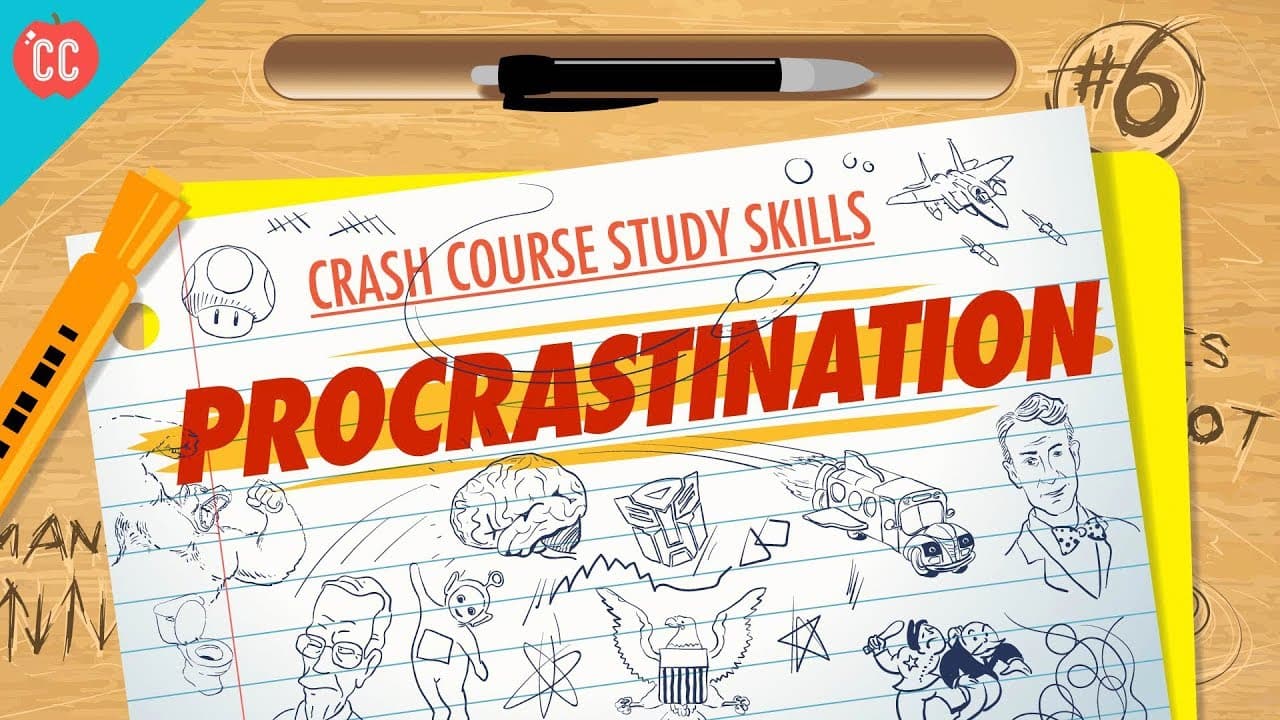
Procrastination: Crash Course Study Skills #6
TL;DR
Explore strategies to overcome procrastination using Temporal Motivation Theory.
Transcript
Down to brass tacks, friend. Last week we covered several techniques for improving your ability to focus on your work and resist distractions. This week we’re digging into a related issue, which is in fact the most pernicious problem that perpetually plagues pupils… procrastination. Nick, I still think that intro needs more alliteration. And cowbel... Read More
Key Insights
- Temporal Motivation Theory explains procrastination through an equation involving expectancy, value, impulsiveness, and delay.
- Expectancy can be increased by breaking tasks into smaller sub-tasks and seeking help when needed.
- Improving a task's value involves enhancing the reward, making the task enjoyable, and setting mini-rewards.
- High-density fun, such as playing games, should be prioritized over low-density distractions like social media.
- Creating a distraction-free environment and using apps like Cold Turkey can reduce impulsiveness.
- Ego depletion theory suggests willpower might be limited, but focusing on difficult tasks first can help.
- The Pomodoro Technique uses timed work sessions to reduce procrastination by reframing tasks as time-based.
- Gamification apps like Habitica can motivate task completion through engaging, game-like elements.
Install to Summarize YouTube Videos and Get Transcripts
Explore YouTube Video Summarizer or Get YouTube Transcript Extractor
Questions & Answers
Q: What is the Procrastination Equation?
The Procrastination Equation is a concept from Temporal Motivation Theory that describes motivation as a function of expectancy, value, impulsiveness, and delay. It suggests that motivation to complete a task is calculated by multiplying expectancy and value, then dividing by impulsiveness and delay. This equation helps identify specific procrastination causes.
Q: How can expectancy be increased to reduce procrastination?
To increase expectancy, tasks should be broken down into smaller, manageable sub-tasks, making them less daunting. Additionally, seeking help from teachers or peers can boost confidence and competence, thereby increasing expectancy and reducing procrastination.
Q: What are some ways to improve a task's perceived value?
Improving a task's value involves enhancing the reward for completing it, making the experience enjoyable, and adding mini-rewards for sub-tasks. Choosing a pleasant study location, listening to music, or working with friends can make tasks more enjoyable and motivate completion.
Q: What is the difference between high-density and low-density fun?
High-density fun involves engaging activities that provide significant enjoyment, like playing video games or joining clubs. Low-density fun includes mindless distractions, such as browsing social media. Prioritizing high-density fun can motivate task completion, while low-density fun often leads to wasted time and reduced productivity.
Q: How can impulsiveness be managed to reduce procrastination?
Impulsiveness can be managed by creating a distraction-free environment, such as choosing a dedicated study spot away from distractions. Tools like the Cold Turkey app can block distracting websites, helping focus on tasks and reducing the tendency to procrastinate.
Q: What is the Pomodoro Technique and how does it help with procrastination?
The Pomodoro Technique involves setting a timer for 25 minutes to focus on a single task, followed by a 5-minute break. This method reframes tasks as time-based, reducing resistance to start and maintaining focus. It provides external motivation and structure, helping combat procrastination effectively.
Q: How does gamification help in reducing procrastination?
Gamification uses elements from games, such as points and rewards, to motivate task completion. Apps like Habitica turn tasks into a role-playing game, making productivity engaging and rewarding. This approach leverages the addictive nature of games to encourage consistent task completion and reduce procrastination.
Q: What role does willpower play in procrastination?
Willpower, once thought to be a limited resource, is debated in its role in procrastination. Despite conflicting research on ego depletion, focusing on challenging tasks first, known as 'eating the frog,' can help overcome procrastination by leveraging willpower effectively at the start of the day.
Summary & Key Takeaways
-
The video discusses procrastination through Temporal Motivation Theory, which identifies key factors influencing motivation: expectancy, value, impulsiveness, and delay. By understanding these factors, one can pinpoint the causes of procrastination and address them effectively.
-
To increase expectancy, breaking tasks into smaller parts and asking for help are recommended. Enhancing a task's value can be achieved by improving rewards, making tasks enjoyable, and adding mini-rewards for completing sub-tasks.
-
The Pomodoro Technique is highlighted as a method to combat procrastination by using timed work intervals. Additionally, the importance of high-density fun over low-density distractions is emphasized to maintain motivation and focus.
Read in Other Languages (beta)
Share This Summary 📚
Summarize YouTube Videos and Get Video Transcripts with 1-Click
Try YouTube Summary with ChatGPT & Claude or YouTube Transcript Generator
Explore More Summaries from CrashCourse 📚

Summarize YouTube Videos and Get Video Transcripts with 1-Click
Try YouTube Summary with ChatGPT & Claude or YouTube Transcript Generator