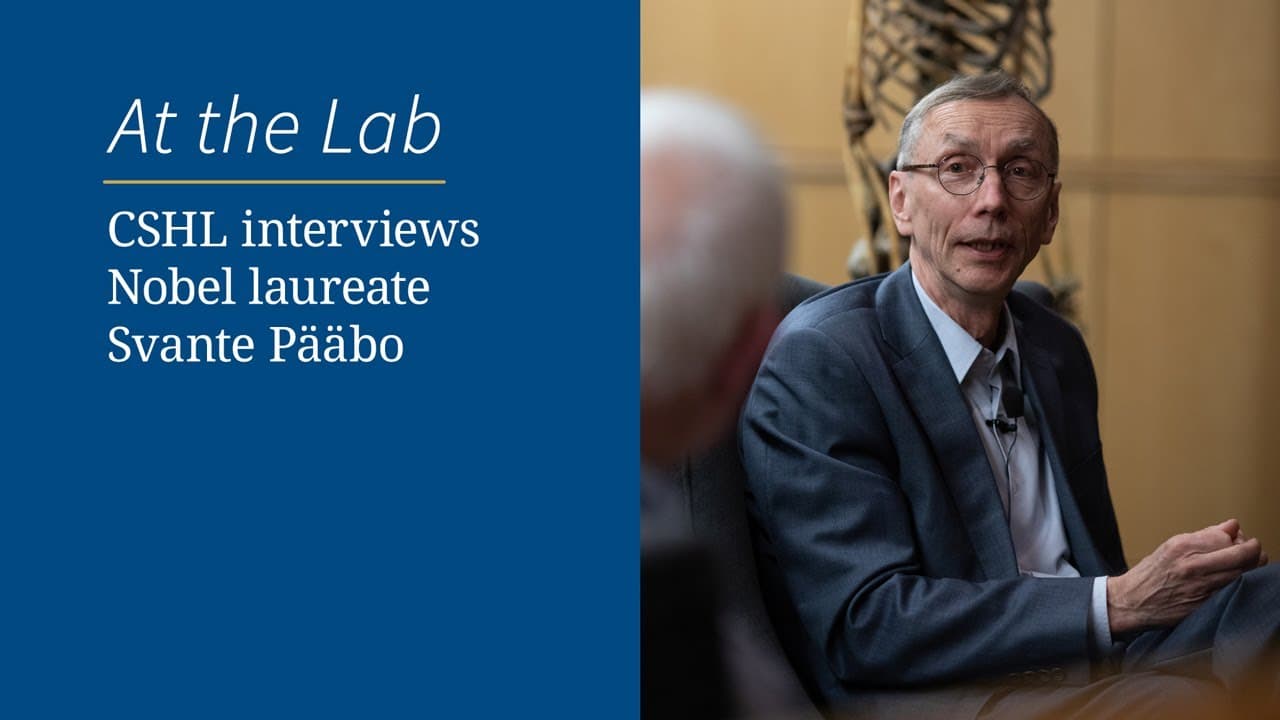
CSHL interviews Nobel laureate Svante Pääbo
TL;DR
Svante Pääbo discusses his scientific journey and ancient DNA research.
Transcript
This is actually, I think, your 15th Biology of Genomes meeting. Really? Yeah, and, 45 minus 30. 15. You've been here another 30 times plus doing things at the DNA Learning Center. So Svante is a, I hope Cold Spring Harbor is a special place for him and we'll come back to that in a bit. But to begin at the beginning, Svante, how did you get intere... Read More
Key Insights
- Svante Pääbo's interest in science was influenced by his mother, a chemist, and his father, a Nobel laureate biochemist.
- Pääbo initially pursued Egyptology but shifted to medicine, finding patient interaction unexpectedly rewarding.
- His pioneering work in ancient DNA began with clandestine experiments on mummified tissues, leading to groundbreaking discoveries.
- Pääbo's study of Neanderthal DNA revealed significant insights into human ancestry and interbreeding with ancient hominins.
- His discovery of the Denisovans, a previously unknown human relative, expanded understanding of human evolutionary history.
- Pääbo's research has shown that Neanderthal and Denisovan DNA contribute to modern human genetics, affecting traits like pain sensitivity.
- The development of techniques to prevent contamination was crucial in accurately analyzing ancient DNA samples.
- Pääbo emphasizes Cold Spring Harbor Laboratory's significant role in advancing genomic research and fostering scientific collaboration.
Install to Summarize YouTube Videos and Get Transcripts
Explore YouTube Video Summarizer or Get YouTube Transcript Extractor
Questions & Answers
Q: How did Svante Pääbo's family background influence his scientific career?
Svante Pääbo grew up with his mother, a chemist who held science in high regard, which influenced his interest in the field. His father, a Nobel laureate biochemist, also played a role despite having another family. This unique upbringing fostered an environment where Pääbo was encouraged to pursue scientific endeavors, ultimately shaping his career in genetics and ancient DNA research.
Q: What led Pääbo to transition from Egyptology to medicine?
Pääbo's initial fascination with Egyptology was driven by a romanticized view of the field, inspired by childhood interests. However, the reality of studying ancient Egyptian grammar disenchanted him. Seeking a more practical career, he pursued medicine, where he unexpectedly found patient interactions rewarding and fulfilling, ultimately leading him to focus on scientific research and genetics.
Q: How did Pääbo's clandestine experiments contribute to his research on ancient DNA?
Pääbo conducted secret experiments on ancient mummified tissues, driven by his interest in whether DNA could survive post-mortem. These experiments, initially hidden from his supervisor, laid the foundation for his pioneering work in ancient DNA. His success in extracting DNA from mummies and other ancient specimens was a breakthrough, contributing significantly to the field of paleogenetics.
Q: What was the significance of Pääbo's discovery of Neanderthal DNA?
Pääbo's discovery of Neanderthal DNA was groundbreaking, revealing that Neanderthals interbred with modern humans. This finding provided critical insights into human evolutionary history, demonstrating that Neanderthal genes are present in modern humans. His research reshaped understanding of human ancestry, showing that ancient hominins contributed to the genetic makeup of contemporary populations.
Q: How did Pääbo's work lead to the discovery of the Denisovans?
Pääbo's collaboration with Russian archaeologists led to the analysis of a tiny bone fragment from Denisova Cave. The DNA extracted from this specimen revealed a previously unknown human relative, the Denisovans, who were distinct from Neanderthals. This discovery expanded knowledge of human evolution, highlighting the complexity of ancient human populations and their interactions.
Q: What challenges did Pääbo face in preventing contamination in ancient DNA research?
Contamination from modern DNA was a significant challenge in ancient DNA research, as tiny amounts could overwhelm ancient samples. Pääbo implemented rigorous cleanliness protocols, including using bleach, UV light, and changing clothes, to prevent contamination. These measures were crucial in ensuring the accuracy of his findings, allowing for reliable analysis of ancient genetic material.
Q: How has Neanderthal and Denisovan DNA influenced modern humans?
Neanderthal and Denisovan DNA contribute to the genetic diversity of modern humans, affecting traits such as pain sensitivity and immune responses. Pääbo's research showed that these ancient hominins interbred with modern humans, introducing genetic variations that have persisted. Some of these variations confer advantages or susceptibilities, highlighting the ongoing impact of ancient DNA on contemporary human biology.
Q: What role has Cold Spring Harbor Laboratory played in Pääbo's scientific career?
Cold Spring Harbor Laboratory has been instrumental in Pääbo's career, providing a platform for collaboration and knowledge exchange. The laboratory's meetings and courses have been pivotal in advancing genomic research and fostering scientific innovation. Pääbo regards Cold Spring Harbor as a central hub for the field, where emerging research is shared and discussed, contributing to the development of groundbreaking scientific discoveries.
Summary & Key Takeaways
-
Svante Pääbo's scientific journey began with influences from his scientific family, leading him to explore various fields before settling on genetics. His early clandestine work on ancient DNA paved the way for significant discoveries in human evolution.
-
Pääbo's research on Neanderthal and Denisovan DNA has provided profound insights into human ancestry and evolution. His work demonstrated the interbreeding between ancient hominins and modern humans, influencing contemporary human genetics.
-
His meticulous efforts to prevent contamination in ancient DNA research were pivotal in ensuring the accuracy of his findings. Pääbo's contributions have significantly advanced the field of genomics, with Cold Spring Harbor Laboratory playing a key role in his scientific development.
Read in Other Languages (beta)
Share This Summary 📚
Summarize YouTube Videos and Get Video Transcripts with 1-Click
Try YouTube Summary with ChatGPT & Claude or YouTube Transcript Generator
Explore More Summaries from Cold Spring Harbor Laboratory 📚
Summarize YouTube Videos and Get Video Transcripts with 1-Click
Try YouTube Summary with ChatGPT & Claude or YouTube Transcript Generator