Isabella Rossellini Discusses Art, Science, and Emotion
TL;DR
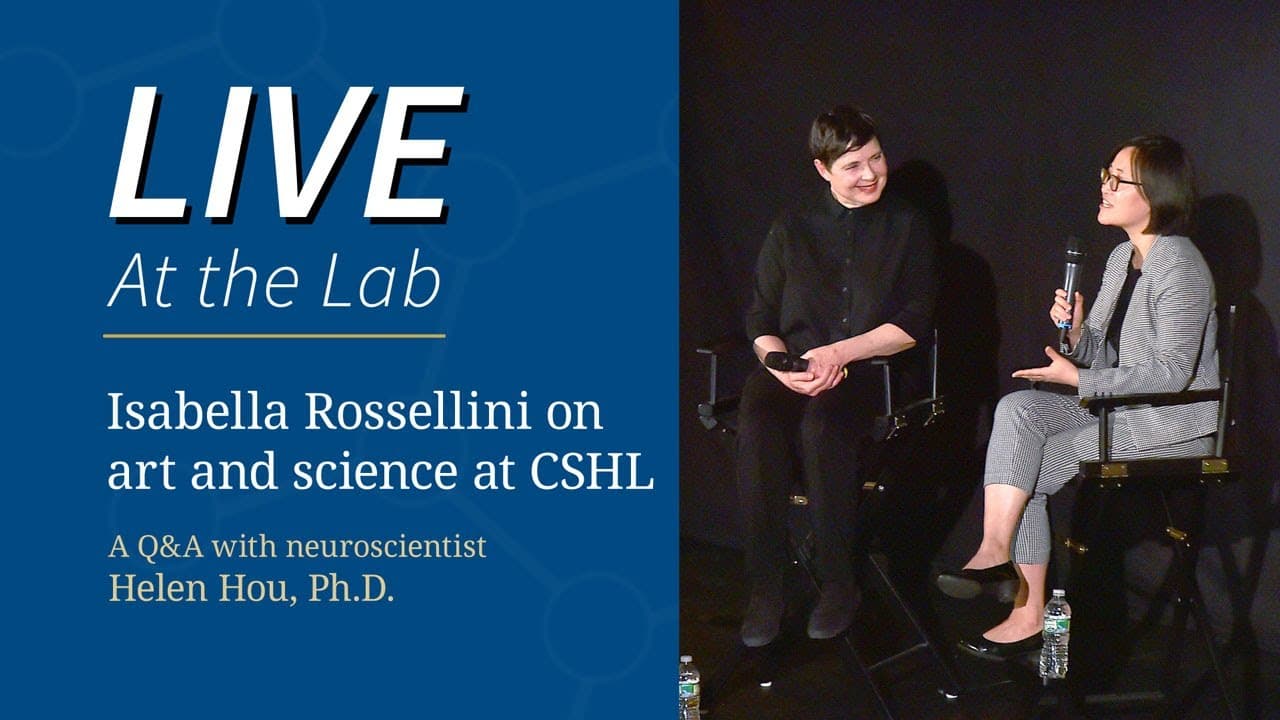
Isabella Rossellini and Helen Hou explore the intersection of art and science through the lens of facial expressions and animal behavior. They discuss how acting and scientific research can reveal insights into emotions and communication, with Rossellini sharing her journey from an artistic background to a fascination with ethology, and Hou detailing her lab's work on brain-behavior connections.
Transcript
Hello, everyone. My name is Helen Hou. I'm an Assistant Professor here at Cold Spring Harbor Labs, and my lab, which is just 5 minutes uphill from here, studies how the brain controls behavior, especially facial expression. So that's the topic that brings me and Isabella together tonight. So why facial expression? Why expression of emotions? So whe... Read More
Key Insights
- Facial expressions are a key window into understanding emotions and brain function.
- Isabella Rossellini connects her acting experience with her interest in animal behavior.
- Helen Hou's lab studies how the brain controls facial expressions in mice.
- Science and art can intersect to provide deeper insights into human and animal behavior.
- Women in STEM have made significant progress, but challenges still exist.
- Public speaking involves overcoming stage fright and connecting with the audience.
- Modern technology allows scientists to explore questions Darwin could only theorize about.
- Curiosity is a driving force in both scientific research and artistic exploration.
Install to Summarize YouTube Videos and Get Transcripts
Explore YouTube Video Summarizer or Get YouTube Transcript Extractor
Questions & Answers
Q: How do facial expressions help in understanding emotions?
Facial expressions serve as a clear window into the mind, offering insights into emotions and brain function. By studying how the brain controls facial expressions, researchers can gain a better understanding of how emotions are expressed and communicated, both in humans and animals. This research can reveal fundamental principles of behavior and communication.
Q: What motivated Isabella Rossellini to study animal behavior?
Isabella Rossellini was motivated to study animal behavior due to her interest in the connection between acting and emotions. She found parallels between her work as an actress and the study of animal behavior, particularly after reading Darwin's work on the expression of emotions. Her artistic background and curiosity drove her to explore ethology, despite initial intimidation by science.
Q: What challenges do women face in STEM fields?
Women in STEM fields face various challenges, including underrepresentation and biases. However, progress has been made, with more women entering and succeeding in scientific careers. Helen Hou highlights the diverse women in her lab as an example of this progress, though she acknowledges that challenges remain and that continued efforts are needed to support and empower women in STEM.
Q: How can public speaking skills be improved?
Public speaking skills can be improved by overcoming stage fright and connecting with the audience. Isabella Rossellini suggests focusing on a few engaged audience members to feel positive energy and avoid distractions from disengaged individuals. Building empathy and connection with the audience, along with practice and repetition, can help speakers feel more confident and effective in their delivery.
Q: What role does curiosity play in scientific research?
Curiosity is a fundamental driving force in scientific research, motivating scientists to explore and understand the unknown. It fuels the desire to uncover the mysteries of the natural world and solve complex problems. Both Isabella Rossellini and Helen Hou emphasize that curiosity leads to new discoveries and advancements in science, as well as personal growth and fulfillment.
Q: How has technology advanced the study of emotions and behavior?
Technology has significantly advanced the study of emotions and behavior by providing tools that allow scientists to observe and analyze phenomena that were previously inaccessible. Modern genetic and molecular tools, high-speed cameras, and artificial intelligence enable researchers to study facial expressions and brain activity in detail, addressing questions that scientists like Darwin could only theorize about.
Q: What is the connection between acting and scientific research?
The connection between acting and scientific research lies in the exploration of emotions and communication. Both fields seek to understand and convey the nuances of human and animal behavior. Isabella Rossellini highlights how her acting experience informs her understanding of emotions, while Helen Hou's research focuses on the brain's role in controlling facial expressions, illustrating the intersection of art and science.
Q: How can acting exercises benefit public speaking?
Acting exercises can benefit public speaking by helping individuals connect with their audience and manage stage fright. Exercises that focus on repetition and emotional expression, like the one demonstrated by Isabella Rossellini and Helen Hou, can enhance empathy and engagement. By practicing these techniques, speakers can develop a stronger presence and more effectively communicate their message to the audience.
Summary & Key Takeaways
-
Isabella Rossellini and Helen Hou discuss the connections between acting and scientific research, focusing on facial expressions and animal behavior. Rossellini shares her transition from an artistic family to studying ethology, highlighting how acting informs her understanding of emotions. Hou explains her lab's work on brain-behavior connections, emphasizing the role of curiosity and modern technology in advancing scientific knowledge.
-
The conversation delves into the challenges and progress of women in STEM, with Hou expressing admiration for the diverse women in her lab. Rossellini and Hou also touch on public speaking, with Rossellini offering tips on overcoming stage fright by connecting with the audience. They explore how modern tools allow scientists to address questions that Darwin could only theorize about, emphasizing the role of curiosity in both science and art.
-
Rossellini and Hou highlight the intersection of art and science, showing how acting and research can provide insights into emotions and communication. They discuss the importance of curiosity as a driving force, the progress of women in STEM, and the use of modern technology to explore longstanding scientific questions. The conversation underscores the value of connecting with audiences in public speaking and the shared human experience of emotions.
Read in Other Languages (beta)
Share This Summary 📚
Summarize YouTube Videos and Get Video Transcripts with 1-Click
Try YouTube Summary with ChatGPT & Claude or YouTube Transcript Generator
Explore More Summaries from Cold Spring Harbor Laboratory 📚

Summarize YouTube Videos and Get Video Transcripts with 1-Click
Try YouTube Summary with ChatGPT & Claude or YouTube Transcript Generator