Lecture 12.4 - Generators, Shift Operators and Frequency Representations
TL;DR
Signal processing uses algebraic frameworks to analyze filters via generators and frequency representations.
Transcript
different shop convolución al signo processing que anvil ricas into the common abstract framework of the bride signal processing we used álgebras a know how amor first to the fine diferente iverson convolución filter in the analysis of these filters de la actriz se entra al componente de peer generator chief operators and free quincy representation... Read More
Key Insights
- Algebraic signal processing provides a framework to analyze convolutional filters using algebras and homomorphisms.
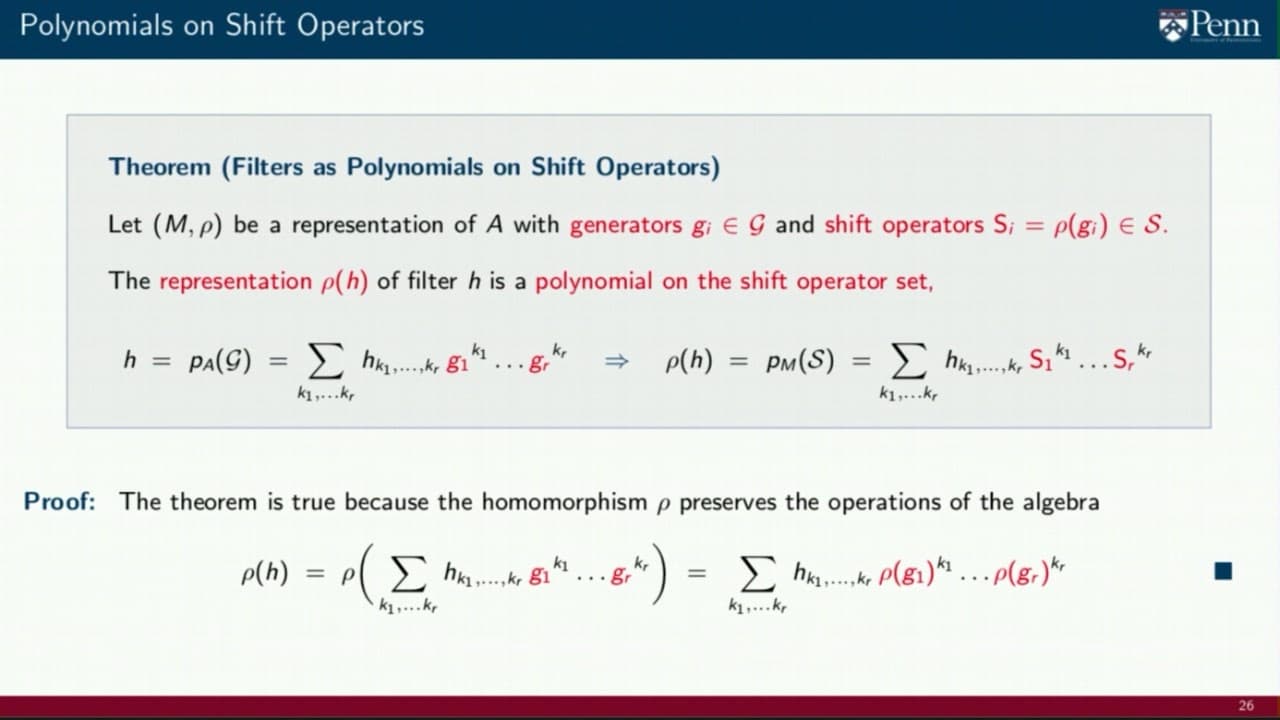
- Generators are fundamental in defining polynomial expressions that represent filters in signal processing.
- Shift operators are used to map algebraic elements to specific operations within the vector space of signals.
- Frequency representations offer a means to analyze filters through polynomial functions over a field.
- Different algebraic structures can represent the same filter, providing flexibility in signal processing analysis.
- The frequency response of a filter is independent of specific instances, focusing on abstract properties.
- Signal processing involves mapping generator elements to shift operators, creating a bridge between abstract and concrete operations.
- The algebraic approach to signal processing enhances stability, transferability, and the ability to derive general results.
Install to Summarize YouTube Videos and Get Transcripts
Explore YouTube Video Summarizer or Get YouTube Transcript Extractor
Questions & Answers
Q: What is the role of generators in signal processing?
Generators play a crucial role in signal processing as they define the polynomial expressions that represent filters within the algebraic framework. These generators act as the foundational elements that are used to construct and analyze filters, providing a structured approach to understanding the operations and effects of signal processing tasks.
Q: How do shift operators function in this framework?
Shift operators function by mapping algebraic elements to specific operations within the vector space of signals. They serve as a bridge between abstract algebraic concepts and practical signal processing tasks, allowing the application of filters to be understood and executed within the context of the vector space where the signals reside.
Q: What is the significance of frequency representations?
Frequency representations are significant because they offer a way to analyze filters through polynomial functions over a field. This approach focuses on the abstract properties of filters, allowing for a deeper understanding of their behavior and effects, independent of specific instances. It enhances the ability to derive general results and provides insights into the stability and transferability of filters.
Q: How does algebraic signal processing enhance analysis?
Algebraic signal processing enhances analysis by providing a structured framework that uses algebras and homomorphisms to define and analyze filters. This approach allows for flexibility and generality in handling different signal processing tasks, enabling a deeper understanding of filter properties and operations. It also supports the derivation of general results and enhances stability and transferability.
Q: What is the relationship between generators and shift operators?
The relationship between generators and shift operators is foundational in algebraic signal processing. Generators define the polynomial expressions that represent filters, while shift operators map these expressions to specific operations within the vector space of signals. This relationship allows for the practical application of filters, bridging the gap between abstract algebraic concepts and concrete signal processing tasks.
Q: Can different algebraic structures represent the same filter?
Yes, different algebraic structures can represent the same filter, providing flexibility in signal processing analysis. This allows for various approaches to be taken when analyzing and applying filters, depending on the specific context and requirements of the signal processing task at hand. It enhances the adaptability and robustness of the analysis.
Q: Why is the frequency response independent of specific instances?
The frequency response is independent of specific instances because it focuses on the abstract properties of the filter, rather than its application to individual signals. This allows for a consistent and general analysis of the filter's behavior and effects, enhancing the ability to derive broad insights and results that are applicable in various contexts.
Q: What are the benefits of using an algebraic approach in signal processing?
The benefits of using an algebraic approach in signal processing include enhanced stability, transferability, and the ability to derive general results. This approach provides a structured framework for analyzing filters, allowing for a deeper understanding of their properties and operations. It also supports flexibility in handling different signal processing tasks and enhances the robustness and adaptability of the analysis.
Summary & Key Takeaways
-
Algebraic signal processing uses a common framework to analyze convolutional filters, focusing on generators, shift operators, and frequency representations. This approach provides a structured way to handle different signal processing tasks, offering flexibility and generality in analysis.
-
Generators define polynomial expressions within the algebraic framework, acting as the building blocks for filters. Shift operators map these algebraic elements to specific operations in the signal vector space, facilitating the application of filters.
-
Frequency representations provide a means to analyze filters abstractly, focusing on the polynomial functions over a field. This allows for a deeper understanding of filter properties, independent of specific instances, enhancing the analysis's stability and transferability.
Read in Other Languages (beta)
Share This Summary 📚
Summarize YouTube Videos and Get Video Transcripts with 1-Click
Try YouTube Summary with ChatGPT & Claude or YouTube Transcript Generator
Explore More Summaries from Alelab Alelab 📚
Summarize YouTube Videos and Get Video Transcripts with 1-Click
Try YouTube Summary with ChatGPT & Claude or YouTube Transcript Generator