What Are Substitutional and Interstitial Alloys?
TL;DR
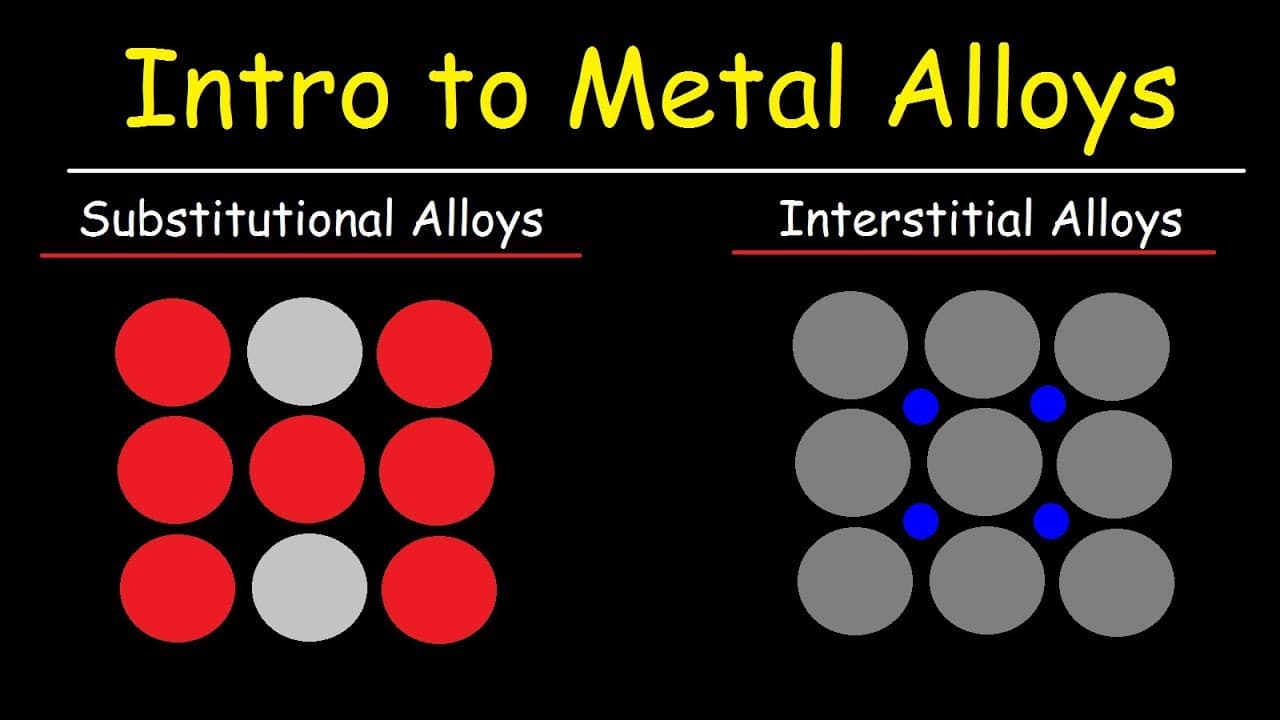
Substitutional alloys are formed when one metal's atoms replace those of another, while interstitial alloys occur when smaller atoms fill the spaces between larger metal atoms. The melting point of an alloy generally depends on its composition, often being closer to that of the predominant metal. Examples include brass (zinc and copper) as a substitutional alloy and steel (iron and carbon) as an interstitial alloy.
Transcript
in this video i want to talk about alloys when you hear the word alloy what do you think of what is an alloy an alloy is a mixture of two or more metals so for instance if we mix zinc with copper metal we can get the alloy known as brass now zinc has a melting point of 420 degrees celsius and copper is 1086 so what do you think the melting point of... Read More
Key Insights
- 🫠 Alloys are mixtures of metals with different melting points.
- 🫠 The melting point of an alloy is influenced by the composition ratio of the metals present.
- 🫀 Substitutional alloys involve the replacement of atoms, while interstitial alloys fill in the spaces between atoms.
- 🤘 Alloys can be made from two or more metals, or from a metal and a non-metal.
- 😆 Some commonly known alloys include brass (zinc and copper), sterling silver (silver and copper), bronze (copper and tin), and solder (tin and lead).
- 🤘 Alloys that are predominantly composed of one metal have melting points close to that metal.
- 🫠 Some alloys can have melting points lower than the individual metals, depending on the composition ratios.
Install to Summarize YouTube Videos and Get Transcripts
Explore YouTube Video Summarizer or Get YouTube Transcript Extractor
Questions & Answers
Q: What is an alloy?
An alloy is a mixture of two or more metals that have different melting points. It can also be a combination of a metal and a non-metal if the substance still exhibits metallic properties.
Q: Why does the melting point of brass fall between the melting points of zinc and copper?
Brass is predominantly composed of copper and contains a smaller amount of zinc. The melting point of an alloy is close to the melting point of the metal that is more abundant in the composition.
Q: What is the difference between a substitutional and an interstitial alloy?
In a substitutional alloy, one type of metal replaces some of the atoms of another metal. In contrast, an interstitial alloy involves smaller atoms filling the spaces between the larger atoms of a metal.
Q: Can alloys have melting points lower than the individual metals?
Yes, alloys with specific ratios can have melting points lower than the individual metals. This is particularly true when the alloy composition is predominantly one metal compared to the other.
Summary & Key Takeaways
-
Alloys are mixtures of two or more metals with different melting points.
-
The melting point of an alloy is influenced by the composition ratio of the metals it contains.
-
Substitutional alloys involve the replacement of atoms, while interstitial alloys fill in the spaces between atoms.
Read in Other Languages (beta)
Share This Summary 📚
Summarize YouTube Videos and Get Video Transcripts with 1-Click
Try YouTube Summary with ChatGPT & Claude or YouTube Transcript Generator
Explore More Summaries from The Organic Chemistry Tutor 📚

Summarize YouTube Videos and Get Video Transcripts with 1-Click
Try YouTube Summary with ChatGPT & Claude or YouTube Transcript Generator