How do fish swim so quickly?
TL;DR
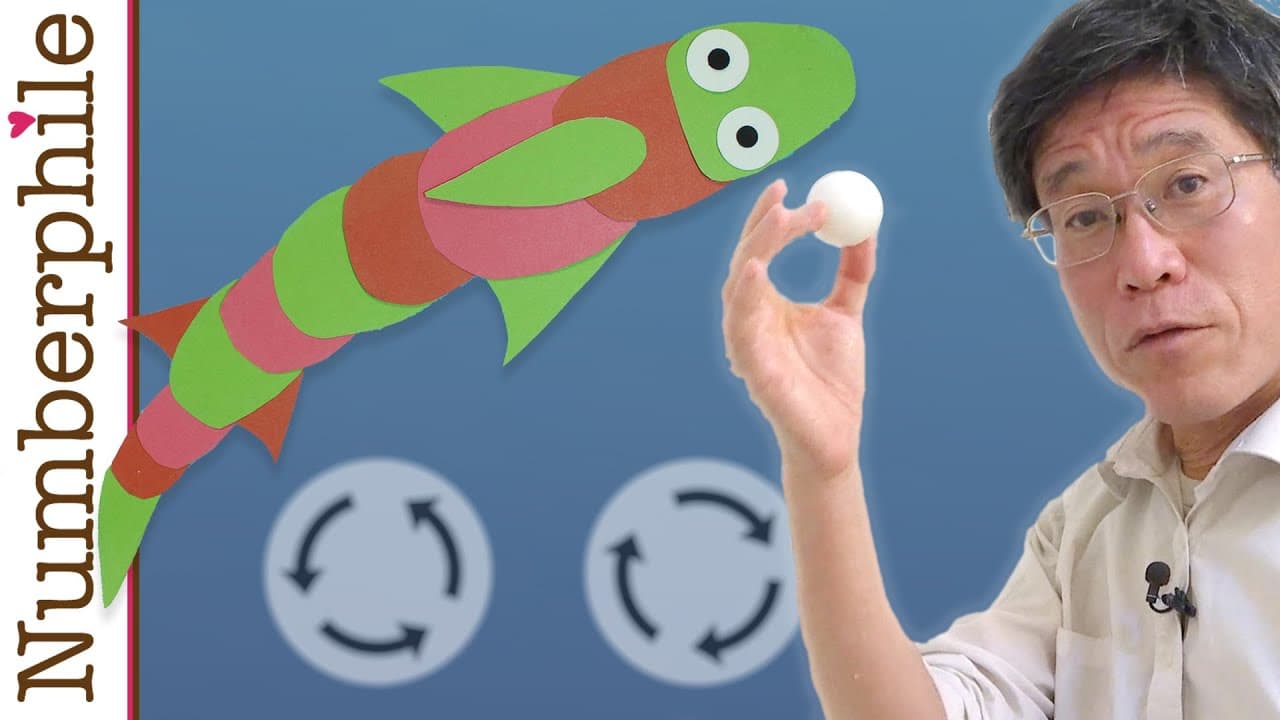
When releasing a ball from different depths in water, it exhibits a unique movement known as porpoising, characterized by an oscillation pattern due to the shedding of vortices.
Transcript
We are in the Tokyo bathroom in northern California, near San Francisco, on Stanford campus. Something that was discovered between my son who's just turned four, but he was two at the time, and me two summers ago; we used to go to a swimming pool and he really liked it, I would of course cuddle him and go into the pool and he was very ver... Read More
Key Insights
- 💦 Releasing a ball from different depths in water produces a unique movement known as porpoising.
- 🍠 The maximum height achieved during porpoising represents a sweet spot for optimal jumping.
- 💬 The sideways motion of the ball is a result of vortex shedding, which wastes energy and prevents the ball from leaping high.
- 🏊 Swimming creatures use a similar mechanism of vortex shedding to enhance their swimming efficiency.
- 💬 The shedding of vortices creates alternating patterns that oscillate the motion of the ball or swimming creature.
- 🥺 A rigid object, like a submarine, leaves forward momentum in its wake, leading to drag and decreased efficiency.
- 🏊 Fish and other swimming creatures flex their bodies to exchange vortex rows, leaving backward momentum and increasing their swimming speed.
Install to Summarize YouTube Videos and Get Transcripts
Explore YouTube Video Summarizer or Get YouTube Transcript Extractor
Questions & Answers
Q: What is the significance of the maximum height achieved when releasing the ball from a specific depth?
The maximum height represents the sweet spot or sweet interval for porpoising, where the ball jumps into the air most effectively. Releasing the ball from shallower or deeper depths leads to less desirable movements.
Q: Why does the ball exhibit sideways motion during porpoising?
The sideways motion is caused by the shedding of vortices, which destabilize the ball's movement. The vortices induce circular flow patterns, pushing the ball sideways and wasting energy.
Q: How does the shedding of vortices affect the ball's motion?
The shedding of vortices creates alternating patterns that oscillate the ball's motion. This alternating shedding prevents the cancellation of vortices and keeps the ball wobbling instead of moving straight up.
Q: How does the concept of porpoising relate to swimming creatures?
Swimming creatures, such as fish, dolphins, and seals, utilize a similar mechanism of vortex shedding to enhance their swimming efficiency. By using their tails to flick and exchange vortex rows, they generate forward momentum while leaving backward momentum in their wake.
Summary & Key Takeaways
-
The experiment involved releasing a ball from different depths in water and observing its movement.
-
The ball exhibited a maximum height achieved when released from a specific depth, creating a sweet spot for porpoising.
-
The sideways motion of the ball is caused by the shedding of vortices, which waste energy and prevent the ball from leaping high.
Read in Other Languages (beta)
Share This Summary 📚
Summarize YouTube Videos and Get Video Transcripts with 1-Click
Try YouTube Summary with ChatGPT & Claude or YouTube Transcript Generator
Explore More Summaries from Numberphile 📚





Summarize YouTube Videos and Get Video Transcripts with 1-Click
Try YouTube Summary with ChatGPT & Claude or YouTube Transcript Generator