What Are the Formulas for Common 3D Shapes?
TL;DR
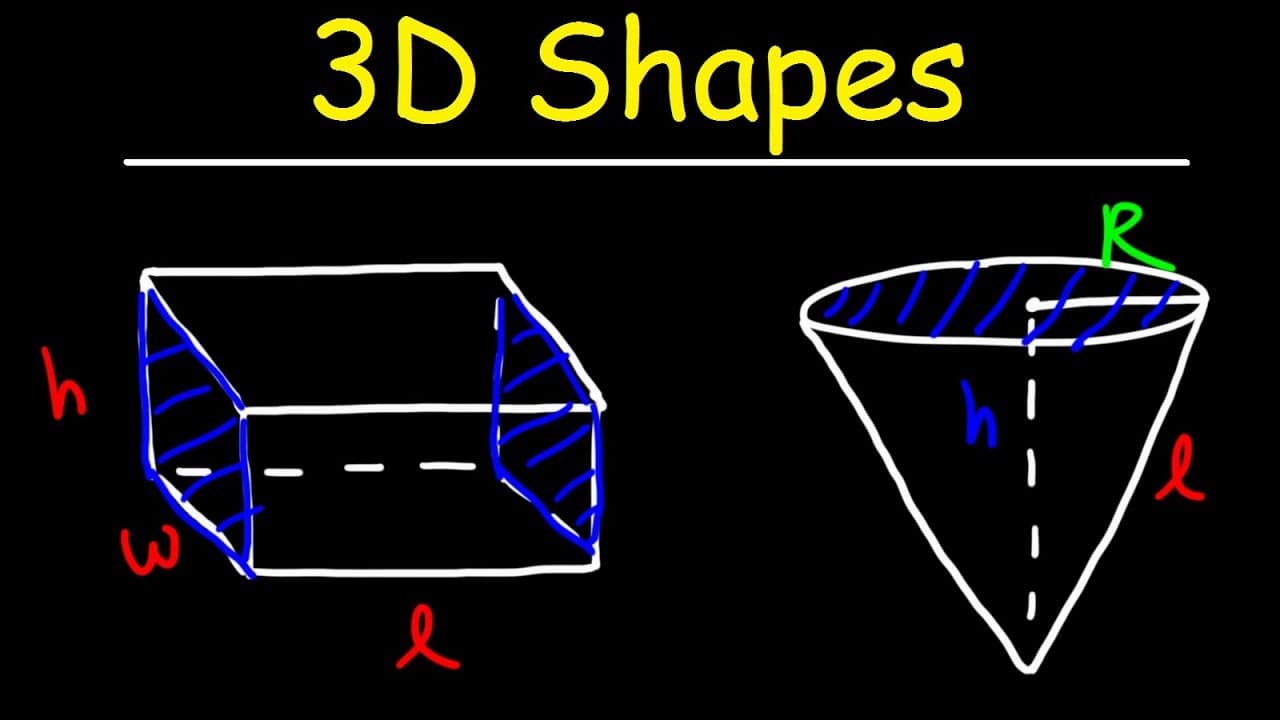
The volume and surface area formulas for common 3D shapes are essential for calculations: the sphere has volume 4/3πr³ and surface area 4πr²; the cylinder's volume is πr²h and surface area 2πr² + 2πrh; the cone has volume (1/3)πr²h and surface area πr² + πrl; the rectangular prism's volume is lwh and surface area 2lw + 2lh + 2wh; the cube's volume is x³ and surface area 6x².
Transcript
in this video we're going to go over some common 3d shapes that you need to know along with some equations and formulas as well so the first shape we're going to talk about is the sphere it looks like a circle if you draw the two dimensional version of it but if you draw the 3d version of it it's a sphere now you need to know that the volume of a s... Read More
Key Insights
- 🔇 Understanding the formulas for volume and surface area is essential in calculating the properties of 3D shapes.
- 🔇 Each 3D shape has unique formulas for volume and surface area, which are derived from the properties of their individual components.
- 💠 The diagonal length of a 3D shape can be calculated using the Pythagorean theorem and the dimensions of the shape.
- 🇦🇪 The measurement units for volume are always cubic units, while the units for surface area are always square units.
- 🤨 Calculating the exact value of pi may result in more accurate calculations compared to using an approximation like 3.14.
- 🔇 The formulas for volume and surface area provide a mathematical representation of the physical properties of 3D shapes.
- 💠 The cube is a special case among the 3D shapes, with all sides being equal in length.
Install to Summarize YouTube Videos and Get Transcripts
Explore YouTube Video Summarizer or Get YouTube Transcript Extractor
Questions & Answers
Q: What is the formula for finding the volume of a sphere?
The formula for the volume of a sphere is four-thirds pi r cubed, where r is the radius of the sphere. This formula takes into account the three-dimensional nature of the sphere and gives the volume in cubic units.
Q: How do you calculate the surface area of a cylinder?
The surface area of a cylinder is calculated by adding the area of the two circular bases (2 pi r squared) to the lateral area (2 pi rh), where r is the radius and h is the height of the cylinder. This formula provides the total surface area in square units.
Q: What is the formula for finding the volume of a cone?
The volume of a cone can be found by taking one-third of the volume of a cylinder with equal base and height dimensions. The formula is one-third pi r squared h, where r is the radius and h is the height of the cone. This formula gives the volume in cubic units.
Q: How do you find the diagonal length of a rectangular prism?
The diagonal length of a rectangular prism can be found using the formula square root of (width squared + height squared + length squared). This formula utilizes the Pythagorean theorem to calculate the length of the diagonal line connecting two opposite corners of the prism.
Summary & Key Takeaways
-
The volume of a sphere is equal to four-thirds pi r cubed, and the surface area is equal to 4 pi r squared.
-
The volume of a cylinder is equal to the area of the base (pi r squared) multiplied by the height, and the surface area is equal to 2 pi r squared plus 2 pi rh.
-
The volume of a cone is one-third pi r squared multiplied by the height, and the surface area is equal to pi r squared plus pi rl (where l is the slant height).
-
The volume of a rectangular prism is equal to length times width times height, and the surface area is equal to 2lw + 2wh + 2lh.
-
The volume of a cube is equal to side cubed, and the surface area is equal to 6x squared (where x is the length of each side).
Read in Other Languages (beta)
Share This Summary 📚
Summarize YouTube Videos and Get Video Transcripts with 1-Click
Try YouTube Summary with ChatGPT & Claude or YouTube Transcript Generator
Explore More Summaries from The Organic Chemistry Tutor 📚


Summarize YouTube Videos and Get Video Transcripts with 1-Click
Try YouTube Summary with ChatGPT & Claude or YouTube Transcript Generator