The rise and fall of the Mongol Empire - Anne F. Broadbridge
TL;DR
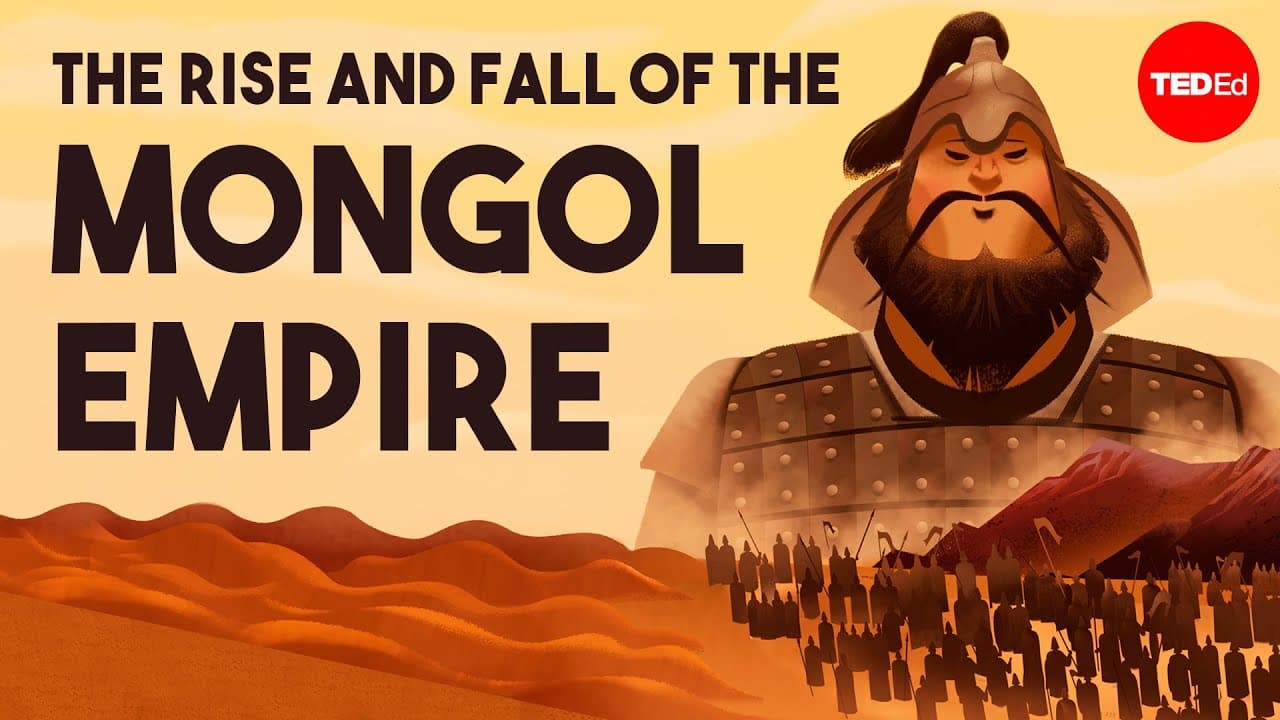
The Mongol Empire, from humble nomadic beginnings to world domination, shaped Eurasian history with innovation and conquest.
Transcript
It was the largest contiguous land empire in history— stretching from Korea to Ukraine and from Siberia to southern China, and was forged on the open plains. In the 12th century CE, before the Mongol Empire formed, the East Asian steppe was home to scattered groups of Mongol and Turkic pastoral nomads led by Khans. The people herded sheep, catt... Read More
Key Insights
- 😮 Chinggis Khan's rise to power through strategic alliances and innovative military tactics shaped the Mongol Empire's success.
- 👻 The Mongols' belief in Tenggeri's mandate drove their conquests and governance practices, allowing for religious freedom and cultural diversity within their empire.
- 😵 The Mongol Empire's impact on trade, innovation, and cross-cultural exchange along the Silk Road contributed to the spread of knowledge and goods across Eurasia.
Install to Summarize YouTube Videos and Get Transcripts
Explore YouTube Video Summarizer or Get YouTube Transcript Extractor
Questions & Answers
Q: How did Temujin rise to power and become Chinggis Khan?
Temujin rose to power by forming strategic alliances, promoting soldiers based on merit, and scattering conquered nomads among his soldiers to prevent uprisings against him.
Q: What was the Mongol Empire's approach to governance and religion?
The Mongols allowed local administrators to govern conquered territories and respected all religions as long as prayers were offered for their rulers. They were shamanists believing in Tenggeri's mandate.
Q: What were the key contributions of the Mongols to trade and innovation?
The Mongols facilitated robust trade along the Silk Road, settled artisans and engineers across Asia, prized gunpowder technicians, and combined different cultures in producing goods like gold brocade and blue-and-white porcelain.
Q: How did the Mongol Empire's succession system lead to its fragmentation?
The Mongol Empire's succession system, allowing various family members to compete for leadership, led to a civil war among Chinggis Khan's grandsons, resulting in the division of the empire into four separate entities.
Summary & Key Takeaways
-
The Mongol Empire, spanning Korea to Ukraine, arose from nomadic Mongol and Turkic groups led by Khans, herding animals and specializing in mounted warfare.
-
Temujin, later Chinggis Khan, united the nomads through strategic alliances, merit-based promotions, and dispersing conquered nomads among his soldiers.
-
Mongols, believing in shamanism and Tenggeri's mandate, conquered vast territories, governed with local administrators, and fostered cross-cultural trade and innovation.
Read in Other Languages (beta)
Share This Summary 📚
Summarize YouTube Videos and Get Video Transcripts with 1-Click
Try YouTube Summary with ChatGPT & Claude or YouTube Transcript Generator
Explore More Summaries from TED-Ed 📚





Summarize YouTube Videos and Get Video Transcripts with 1-Click
Try YouTube Summary with ChatGPT & Claude or YouTube Transcript Generator