What Is LHS 1140b and Why Is It Significant for Habitability?
TL;DR
LHS 1140b is a super-Earth exoplanet 40 light-years away, which may have conditions suitable for life. Its proximity to a stable red dwarf star allows for the potential presence of liquid water, despite receiving less light than Earth. Scientists are eager to study this planet's atmosphere for biosignatures, making it a top candidate in the search for extraterrestrial life.
Transcript
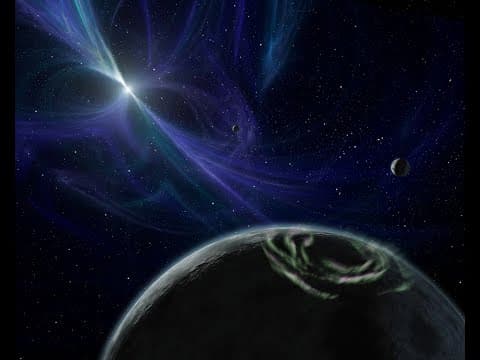
Yet another case of a seemingly habitable world orbiting an M type red dwarf has surfaced. Just 40 light-years away, a super earth exoplanet has been found that seems to have, at least on its face, the best chance of detecting earth-like habitability that we have yet seen. Known as LHS 1140b, this planet has some significant differences with earth.... Read More
Key Insights
- 🤩 LHS 1140b offers an opportunity to study exoplanet atmospheres for signs of life due to its favorable conditions, like higher gravity and the history of its star's activity.
- 🤩 Red dwarf stars are the most common in the galaxy, and determining their habitability will contribute significantly to understanding the prevalence of life in the universe.
Install to Summarize YouTube Videos and Get Transcripts
Explore YouTube Video Summarizer or Get YouTube Transcript Extractor
Questions & Answers
Q: What makes LHS 1140b a promising candidate for studying exoplanet atmospheres?
LHS 1140b has higher gravity, increasing its ability to retain an atmosphere, and its red dwarf star had a relatively stable and short active phase, indicating potential habitability.
Q: Why are planets orbiting red dwarf stars easier to observe than those orbiting brighter stars like our sun?
Red dwarf stars are dimmer, making it easier to study transiting exoplanet atmospheres. This is crucial for detecting gases associated with life.
Q: What challenges do astronomers face when studying exoplanet atmospheres?
Even with nearby exoplanets, detecting their atmospheres can be difficult. For example, Proxima B does not pass in front of its star, making it hard to study any potential atmosphere.
Q: How does LHS 1140b compare to other potentially habitable exoplanets?
LHS 1140b's higher gravity and the stability of its red dwarf star make it a strong candidate for studying biosignatures and potential signs of life.
Summary & Key Takeaways
-
LHS 1140b is a super earth exoplanet located 40 light-years away with potential habitability and similarities to Earth.
-
Orbiting closely to its red dwarf star, LHS 1140b has a year of only 25 days, which may cause it to be tidally locked and have a habitable twilight area.
-
Despite receiving half as much light as Earth, LHS 1140b could still maintain liquid water in certain areas.
Read in Other Languages (beta)
Share This Summary 📚
Summarize YouTube Videos and Get Video Transcripts with 1-Click
Try YouTube Summary with ChatGPT & Claude or YouTube Transcript Generator
Explore More Summaries from John Michael Godier 📚

Summarize YouTube Videos and Get Video Transcripts with 1-Click
Try YouTube Summary with ChatGPT & Claude or YouTube Transcript Generator