How To Simplify Square Roots
TL;DR
Learn how to simplify square roots by breaking down the numbers into perfect squares and combining like terms.
Transcript
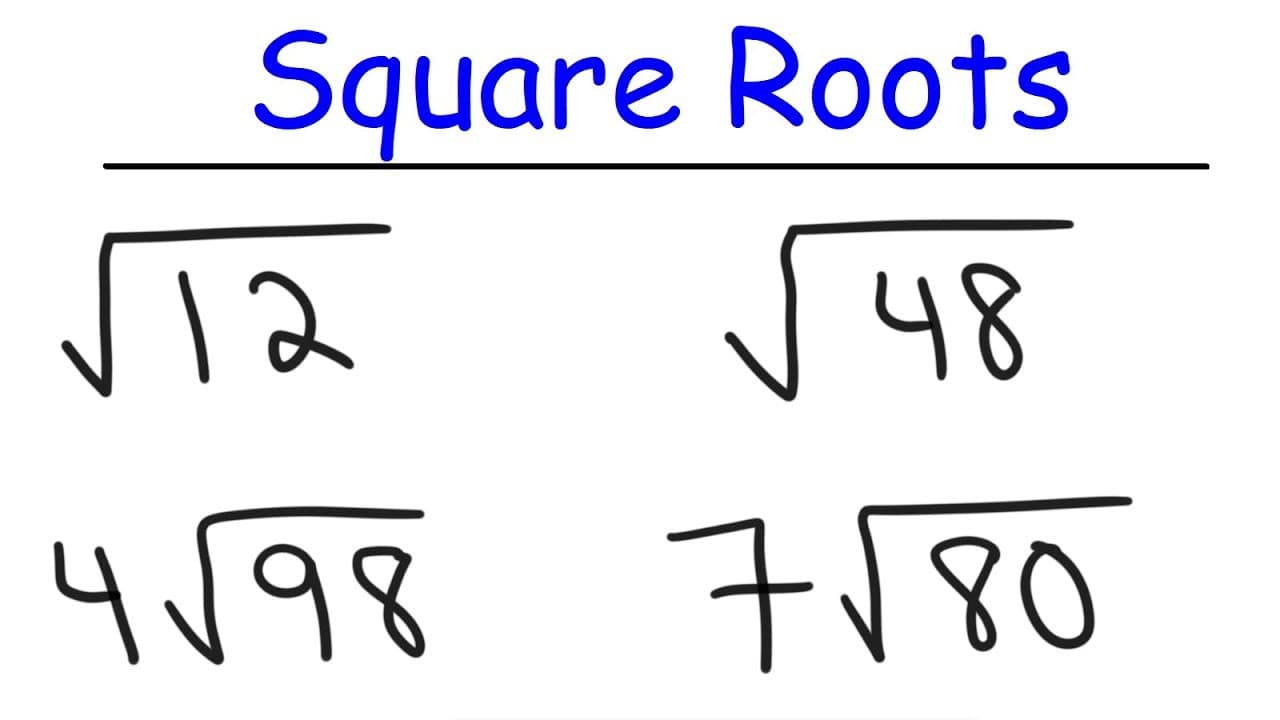
in this video we're going to focus on simplifying square roots we're going to start with some basic examples and then gradually they're going to get harder so consider these four examples how would you simplify it let's start with the first one what is the square root of 49 what two identical numbers when multiplied will give you 49. forty nine is ... Read More
Key Insights
- ❎ The square root of a perfect square is a whole number.
- ❎ Square roots of negative numbers result in imaginary numbers.
- ◾ Numbers that are not perfect squares can be broken down into smaller numbers for simplified square roots.
- 🫚 When simplifying expressions with square roots, focus on simplifying each square root and then combine like terms.
- ❎ Perfect squares that are commonly encountered include 1, 4, 9, 16, 25, 36, 49, and 64.
- ❎ To simplify square roots, identify the highest perfect square that divides evenly into the given number.
- 😑 Use the distributive property to simplify expressions involving square roots.
Install to Summarize YouTube Videos and Get Transcripts
Explore YouTube Video Summarizer or Get YouTube Transcript Extractor
Questions & Answers
Q: How do you simplify the square root of a perfect square?
The square root of a perfect square, such as 49 or 25, is simply the whole number. For example, the square root of 49 is 7.
Q: What happens when the number inside the square root is negative?
When the number inside the square root is negative, it results in an imaginary number. For example, the square root of -25 is 5i.
Q: How do you simplify square roots that are not perfect squares?
To simplify square roots that are not perfect squares, you can break them down into smaller numbers. For example, the square root of 18 becomes 3√2, and the square root of 75 becomes 5√3.
Q: How do you simplify expressions with square roots?
To simplify expressions with square roots, simplify each square root individually by breaking them down into perfect squares. Then, combine like terms by adding or subtracting coefficients.
Summary & Key Takeaways
-
The square root of a perfect square, like 49 or 25, is a whole number. For example, the square root of 49 is 7.
-
When the number inside the square root is negative, it results in an imaginary number. The square root of -25 is 5i.
-
For numbers that are not perfect squares, you can break them down into smaller numbers. The square root of 18 becomes 3√2, and the square root of 75 becomes 5√3.
-
To simplify expressions with square roots, simplify each square root individually and then combine like terms.
Read in Other Languages (beta)
Share This Summary 📚
Summarize YouTube Videos and Get Video Transcripts with 1-Click
Try YouTube Summary with ChatGPT & Claude or YouTube Transcript Generator
Explore More Summaries from The Organic Chemistry Tutor 📚



Summarize YouTube Videos and Get Video Transcripts with 1-Click
Try YouTube Summary with ChatGPT & Claude or YouTube Transcript Generator