Simplifying Radical Expressions - Practice Problems
TL;DR
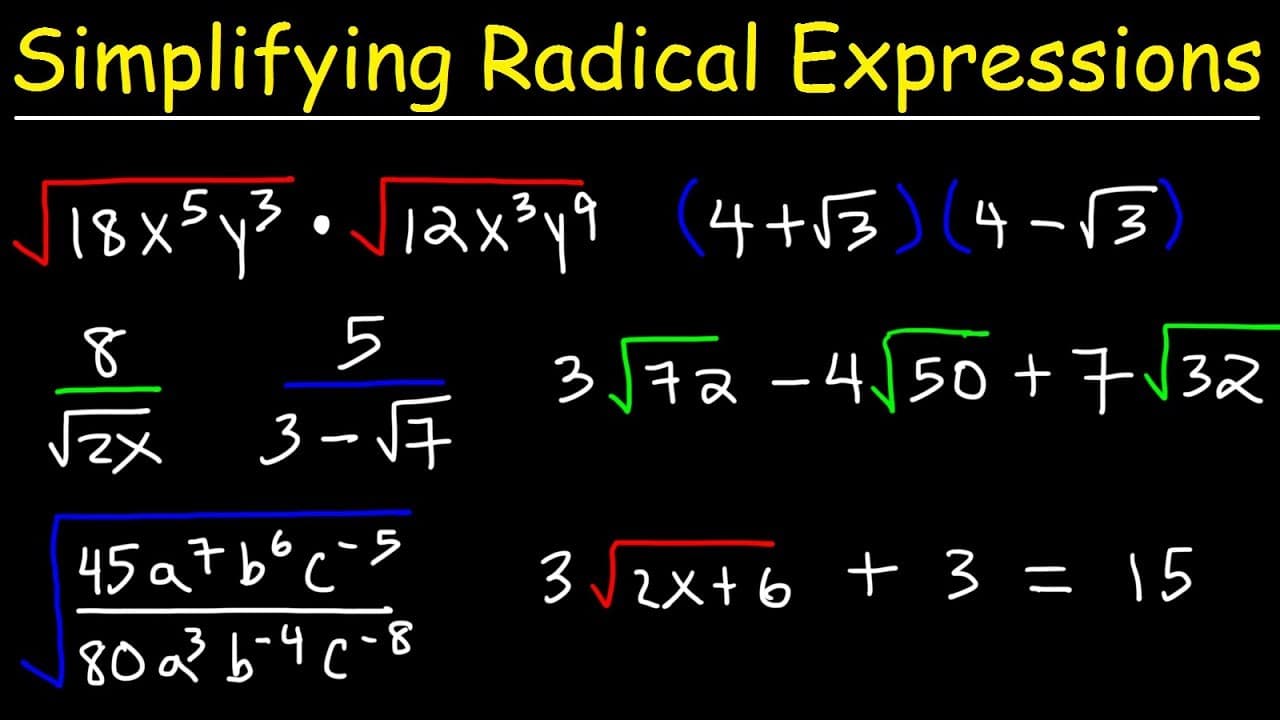
This content covers simplifying expressions, rationalizing denominators, and solving equations with square roots.
Transcript
number one simplify the following expression so feel free to pause the video and try this problem the square root of 18 we can write it as root 2 times root 9 and the square root of 12 is the square root of 4 times square root of 3. x to the fifth times x cubed we need to add the exponents 5 plus 3 is 8 and 3 plus 9 is 12. the square root of 9 is t... Read More
Key Insights
- 😑 Expressions with square roots and exponents can be simplified by breaking them down into prime factors and applying exponent rules.
- ✖️ Rationalizing a denominator involves multiplying both the numerator and denominator by the conjugate of the denominator.
- ❎ Equations with square roots can be solved by isolating the variable and squaring both sides.
- 🟧 When finding the range and domain of a function with square roots, consider any restrictions or limitations on the input and output values.
- 🫚 Solving equations with square roots may result in extraneous solutions that need to be verified.
Install to Summarize YouTube Videos and Get Transcripts
Explore YouTube Video Summarizer or Get YouTube Transcript Extractor
Questions & Answers
Q: How do you simplify an expression with square roots and exponents?
To simplify, you can break down each square root into its prime factors and combine like terms. Then, apply the exponent rule by adding or subtracting the exponents.
Q: What is the process for rationalizing a denominator?
To rationalize a denominator, multiply the top and bottom of the fraction by the conjugate of the denominator. This eliminates the square root in the denominator and simplifies the expression.
Q: How do you solve an equation involving square roots?
Start by isolating the variable on one side of the equation. Then, square both sides to eliminate the square root. Finally, solve for the variable by simplifying and applying proper operations.
Q: How do you find the range and domain of a function involving square roots?
For the range, determine the maximum and minimum values the function can output. For the domain, identify any restrictions on the input values, such as avoiding division by zero or negative square roots.
Summary & Key Takeaways
-
The content starts by simplifying an expression involving square roots and exponents.
-
It then moves on to simplifying a more complex expression by dividing and multiplying exponents.
-
Next, it demonstrates how to rationalize a denominator by multiplying the top and bottom by the conjugate.
-
It continues by solving equations involving square roots by isolating the variable and squaring both sides.
-
The content concludes with simplifying expressions by combining like terms and finding the range and domain of a function.
Read in Other Languages (beta)
Share This Summary 📚
Summarize YouTube Videos and Get Video Transcripts with 1-Click
Try YouTube Summary with ChatGPT & Claude or YouTube Transcript Generator
Explore More Summaries from The Organic Chemistry Tutor 📚




Summarize YouTube Videos and Get Video Transcripts with 1-Click
Try YouTube Summary with ChatGPT & Claude or YouTube Transcript Generator