How Big Is the Solar System in Astronomical Units?
TL;DR
The Solar System extends up to 100,000 astronomical units, with distances so vast that travel to its edge would take 19 million years by car. Key regions include the Kuiper Belt at 30-50 AU and the Oort Cloud, which is theorized to house icy objects and comets. The Sun's gravity effectively governs space within about 2 light-years from its core.
Transcript
I'm Fraser Cain, the publisher of Universe Today. For most of us, stuck here on Earth, we see very little of the rest of the Solar System. Just the bright Sun during the day, the Moon and the planets at night. But in fact, we're embedded in a huge Solar System that extends across a vast amount of space. Which begs the question, just how big is the ... Read More
Key Insights
- 👾 The Solar System's size is measured in astronomical units, showcasing distances within space accurately.
- 🛰️ Dwarf planets like Eris and Pluto orbit at tremendous distances from the Sun, reflecting the vastness of our cosmic neighborhood.
- 🚴 The Oort Cloud extends to 100,000 astronomical units, theorized to house long-period comets and icy objects.
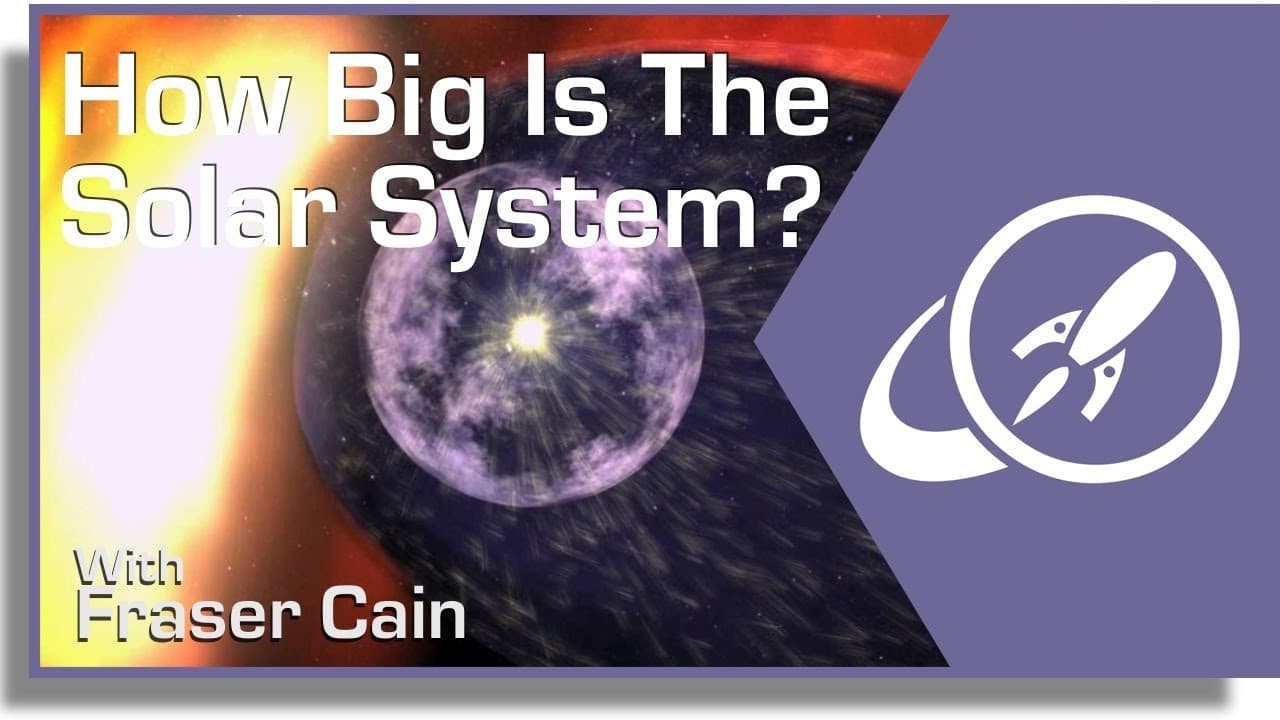
- 🫢 The termination shock marks the boundary where the Sun's solar wind meets the interstellar medium.
- 🙂 Objects within the Oort Cloud could orbit the Sun up to 1.87 light-years away, influencing our understanding of the Solar System's reach.
- 🤩 The Sun's gravity affects space up to almost half the distance to the nearest star, Proxima Centauri.
- 👪 Traveling to the edge of the Solar System would take millions of years, showcasing the immense scale of our cosmic home.
Install to Summarize YouTube Videos and Get Transcripts
Explore YouTube Video Summarizer or Get YouTube Transcript Extractor
Questions & Answers
Q: What is an astronomical unit, and why is it used in measuring space distances?
An astronomical unit is the average distance from Earth to the Sun, approximately 150 million kilometers, used in space measurements as regular meters and kilometers are insufficient to cover vast distances accurately.
Q: How far do dwarf planets like Eris and Pluto orbit from the Sun?
Dwarf planets like Eris and Pluto orbit at distances reaching up to 39.2 astronomical units, equivalent to billions of kilometers, showcasing the vast expanse of the Solar System.
Q: What is the termination shock, and where is it located in the Solar System?
The termination shock is where the Sun's solar wind meets the interstellar medium 80-200 AU from the Sun, creating a comet-like tail, illustrating the boundaries of the Solar System's influence.
Q: How long would it take NASA's New Horizons spacecraft to reach the edge of the Solar System?
NASA's New Horizons spacecraft, the fastest from Earth, would need 37,000 years to travel to the Solar System's edge, emphasizing the immense distances and vastness of space.
Summary & Key Takeaways
-
The Solar System spans a vast distance, measured in astronomical units.
-
Planets like Pluto and Eris are miles away from the Sun.
-
The Oort Cloud extends to 100,000 astronomical units, showing the Solar System's true size.
Read in Other Languages (beta)
Share This Summary 📚
Summarize YouTube Videos and Get Video Transcripts with 1-Click
Try YouTube Summary with ChatGPT & Claude or YouTube Transcript Generator
Explore More Summaries from Fraser Cain 📚





Summarize YouTube Videos and Get Video Transcripts with 1-Click
Try YouTube Summary with ChatGPT & Claude or YouTube Transcript Generator