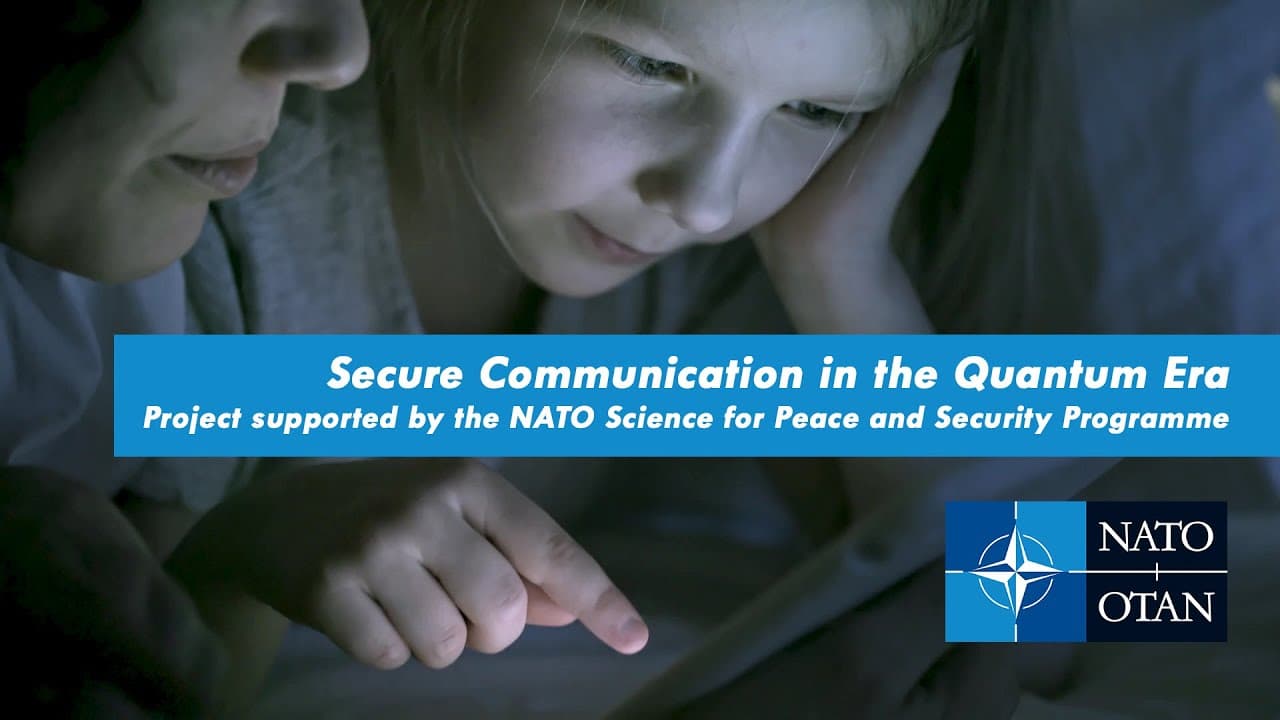
Secure Communication in the Quantum Era
TL;DR
Exploring quantum-safe communication solutions against evolving cyber threats.
Transcript
this year we celebrate the 30 years anniversary one of the greatest inventions in the last century the internet no doubt that it was Tim berners-lee concept of web which brings to our lives freedom however along with many positive influence to our lives there are dark sides in the connected world we live in as the number and violence of cyberattack... Read More
Key Insights
- The internet, a revolutionary invention, brings both freedom and increased cyber threats, necessitating new security measures.
- NATO's Science for Peace and Security Programme supports projects like Secure Loop Communication to enhance cyber defense.
- Cyber threats are increasingly sophisticated, requiring advanced defense strategies, including quantum-safe cryptographic protocols.
- Quantum computing poses potential risks to current encryption methods, prompting the need for quantum-resistant solutions.
- The project involves collaboration among four universities, each contributing expertise in cryptanalysis, cryptographic implementation, and security modeling.
- Key establishment protocols are essential for secure communication, relying on mathematical problems difficult for current computers but potentially vulnerable to quantum attacks.
- Implementation-level protections are crucial, including runtime verification and defense against side-channel attacks.
- The project aims to advance secure communication systems and train researchers in managing complex cryptographic protocol designs.
Install to Summarize YouTube Videos and Get Transcripts
Explore YouTube Video Summarizer or Get YouTube Transcript Extractor
Questions & Answers
Q: What is the main focus of the Secure Loop Communication project?
The main focus of the Secure Loop Communication project is to develop quantum-safe communication solutions that can withstand the potential threats posed by quantum computing. This involves creating robust cryptographic protocols and implementation-level protections to ensure secure communication in the face of evolving cyber threats.
Q: Why is NATO's Science for Peace and Security Programme involved in this project?
NATO's Science for Peace and Security Programme is involved in this project because it supports dialogue and practical cooperation among NATO member and partner countries. The programme recognizes the critical role of science in addressing global security challenges, including cybersecurity threats, and supports projects that aim to enhance cyber defense capabilities.
Q: How does quantum computing pose a threat to current encryption methods?
Quantum computing poses a threat to current encryption methods because it has the potential to solve complex mathematical problems much faster than traditional computers. Many encryption techniques rely on the difficulty of these problems for security. Quantum computers could potentially break these encryption methods, necessitating the development of quantum-resistant solutions.
Q: What expertise do the collaborating universities bring to the project?
The collaborating universities bring diverse expertise to the project, including cryptanalysis using quantum computers, cryptographic implementation, and security modeling. Each university contributes its strengths, such as designing secure protocols, preventing side-channel attacks, and implementing runtime verification to ensure robust security against potential threats.
Q: What are side-channel attacks, and how does the project aim to prevent them?
Side-channel attacks exploit information leaked during the physical implementation of cryptographic systems, such as timing behavior or power consumption. The project aims to prevent these attacks by incorporating implementation-level protections, including runtime verification and sophisticated algorithmic countermeasures, to safeguard against such vulnerabilities.
Q: What are the goals of the Secure Loop Communication project?
The goals of the Secure Loop Communication project are twofold: to advance the state-of-the-art in designing, building, and analyzing long-term secure communication systems, and to train researchers to manage the complex interplay of cryptographic protocol design with implementation-specific attack mitigation through advanced algorithmic and software countermeasures.
Q: How does the project ensure that the cryptographic protocols are quantum-safe?
The project ensures that the cryptographic protocols are quantum-safe by choosing hardness assumptions based on coding theory and lattices, which are believed to be resistant to quantum attacks. The protocols are designed to provide structural guarantees at the protocol level and are tested through implementation on various platforms to ensure their robustness.
Q: What role does runtime verification play in the project?
Runtime verification plays a critical role in the project by ensuring that the necessary capabilities are available to protect the implementation against manipulation at runtime. It involves monitoring the system's execution to detect and prevent potential attacks, thereby providing an additional layer of security to the cryptographic protocols being developed.
Summary & Key Takeaways
-
The video discusses the importance of secure communication in the face of evolving cyber threats, especially with the advent of quantum computing. It highlights the role of NATO's Science for Peace and Security Programme in supporting projects aimed at developing quantum-safe solutions.
-
The Secure Loop Communication project involves collaboration among universities with expertise in cryptanalysis, cryptographic implementation, and security modeling. The project seeks to develop a robust, quantum-safe group key establishment solution to counteract potential threats posed by quantum computing.
-
The video emphasizes the need for advanced cryptographic protocols and implementation-level protections, such as runtime verification and defense against side-channel attacks. The project's goal is to advance secure communication systems and train researchers in managing complex cryptographic protocol designs.
Read in Other Languages (beta)
Share This Summary 📚
Summarize YouTube Videos and Get Video Transcripts with 1-Click
Try YouTube Summary with ChatGPT & Claude or YouTube Transcript Generator
Explore More Summaries from universidadurjc 📚


Summarize YouTube Videos and Get Video Transcripts with 1-Click
Try YouTube Summary with ChatGPT & Claude or YouTube Transcript Generator