What Is Diamagnetic Anisotropy in NMR Spectroscopy?
TL;DR
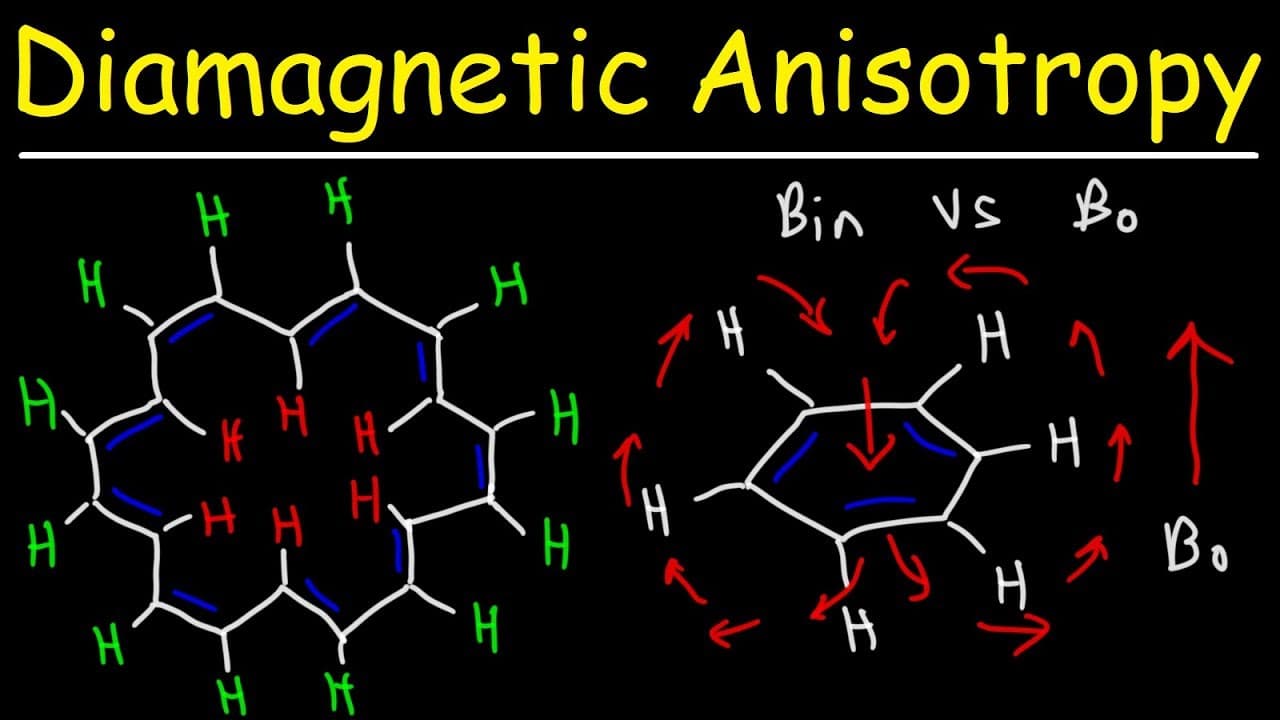
Diamagnetic anisotropy explains how the chemical shift of protons in NMR spectroscopy varies based on their environment in a magnetic field. Protons attached to sp2 hybridized carbons, like in benzene and ethylene, exhibit high chemical shifts due to reinforcing induced and applied magnetic fields. In contrast, protons attached to sp hybridized carbons, like acetylene, show lower chemical shifts because the magnetic fields oppose each other.
Transcript
so here we have benzene ethylene and acetylene the chemical shift for benzene that is in h nmr looking at the uh protons it's between 6.5 to 8 parts per million and the chemical shifts for the protons in ethylene is around 4.5 to 6.5 and the protons attached to an alkyne like acetylene it varies between 2 and 2.5 now here's a question for you why i... Read More
Key Insights
- 🏑 Chemical shifts in NMR spectroscopy depend on the interaction of protons with induced and applied magnetic fields.
- 🫀 The hybridization of carbon atoms in a molecule affects the chemical shifts of attached protons.
- 🖐️ Diamagnetic anisotropy plays a significant role in determining the chemical shifts of different types of protons.
- 😋 Protons on the exterior of a molecule, such as those outside the benzene ring, have higher chemical shifts.
Install to Summarize YouTube Videos and Get Transcripts
Explore YouTube Video Summarizer or Get YouTube Transcript Extractor
Questions & Answers
Q: Why is the chemical shift for acetylene much lower than for the protons in ethylene and benzene?
The chemical shift is lower in acetylene because the induced and applied magnetic fields for the protons are in opposite directions, resulting in a weak net magnetic field.
Q: How does the hybridization of carbon atoms affect chemical shifts?
In benzene, ethylene, and acetylene, the protons are attached to sp2, sp2, and sp hybridized carbon atoms, respectively. This difference in hybridization contributes to the variation in chemical shifts.
Q: What is diamagnetic anisotropy?
Diamagnetic anisotropy refers to the variation in induced magnetic fields at different points in space relative to a molecule when placed in an applied magnetic field.
Q: How does the orientation of protons in space affect chemical shifts?
The orientation of protons relative to the molecule and the applied magnetic field determines the direction of the induced magnetic field, which influences the chemical shift.
Summary & Key Takeaways
-
The chemical shifts for protons in benzene, ethylene, and acetylene differ due to hybridization and the presence of induced magnetic fields.
-
Benzene has a high chemical shift because the induced and applied magnetic fields reinforce each other at the location of the protons.
-
Ethylene also has a high chemical shift due to the parallel alignment of the induced and applied magnetic fields.
-
Acetylene, with anti-parallel induced and applied magnetic fields, has a low chemical shift.
Read in Other Languages (beta)
Share This Summary 📚
Summarize YouTube Videos and Get Video Transcripts with 1-Click
Try YouTube Summary with ChatGPT & Claude or YouTube Transcript Generator
Explore More Summaries from The Organic Chemistry Tutor 📚





Summarize YouTube Videos and Get Video Transcripts with 1-Click
Try YouTube Summary with ChatGPT & Claude or YouTube Transcript Generator