r greater than g but less inequality
TL;DR
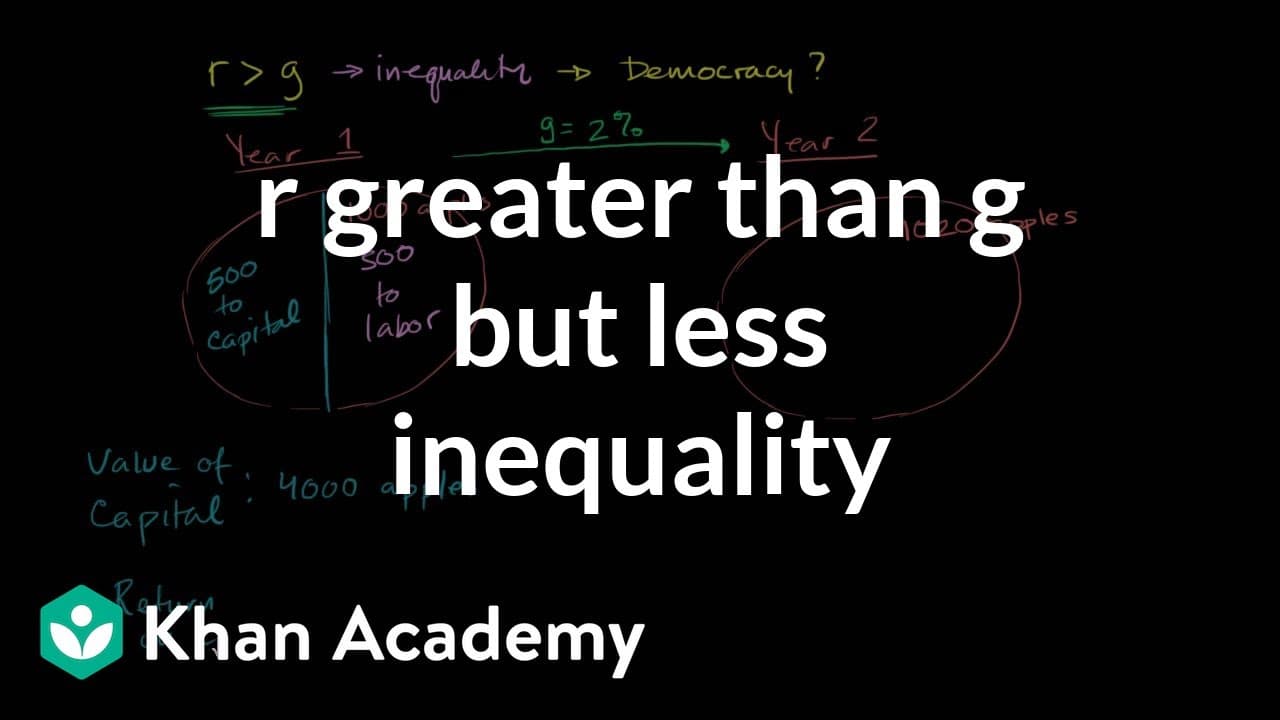
The video discusses the idea that if the return on capital is higher than the growth in the economy, it could lead to inequality, potentially impacting democracy and economic growth.
Transcript
- [Instructor] One of the core ideas of Thomas Piketty's book is if the return on capital is greater than the growth in economy, then that could drive inequality. That could drive inequality. Inequality. And inequality is a natural byproduct of a market capitalist economy and one could argue that, "Hey, look, some inequality is going to happen "as ... Read More
Key Insights
- 🫵 Inequality is viewed as a natural outcome of a market capitalist economy, but extreme inequality can have negative consequences for democracy.
- ↩️ The relationship between return on capital and economic growth is complex, and higher returns on capital do not always result in increasing inequality.
- 😮 Rising inequality can lead to reduced economic growth if there is a lack of consumers with sufficient purchasing power.
- 🔬 The connection between capital and labor income is important, as capital tends to concentrate wealth in the top percentiles, while labor income is more indicative of the income received by the lower quartiles of the population.
- 🖐️ Factors such as government policies, income distribution, and economic variables play a role in determining the impact of return on capital on inequality.
- 🥺 Extreme inequality can lead to power imbalances in society, potentially undermining democracy.
- 🔬 The distribution of income between capital and labor affects the income distribution across different sections of the population.
Install to Summarize YouTube Videos and Get Transcripts
Explore YouTube Video Summarizer or Get YouTube Transcript Extractor
Questions & Answers
Q: Why does the video suggest that extreme inequality can be bad for democracy?
Extreme inequality can lead to power accumulation in some groups, potentially undermining the democratic principles of equal representation and opportunity. This can create a disparity in political influence and decision-making.
Q: How can rising inequality potentially impact economic growth?
Rising inequality can lead to a lack of consumers or people with sufficient purchasing power, resulting in reduced demand for goods and services. This can hinder economic growth by limiting market opportunities and stalling investment.
Q: Does a higher return on capital always lead to increasing inequality?
No, a higher return on capital does not always lead to increasing inequality. Factors such as the distribution of income between capital and labor, government policies, and other economic variables can influence whether inequality rises or remains stable.
Q: What is the connection between capital and labor income in relation to inequality?
Capital income, which is associated with ownership of assets, tends to be concentrated in the top percentiles of the population. On the other hand, labor income, which is earned through work, is more indicative of the income received by lower quartiles of the population. This income distribution contributes to income inequality.
Summary & Key Takeaways
-
The video explores the concept that inequality is a natural byproduct of a market capitalist economy, but extreme forms of inequality can be detrimental to democracy and economic growth.
-
It presents a scenario where the return on capital is greater than the economic growth, but it notes that this doesn't always lead to rising inequality.
-
The connection between capital and labor income is discussed, suggesting that income distribution is often skewed towards the top percentile or decile due to the concentration of capital.
Read in Other Languages (beta)
Share This Summary 📚
Summarize YouTube Videos and Get Video Transcripts with 1-Click
Try YouTube Summary with ChatGPT & Claude or YouTube Transcript Generator
Explore More Summaries from Khan Academy 📚



Summarize YouTube Videos and Get Video Transcripts with 1-Click
Try YouTube Summary with ChatGPT & Claude or YouTube Transcript Generator