What Is Work, Energy, and Power in Physics?
TL;DR
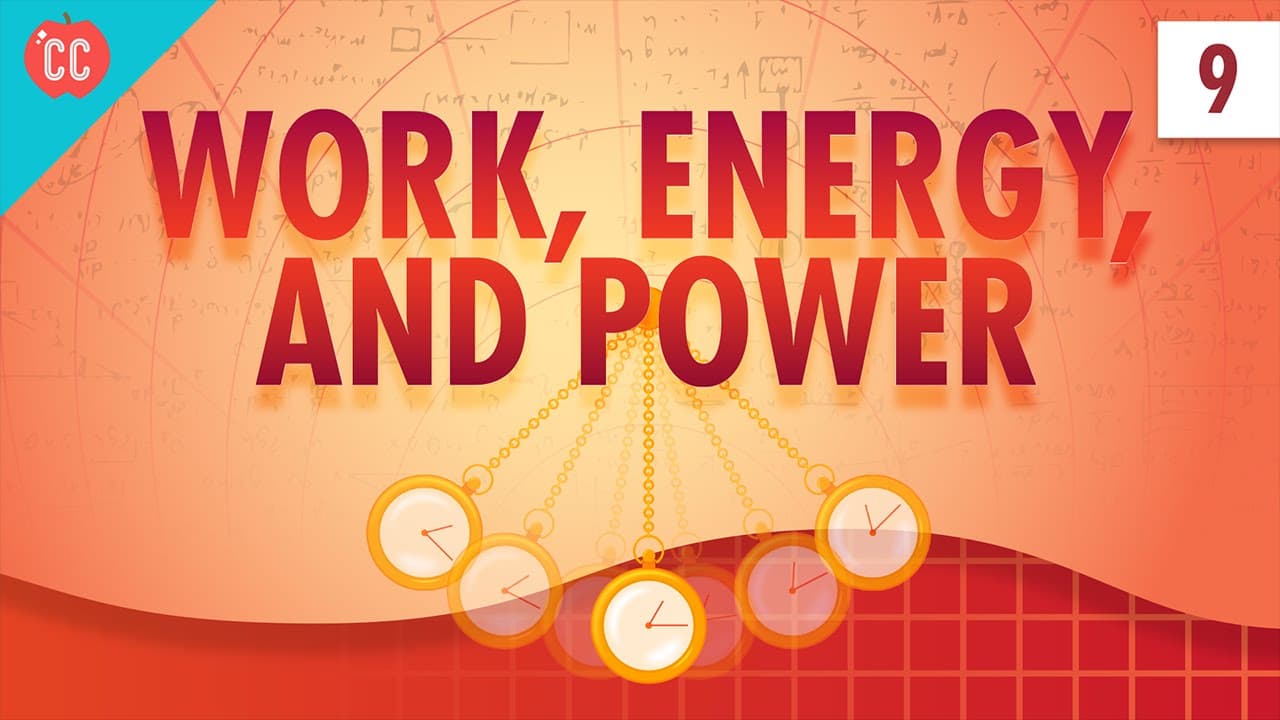
Work in physics is defined as the application of force over a distance, calculated as force times distance, and is measured in Joules. Energy, the ability to do work, can be kinetic or potential, and the concept of power describes the rate of doing work over time, measured in Watts. Understanding these principles is essential for exploring topics like electricity.
Transcript
When I say “work,” what’s the first thing that comes to mind? Maybe a cubicle? Or a briefcase? Or that history exam that’s coming up soon? But if you’re a physicist, work has a very specific meaning -- one that has very little to do with spreadsheets or the fall of the Roman Empire. Today, we’re going to explore that definition -- and how it connec... Read More
Key Insights
- In physics, 'work' is defined as applying a force over a distance, differing from common interpretations related to jobs or tasks.
- Work is calculated as the product of force and distance, and is measured in Joules, which are also units of energy.
- When force is applied at an angle, only the component parallel to the direction of movement contributes to work.
- Energy, defined as the ability to do work, can be kinetic (motion) or potential (stored), with specific formulas for each type.
- Conservative systems, like pendulums, conserve total mechanical energy, while non-conservative systems lose energy to factors like friction.
- Power is the rate of doing work, measured in Watts, and can be calculated as work over time or force times velocity.
- Gravitational potential energy is calculated using mass, gravity, and height, while spring potential energy uses Hooke's Law.
- Understanding power is vital for discussing electricity and energy conversion in circuits, topics for future exploration.
Install to Summarize YouTube Videos and Get Transcripts
Explore YouTube Video Summarizer or Get YouTube Transcript Extractor
Questions & Answers
Q: What is the physics definition of work?
In physics, work is defined as the application of a force over a certain distance. It is calculated by multiplying the force applied by the distance over which it is applied. This definition differs significantly from the everyday use of the word 'work,' which often refers to tasks or employment.
Q: How is work calculated when force is applied at an angle?
When force is applied at an angle, only the component of the force that is parallel to the direction of movement contributes to work. This component is found by multiplying the force by the cosine of the angle between the force and the direction of movement. The work is then calculated as this component times the distance.
Q: What is the relationship between work and energy?
Work and energy are closely related, as work is a change in energy. When work is done on a system, it changes the energy of that system. Energy is the ability to do work, and it is measured in the same units as work, which are Joules. This relationship is fundamental to understanding energy conservation.
Q: How do kinetic and potential energy differ?
Kinetic energy is the energy of motion, calculated as half the mass of an object times its velocity squared. Potential energy, on the other hand, is stored energy that has the potential to do work. Gravitational potential energy is a common form, calculated using mass, gravity, and height. Both types of energy are integral to understanding work.
Q: What distinguishes conservative from non-conservative systems?
Conservative systems are those that do not lose energy through work, meaning their total mechanical energy is conserved. An example is a pendulum, where energy shifts between kinetic and potential forms. Non-conservative systems, like those involving friction, lose energy to the surroundings, often as heat, and do not conserve total mechanical energy.
Q: How is power defined and calculated in physics?
Power in physics is defined as the rate at which work is done, measured in Watts, equivalent to Joules per second. It can be calculated as work divided by time or as the product of force and velocity. Understanding power is crucial for analyzing energy conversion processes, especially in electrical circuits.
Q: What is gravitational potential energy and how is it calculated?
Gravitational potential energy is the energy an object possesses due to its position in a gravitational field. It is calculated as the product of the object's mass, the acceleration due to gravity, and its height above a reference point, often ground level. This energy represents the work gravity can do on the object if it falls.
Q: How does Hooke's Law relate to spring potential energy?
Hooke's Law states that the force exerted by a spring is proportional to its displacement, with the spring constant as the proportionality factor. Spring potential energy is calculated using Hooke's Law by integrating the force over the displacement, resulting in half the spring constant times the displacement squared. This energy is stored as the spring is compressed or stretched.
Summary & Key Takeaways
-
This episode of Crash Course Physics explores the concept of work in physics, explaining how it involves applying force over a distance. The episode also introduces energy, particularly kinetic and potential energy, and explains how work is related to changes in energy.
-
The video explains how work can be calculated when force is applied at an angle, using vector components. It also discusses the difference between conservative and non-conservative systems, highlighting how energy conservation works in systems like pendulums.
-
Power, defined as work done over time, is introduced with examples showing how it's measured in Watts. The episode concludes with a preview of how power relates to electricity, setting the stage for future discussions on circuits.
Read in Other Languages (beta)
Share This Summary 📚
Summarize YouTube Videos and Get Video Transcripts with 1-Click
Try YouTube Summary with ChatGPT & Claude or YouTube Transcript Generator
Explore More Summaries from CrashCourse 📚



Summarize YouTube Videos and Get Video Transcripts with 1-Click
Try YouTube Summary with ChatGPT & Claude or YouTube Transcript Generator