Graphs, Vectors and Machine Learning - Computerphile
TL;DR
This video explores machine learning algorithms for analyzing graphs, including vertex histograms and graph kernel algorithms, highlighting the complexities and challenges of working with graph data.
Transcript
so today I want to talk to you about some machine learning algorithms there are really not much discussed for example we talk a lot about how to work with text for example right so for example if I have some text and I want to predict maybe the next word or something and those are large language models for example that we see a lot out there maybe ... Read More
Key Insights
- 🎰 Machine learning algorithms can be applied to graphs to analyze complex relationships and structures within the data.
- 📈 Vertex histograms count occurrences of specific patterns in graphs and create feature vectors for similarity analysis.
- ⚾ Graph kernel algorithms measure similarity based on patterns and relationships within the graph's structure.
- 💁 Graph analysis algorithms have limitations and require careful consideration of what information to keep or discard.
- ❓ Overfitting can occur when algorithms focus too much on fine-grained details of the training data.
- 🫥 Inner products (dot products) are used to compare feature vectors and measure similarity between graphs.
- 🎰 Graph kernel matrices capture the similarities between all pairs of graphs and can be used in algorithms like support vector machines (SVMs).
Install to Summarize YouTube Videos and Get Transcripts
Explore YouTube Video Summarizer or Get YouTube Transcript Extractor
Questions & Answers
Q: How are graph models different from other types of machine learning models?
Graph models represent relationships between entities using nodes and edges, allowing for a more nuanced understanding of complex relationships. Unlike other models that work with vectors or tables, graph models capture the network structure and connections between entities.
Q: Can graph analysis algorithms be applied to other types of data besides graphs?
While graph analysis algorithms are specifically designed for working with nodes and edges, they can also be used to analyze certain types of data that can be represented as graphs, such as molecule structures or social networks. However, they may not be suitable for analyzing data that do not have a network structure.
Q: How do vertex histograms work in graph analysis?
Vertex histograms count the occurrences of specific patterns in a graph, such as the number of nodes with a certain color or the number of neighbors with certain attributes. These histograms create a feature vector that represents the graph, which can be compared to other graphs to measure similarity.
Q: How do graph kernel algorithms measure similarity between graphs?
Graph kernel algorithms consider patterns and relationships within a graph's structure. By comparing patterns like node colors and neighbor relationships, these algorithms generate similarity scores that indicate how similar or different two graphs are.
Summary & Key Takeaways
-
The video discusses different types of machine learning algorithms that are commonly used for analyzing graphs, such as those for working with text, images, tabular data, and graphs themselves.
-
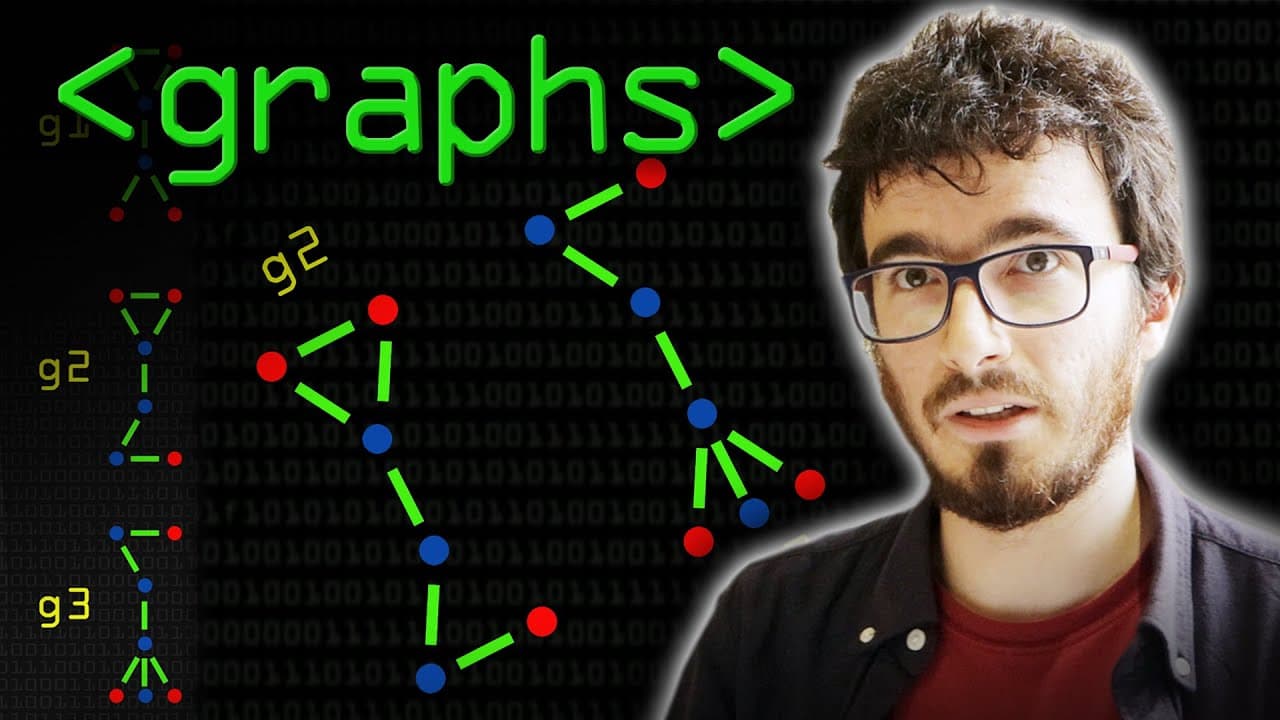
Graphs are represented by nodes (color blobs) and edges (connections between nodes), which can be used to model various real-world scenarios like molecules or friendship networks.
-
Two specific algorithms, vertex histograms and graph kernel algorithms, are introduced and explained in the context of measuring similarity between graphs.
Read in Other Languages (beta)
Share This Summary 📚
Summarize YouTube Videos and Get Video Transcripts with 1-Click
Try YouTube Summary with ChatGPT & Claude or YouTube Transcript Generator
Explore More Summaries from Computerphile 📚





Summarize YouTube Videos and Get Video Transcripts with 1-Click
Try YouTube Summary with ChatGPT & Claude or YouTube Transcript Generator