What Was the Scientific Revolution?
TL;DR
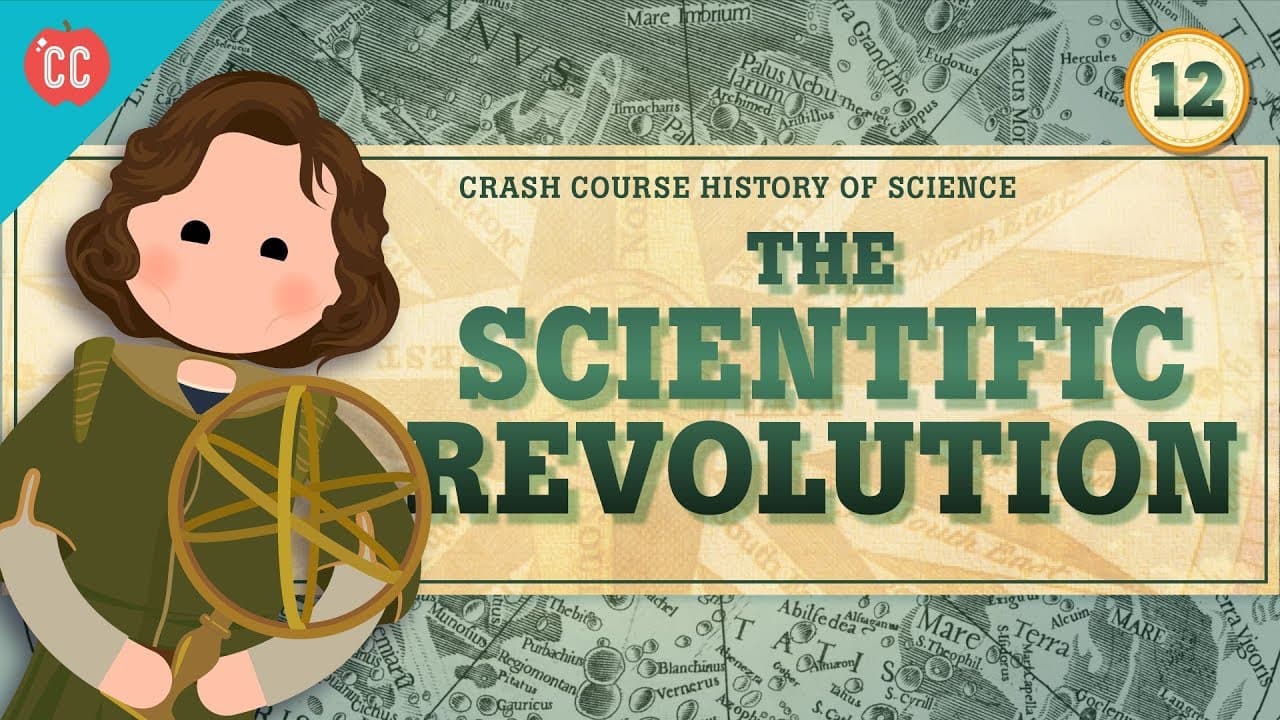
The Scientific Revolution is often seen as a transformative period from the mid-1500s to 1700, marked by paradigm shifts in scientific thought. Key figures like Copernicus and Oresme contributed to this era by challenging existing ideas, although the term 'Scientific Revolution' was coined much later. The revolution's impact was more about changing scientific paradigms than immediate societal shifts.
Transcript
You’ve probably heard about a Scientific Revolution in Europe, lasting from roughly the mid-1500s to 1700. And we have some very good stories to tell from this period. But first, let’s talk historiography, or how historians have told history differently over time. The trope of the Scientific Revolution is a useful tool for organizing events in our ... Read More
Key Insights
- The Scientific Revolution is often considered a period from the mid-1500s to 1700.
- Thomas Kuhn argued that scientific revolutions occur when existing paradigms cannot explain new data.
- Nicolaus Copernicus proposed a heliocentric model, challenging the geocentric views of Ptolemy.
- Nicole Oresme, before Copernicus, argued for heliocentrism but did not push his ideas forward.
- Copernicus's work was not based on new observations but on reinterpreting existing ideas.
- The term 'Scientific Revolution' was coined in the 19th century to describe changes in scientific thought.
- The revolution's impact was more significant in academic circles than in immediate societal changes.
- Historians debate whether the Scientific Revolution was truly a revolution due to its gradual nature.
Install to Summarize YouTube Videos and Get Transcripts
Explore YouTube Video Summarizer or Get YouTube Transcript Extractor
Questions & Answers
Q: What was the Scientific Revolution?
The Scientific Revolution refers to a period from the mid-1500s to 1700, marked by significant changes in scientific thought. It involved paradigm shifts where new ideas challenged existing models, such as Copernicus's heliocentric theory. Although the term was coined later, it describes a time when scientific inquiry began to rely more on observation and experimentation.
Q: Who were key figures in the Scientific Revolution?
Key figures in the Scientific Revolution include Nicolaus Copernicus, who proposed the heliocentric model, and Nicole Oresme, who argued for heliocentrism before him. Other notable figures are Galileo Galilei and Isaac Newton, who further developed scientific ideas. These individuals challenged existing paradigms and contributed to shifts in scientific thought.
Q: Why is Copernicus's heliocentric model significant?
Copernicus's heliocentric model is significant because it challenged the long-held geocentric views of Ptolemy, proposing instead that the Earth and other planets revolve around the Sun. This model simplified astronomical calculations and paved the way for further scientific advancements, despite initial resistance due to religious and philosophical beliefs.
Q: What role did Thomas Kuhn play in understanding scientific revolutions?
Thomas Kuhn played a crucial role in understanding scientific revolutions through his work 'The Structure of Scientific Revolutions.' He argued that scientific progress occurs via paradigm shifts, where existing models are replaced due to accumulating anomalies. Kuhn's ideas have shaped the history and philosophy of science, highlighting how revolutions transform scientific understanding.
Q: How did the Scientific Revolution impact society?
The immediate societal impact of the Scientific Revolution was limited, as its ideas primarily circulated in academic circles. However, it laid the groundwork for modern science by promoting observation and experimentation over reliance on authority. Over time, these changes influenced technological advancements and philosophical perspectives, gradually altering societal views on knowledge.
Q: What challenges did Copernicus face with his heliocentric theory?
Copernicus faced significant challenges with his heliocentric theory, including resistance from religious authorities and adherence to Aristotelian and Ptolemaic models. Many considered his ideas blasphemous, and he feared ridicule. To mitigate backlash, Copernicus delayed publishing his work until near his death, and it was initially presented as a hypothetical model.
Q: How did Nicole Oresme contribute to early scientific thought?
Nicole Oresme contributed to early scientific thought by advocating for heliocentrism and criticizing astrology as a predictive science. He pioneered using mathematical graphs to describe motion and anticipated some of Galileo's work on falling objects. Despite his insights, Oresme's ideas did not gain traction during his time, partly due to his reluctance to promote them.
Q: Why is the term 'Scientific Revolution' debated among historians?
The term 'Scientific Revolution' is debated among historians because it implies a singular, rapid transformation, whereas the changes in scientific thought were gradual and varied across regions. Some historians argue that multiple revolutions occurred in different places and times, making the concept of a single revolution less accurate. The term was also coined retrospectively, influencing its interpretation.
Summary & Key Takeaways
-
The Scientific Revolution is characterized by significant changes in scientific thought from the mid-1500s to 1700. Key figures like Copernicus and Oresme challenged existing paradigms, leading to new understandings of the cosmos. However, the term 'Scientific Revolution' was coined later, and its impact was more academic than societal.
-
Thomas Kuhn's theory of scientific revolutions suggests that paradigm shifts occur when current models cannot explain new data. Copernicus's heliocentric model exemplified this by challenging the geocentric views of Ptolemy, although it was initially resisted due to religious and philosophical beliefs.
-
The idea of a single Scientific Revolution is debated, as similar shifts occurred in different places and times. The revolution's significance lies in changing how knowledge was pursued, moving away from Aristotelian views and embracing experimental methods, facilitated by the spread of printed works.
Read in Other Languages (beta)
Share This Summary 📚
Summarize YouTube Videos and Get Video Transcripts with 1-Click
Try YouTube Summary with ChatGPT & Claude or YouTube Transcript Generator
Explore More Summaries from CrashCourse 📚

Summarize YouTube Videos and Get Video Transcripts with 1-Click
Try YouTube Summary with ChatGPT & Claude or YouTube Transcript Generator