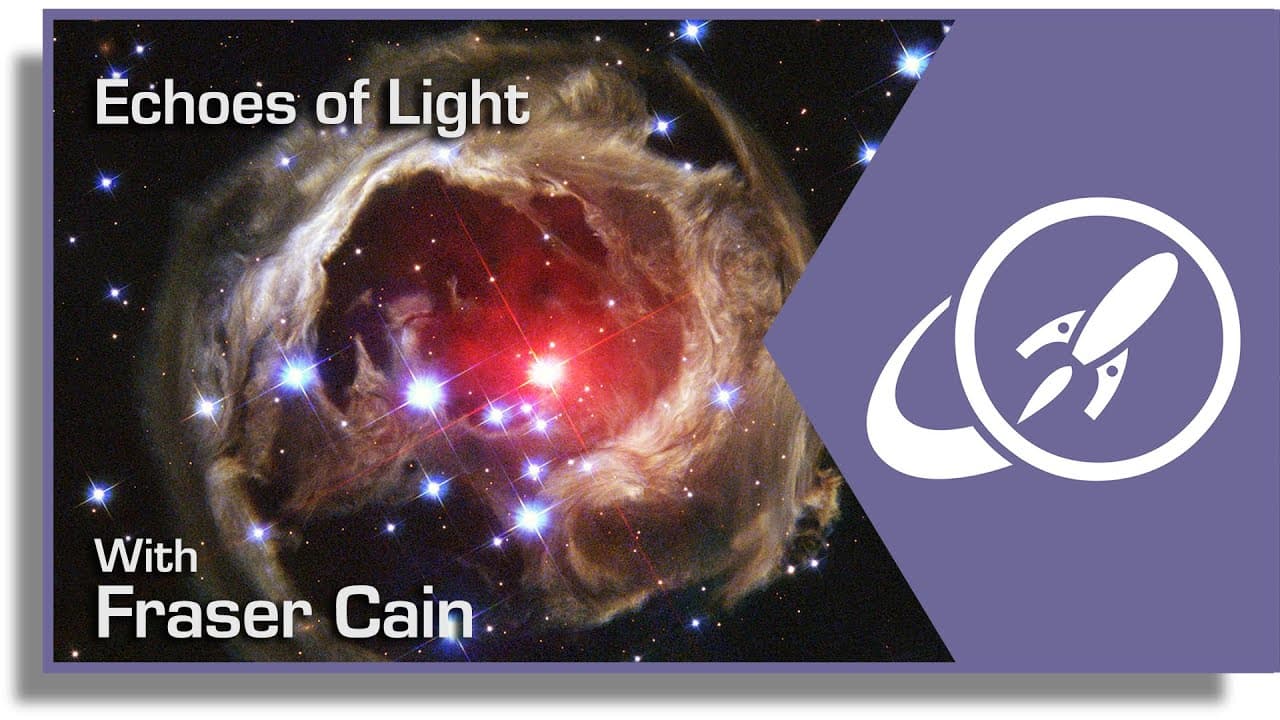
What Are Light Echoes? Using Reflections Of Light To See Even Further Back In Time
TL;DR
Light echoes, reflections off gas and dust, help astronomers study distant cosmic objects and events.
Transcript
When we look outward into space, we’re looking backwards in time. That’s because light moves, at the speed of light. It takes time for the light to reach us. But it gets even stranger than that. Light can be absorbed, reflected, and re-emitted by gas and dust, giving us a second look. They’re called light echoes, and allow astronomers another way t... Read More
Key Insights
- 🙂 Light echoes are reflections of light off gas and dust in space, offering valuable information about cosmic objects and events.
- 🙂 Radar technology, lasers, and modern observatories help astronomers detect and study light echoes from various celestial sources.
- ✴️ Light echoes have been pivotal in studying supernovae, black holes, young stars, protoplanetary disks, and galactic collisions.
- 🙂 Reflections of light from distant objects provide insights into their nature, composition, and surrounding environment.
- 🚦 Light echoes allow astronomers to measure distances, map planetary surfaces, and study the dynamics of cosmic phenomena.
- 🙂 The constant speed of light enables researchers to explore the Universe through light echoes, uncovering hidden details of space.
- 🙂 Light echoes from events like supernovae and black hole flares offer a unique perspective on the processes occurring in the cosmos.
Install to Summarize YouTube Videos and Get Transcripts
Explore YouTube Video Summarizer or Get YouTube Transcript Extractor
Questions & Answers
Q: What are light echoes, and how do they help astronomers study the Universe?
Light echoes are reflections of light off gas and dust in space, providing additional insight into distant cosmic objects and events. Astronomers use various technologies to detect and analyze these echoes, enhancing their understanding of the Universe.
Q: How is radar technology utilized in studying light echoes?
Radar technology bounces radio signals off objects in space to map them out, allowing astronomers to determine distances and gather information about planetary surfaces. It has been instrumental in studying asteroids and planets like 3200 Phaethon.
Q: How do lasers play a role in measuring distances using reflected light?
Scientists use lasers to measure the distance to the Moon by detecting reflected light from retroreflectors placed by astronauts during the Apollo missions. By calculating the time taken for the light to return, they can accurately determine the Moon's distance.
Q: How have light echoes contributed to understanding events like supernovae and black holes?
Light echoes have allowed astronomers to study events like supernovae explosions and black hole flares in detail. By observing the reflections of light moving through space, researchers can analyze the surrounding environment and dynamics of these phenomena.
Summary & Key Takeaways
-
Light echoes, reflections of light off gas and dust, enable astronomers to gain insights into the Universe.
-
Radar technology, lasers, and powerful observatories are used to detect and study light echoes from various celestial phenomena.
-
Light echoes have been instrumental in studying supernovae, black holes, young stars, protoplanetary disks, and even galactic collisions.
Read in Other Languages (beta)
Share This Summary 📚
Summarize YouTube Videos and Get Video Transcripts with 1-Click
Try YouTube Summary with ChatGPT & Claude or YouTube Transcript Generator
Explore More Summaries from Fraser Cain 📚




Summarize YouTube Videos and Get Video Transcripts with 1-Click
Try YouTube Summary with ChatGPT & Claude or YouTube Transcript Generator