Making artificial earthquakes with a huge steel ball
TL;DR
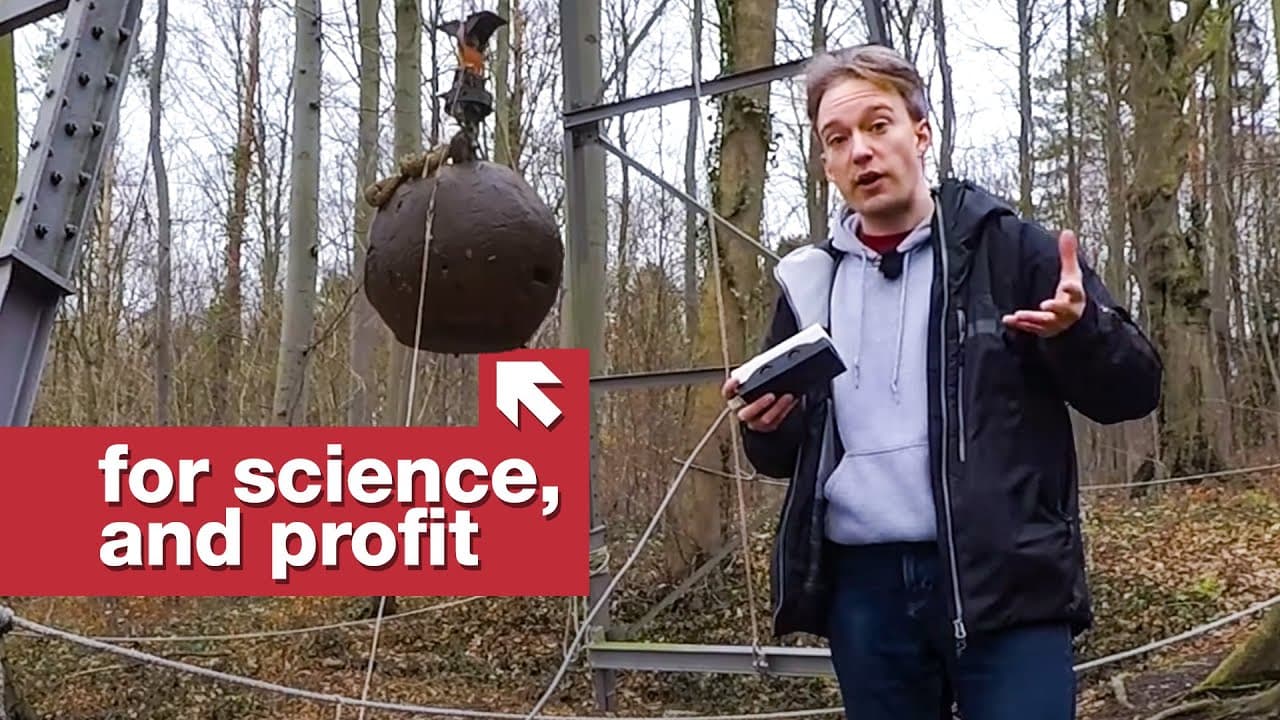
The oldest working seismic station in the world has a unique four-ton steel ball that can be dropped to create earthquakes for calibration and research purposes.
Transcript
I'm at Wiechert's Earthquake Observatory in Göttingen, Germany. This is the oldest working seismic station, — earthquake detector — in the world. But there's also a more unusual bit of scientific equipment here: a four-ton steel ball that can be raised up 14 metres above the ground and then dropped, because it's a lot easier to set up and calibrate... Read More
Key Insights
- 🥶 The Wiechert's Earthquake Observatory in Germany is the oldest functioning seismic station in the world.
- 🔼 A four-ton steel ball can be raised and dropped at the observatory to create small artificial earthquakes for research and calibration purposes.
- 🌊 Seismic waves, including P-waves and S-waves, provide valuable information about the ground and the Earth's interior.
- 🛢️ Mintrop, Wiechert's assistant, used seismic technology to accurately measure the size of an oil field in Mexico.
- 🫤 The seismic experiments conducted a century ago laid the foundation for modern techniques for studying the Earth's interior.
- 😌 The ability to create artificial earthquakes allowed researchers to build a picture of what lay beneath the Earth's surface without extensive digging.
- 💬 The steel ball experiment conducted in Wiechert's Earthquake Observatory inspired advancements in seismic research worldwide.
Install to Summarize YouTube Videos and Get Transcripts
Explore YouTube Video Summarizer or Get YouTube Transcript Extractor
Questions & Answers
Q: What is the purpose of the four-ton steel ball at the Wiechert's Earthquake Observatory?
The steel ball is used to create small artificial earthquakes for calibration and testing seismic detectors. It helps scientists understand seismic waves and gather data without having to rely solely on natural earthquakes.
Q: How do P-waves and S-waves differ in their movement through the ground?
P-waves compress the ground back and forth in the direction of wave travel, while S-waves shear the ground side-to-side. Their behavior varies depending on the characteristics of the ground they traverse.
Q: How did Mintrop, Wiechert's assistant, prove his theory using the steel ball?
Mintrop calculated that dropping the four-ton steel ball would create a small earthquake and allow him to study seismic waves. This experiment helped validate Wiechert's theory that seismic waves provide insights into the Earth's interior.
Q: How did Mintrop use seismic technology in Mexico with oil drilling?
Mintrop accepted an invitation from an oil-drilling company in Mexico and used seismic technology to accurately measure the size of an oil field. This successful application garnered attention and earned him the nickname "The Crazy German."
Summary & Key Takeaways
-
The Wiechert's Earthquake Observatory in Germany is the oldest working seismic station that started operating in 1903.
-
The observatory has a four-ton steel ball that can be raised and dropped to create small earthquakes for testing.
-
By using seismic detectors and studying the reflections from within the Earth, researchers can build a picture of what lies beneath the surface without the need for extensive digging.
Read in Other Languages (beta)
Share This Summary 📚
Summarize YouTube Videos and Get Video Transcripts with 1-Click
Try YouTube Summary with ChatGPT & Claude or YouTube Transcript Generator
Explore More Summaries from Tom Scott 📚





Summarize YouTube Videos and Get Video Transcripts with 1-Click
Try YouTube Summary with ChatGPT & Claude or YouTube Transcript Generator