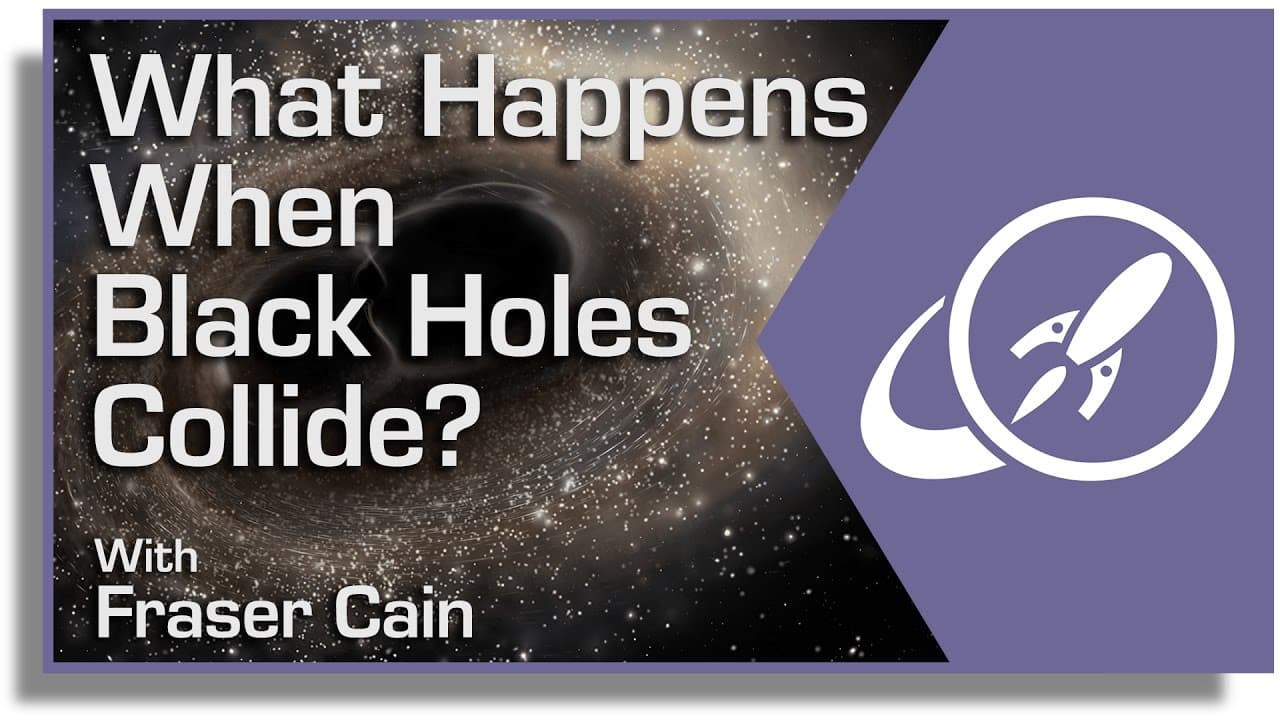
What Happens When Black Holes Collide? Black Hole Mergers Across The Universe
TL;DR
Einstein's theory of Relativity predicts the collision of black holes, confirmed by LIGO in 2016.
Transcript
The sign of a truly great scientific theory is by the outcomes it predicts when you run experiments or perform observations. And one of the greatest theories ever proposed was the concept of Relativity, described by Albert Einstein in the beginning of the 20th century. In addition to helping us understand that light is the ultimate speed limit of t... Read More
Key Insights
- 🖤 Black hole collisions confirm Einstein's theory of Relativity's predictions about gravity and spacetime.
- 🖤 LIGO's detection of gravitational waves from black hole collisions marks a significant milestone in astrophysics.
- ⬛ Stellar mass and supermassive black holes can collide, leading to the formation of larger black holes.
- 🖤 The collision and merging of black holes release energy in the form of gravitational waves, detectable across vast distances.
- 🖤 Black hole collisions provide valuable information about the dynamics of galaxies and the evolution of the Universe.
- 🖤 The future merger of the Milky Way and Andromeda galaxies, including their black holes, exemplifies the continuous process of cosmic evolution.
- 🤗 The study of black hole collisions opens avenues for further research into extreme astrophysical events and the behavior of gravity.
Install to Summarize YouTube Videos and Get Transcripts
Explore YouTube Video Summarizer or Get YouTube Transcript Extractor
Questions & Answers
Q: What is the significance of Einstein's theory of Relativity in predicting black hole collisions?
Einstein's theory predicted that the collision of massive objects like black holes would generate gravitational waves, which were detected by LIGO, confirming the theory.
Q: How do black hole collisions occur and what is their outcome?
Black hole collisions happen when two black holes emit gravitational waves, causing them to spiral together until they merge into a larger black hole, releasing energy in the form of gravitational waves.
Q: Can supermassive black holes collide like stellar mass black holes?
Yes, supermassive black holes at the center of galaxies can also collide, as observed with the Milky Way and Andromeda galaxies, eventually merging into larger black holes.
Q: What are the implications of these black hole collisions for our understanding of the Universe?
Studying black hole collisions provides insights into the behavior of gravity, spacetime, and the formation of massive objects in the Universe, confirming theoretical predictions made by Einstein.
Summary & Key Takeaways
-
Einstein's theory of Relativity predicted that massive objects moving through spacetime would generate gravitational waves.
-
LIGO detected gravitational waves from the collision of two black holes, confirming Einstein's predictions.
-
Stellar mass and supermassive black holes can collide, creating even larger black holes.
Read in Other Languages (beta)
Share This Summary 📚
Summarize YouTube Videos and Get Video Transcripts with 1-Click
Try YouTube Summary with ChatGPT & Claude or YouTube Transcript Generator
Explore More Summaries from Fraser Cain 📚


Summarize YouTube Videos and Get Video Transcripts with 1-Click
Try YouTube Summary with ChatGPT & Claude or YouTube Transcript Generator