What Is Direct Variation and How Do You Solve It?
TL;DR
Direct variation is a linear relationship where one variable changes directly in proportion to another, represented by the equation y = Kx, with K as the constant of variation. To find K, divide y by x for each pair of values; if K remains consistent, y varies directly with x, allowing for the calculation of dependent values.
Transcript
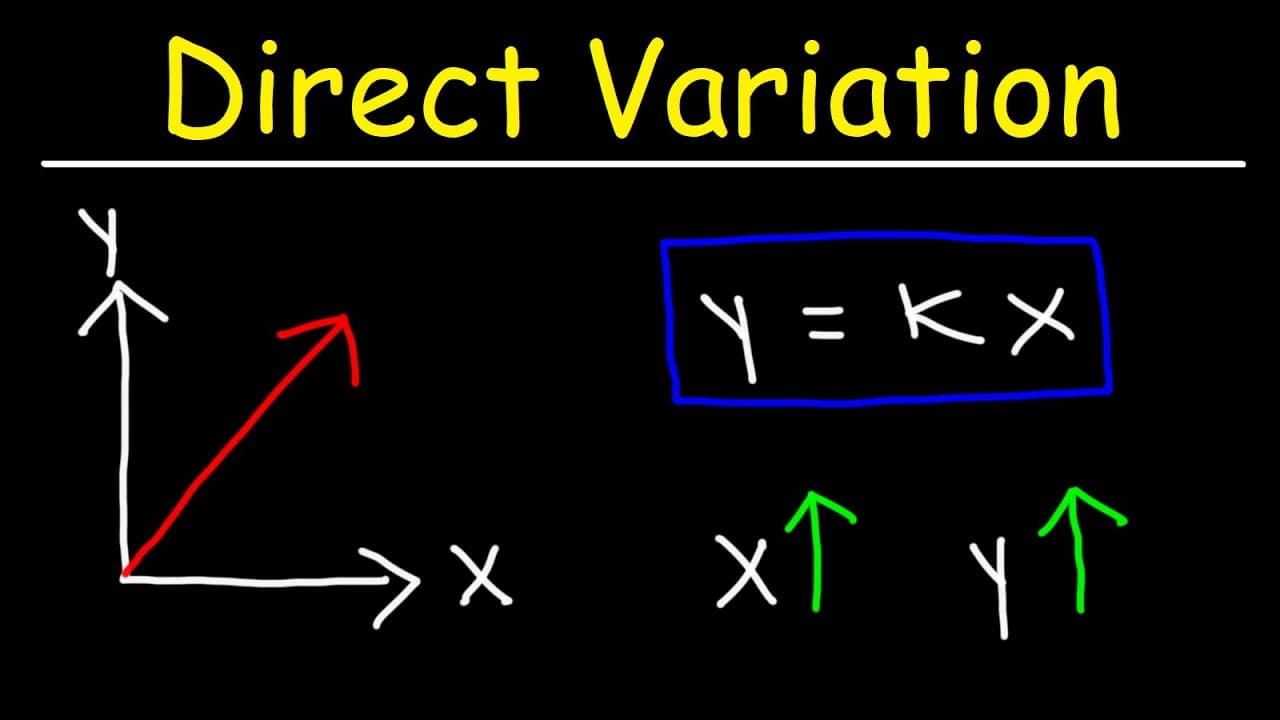
in this video we're going to talk about direct variation what is that direct variation is the relationship between two variables in this case X and Y here's a graph X is the independent variable Y is the dependent variable when y varies directly with X we're going to have is a linear relationship the equation that corresponds to it is y is equal to... Read More
Key Insights
- 🫡 Direct variation is a linear relationship between two variables, where one changes directly and proportionally with respect to the other.
- ❣️ The equation y = Kx represents direct variation, with y as the dependent variable, x as the independent variable, and K as the constant of variation.
- 👌 By calculating the constant of variation, K, you can determine the value of the dependent variable for any given value of the independent variable.
- 👌 The constant of variation, K, can be calculated by dividing the value of the dependent variable by the value of the independent variable in a given situation.
- ❣️ In a table of values, if the constant of variation, K, remains the same for every pair of x and y values, then y varies directly with x.
- 🌍 Direct variation can be used to solve real-world problems by establishing a relationship between two variables and finding the value of the dependent variable for a given value of the independent variable.
- 👻 Understanding direct variation allows for the interpretation and analysis of graphs, equations, and real-world scenarios involving proportional relationships.
Install to Summarize YouTube Videos and Get Transcripts
Explore YouTube Video Summarizer or Get YouTube Transcript Extractor
Questions & Answers
Q: What is direct variation?
Direct variation is a linear relationship between two variables, where one variable varies directly with the other at a proportional rate. The equation y = Kx represents this relationship, with y as the dependent variable, x as the independent variable, and K as the constant of variation.
Q: How do you calculate the constant of variation?
To calculate the constant of variation, K, divide the value of the dependent variable, y, by the value of the independent variable, x, in the given situation. This gives you the rate at which y changes with respect to x.
Q: How do you determine if y varies directly with x using a table of values?
To determine if y varies directly with x using a table of values, calculate the constant of variation, K, for each pair of x and y values. If K remains the same for every pair, then y varies directly with x. If K differs for any pair, then y does not vary directly with x.
Q: How can direct variation be used to solve real-world problems?
Direct variation can be used to solve real-world problems by establishing a relationship between two variables and finding the constant of variation. By substituting known values into the equation y = Kx, you can determine the value of y for a given value of x.
Summary & Key Takeaways
-
Direct variation is a type of linear relationship between two variables, where one variable depends on the other.
-
The equation y = Kx represents direct variation, where y is the dependent variable, x is the independent variable, and K is the constant of variation.
-
By calculating the constant of variation, K, and substituting it into the equation, you can find the value of the dependent variable for a given independent variable.
Read in Other Languages (beta)
Share This Summary 📚
Summarize YouTube Videos and Get Video Transcripts with 1-Click
Try YouTube Summary with ChatGPT & Claude or YouTube Transcript Generator
Explore More Summaries from The Organic Chemistry Tutor 📚

Summarize YouTube Videos and Get Video Transcripts with 1-Click
Try YouTube Summary with ChatGPT & Claude or YouTube Transcript Generator