A Tour Of The Lagrange Points. Part 2 - Space Telescopes At L2 And Nothing At L3
TL;DR
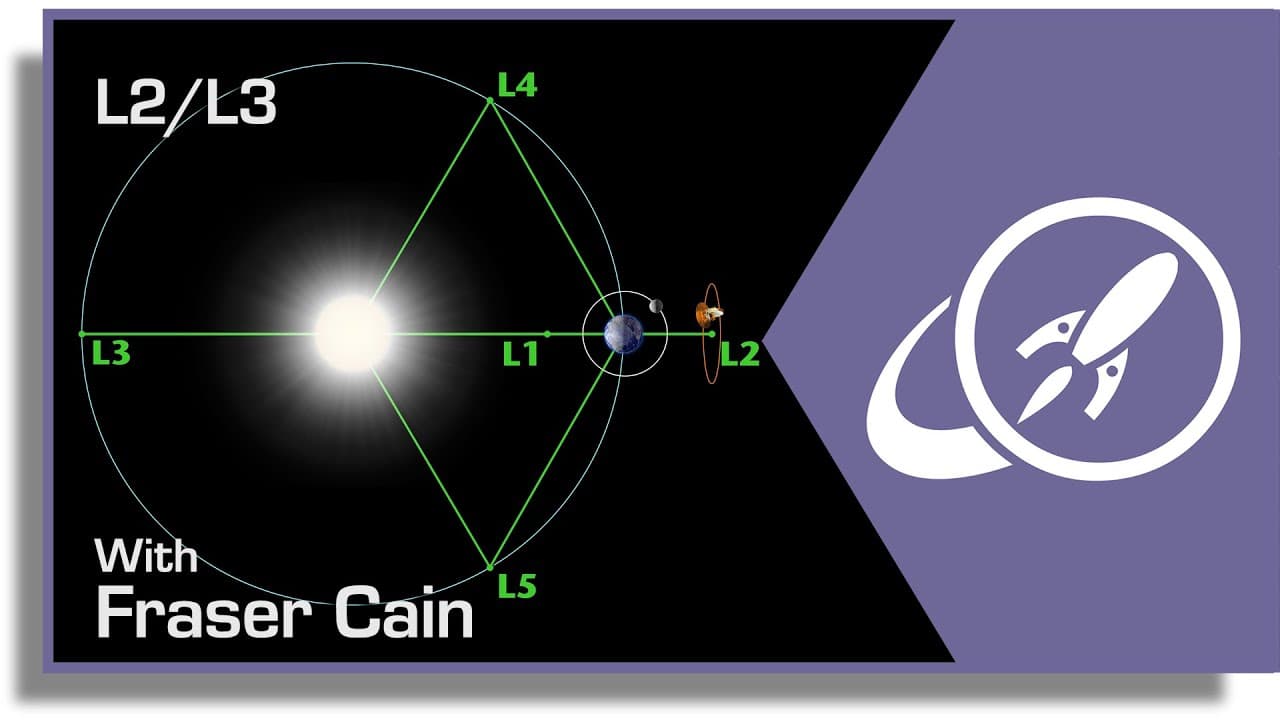
Lagrange points L2 and L3 explored for spacecraft missions with potential uses in space observation and future mission planning.
Transcript
Lagrange points stable spots in space that you just can't stop thinking about what spacecraft work best in which places what are some amazing ideas that could use these regions across the solar system in the last episode I gave an overview of the Lagrangian and then went into the details of spacecraft missions sent to l1 the perfect place to consta... Read More
Key Insights
- 😥 Lagrange points L2 and L3 offer unique locations in space for spacecraft missions with varying stability levels.
- 😒 L3 is unstable and has limited practical use, while L2 is stable and practical for scientific research and observations.
- 😥 Past spacecraft missions have utilized Lagrange point L2 for studying cosmic phenomena like cosmic background radiation, galaxy formations, and infrared observations.
- 😥 Future missions at Lagrange point L2 aim to further explore dark energy, galaxy movements, and exoplanets, expanding our understanding of the universe.
Install to Summarize YouTube Videos and Get Transcripts
Explore YouTube Video Summarizer or Get YouTube Transcript Extractor
Questions & Answers
Q: What are Lagrange points L2 and L3, and how do they differ in terms of stability?
Lagrange points L2 and L3 are locations in space where gravitational forces create stable or unstable positions for spacecraft. L3 is unstable due to gravitational interactions, while L2 is relatively stable for spacecraft missions.
Q: What are the practical uses of Lagrange point L2 for spacecraft missions?
Lagrange point L2 is used for spacecraft missions due to its stability and practical benefits. It allows for observatories and telescopes to observe celestial objects without interference and serves as a strategic location for future missions.
Q: How have past spacecraft missions utilized Lagrange point L2 for scientific research?
Past spacecraft missions like NASA's WMAP, Herschel Space Observatory, and ESA's Planck have used Lagrange point L2 to study cosmic microwave background radiation, infrared observations, and galaxy formations, providing valuable data for astronomers.
Q: What future missions are planned for Lagrange point L2 to further explore space?
Future missions like NASA's James Webb Space Telescope, ESA's Euclid, and Plato mission plan to use Lagrange point L2 for observing galaxies, dark energy, and exoplanets, expanding our knowledge of the universe.
Summary & Key Takeaways
-
Lagrange points L2 and L3 offer unique locations in space for spacecraft missions.
-
L3 is unstable and has limited practical use due to gravitational instabilities.
-
L2 is a practical and popular choice for spacecraft missions with various observatories and telescopes stationed there.
Read in Other Languages (beta)
Share This Summary 📚
Summarize YouTube Videos and Get Video Transcripts with 1-Click
Try YouTube Summary with ChatGPT & Claude or YouTube Transcript Generator
Explore More Summaries from Fraser Cain 📚





Summarize YouTube Videos and Get Video Transcripts with 1-Click
Try YouTube Summary with ChatGPT & Claude or YouTube Transcript Generator