How to Implement Deep Deterministic Policy Gradients in TensorFlow
TL;DR
To implement Deep Deterministic Policy Gradients (DDPG) in TensorFlow, set up an actor and critic model, a replay buffer, and use the Ornstein-Uhlenbeck process for exploration noise. The learn function will handle the training process, updating both networks while leveraging target networks to stabilize learning and minimize bias. This setup effectively trains agents in environments with continuous action spaces.
Transcript
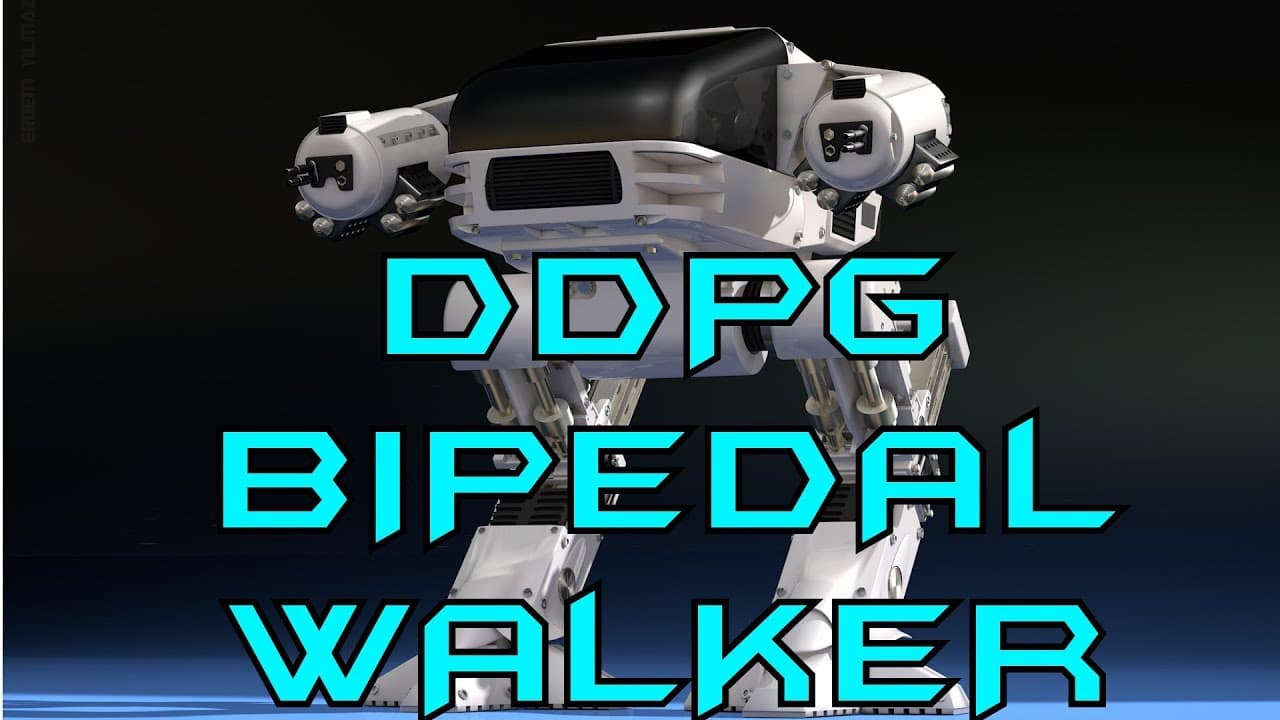
what's up everybody in this tutorial you were gonna see how we're gonna code deep deterministic policy gradients in tensor flow to teach an agent how to walk in the bipedal Walker environment you don't need any prior experience you don't really need to know anything about deep reinforcement learning you just have to be able to follow along grab a d... Read More
Key Insights
- 👾 Deep Deterministic Policy Gradients (DDPG) is a powerful algorithm for training agents in continuous action spaces.
- 🧑🏭 DDPG combines deep learning techniques with the actor-critic method to achieve better learning performance.
- 👻 The replay buffer is used to store and sample transitions, allowing the agent to update its action-value function more effectively.
- 🎯 Separate target networks are used to reduce maximization bias and improve the stability of the learning process.
- 🅰️ The Ornstein-Uhlenbeck process is a type of noise that models exploration in the DDPG algorithm.
- 🧑🏭 The learn() function is responsible for the training process, including updating the actor and critic networks.
Install to Summarize YouTube Videos and Get Transcripts
Explore YouTube Video Summarizer or Get YouTube Transcript Extractor
Questions & Answers
Q: What is the purpose of the Explorer-Exploit Dial Emma in deep reinforcement learning?
The Explorer-Exploit Dial Emma determines the balance between taking actions that exploit the current knowledge and exploring new actions. It is handled using action noise, such as the Ornstein-Uhlenbeck process, which adds randomness to actions.
Q: What is the purpose of the replay buffer in deep reinforcement learning?
The replay buffer stores transitions of states, actions, rewards, and new states encountered by the agent. It allows the agent to sample non-sequential memories to update its action-value estimation and improve learning stability.
Q: Why is it important to have separate target networks in deep reinforcement learning?
Separate target networks are used to reduce the maximization bias caused by updating a single network. By periodically updating the target networks with the parameters of the evaluation networks, the agent can more effectively learn the optimal action-value function.
Q: How does the Deep Deterministic Policy Gradients algorithm handle continuous action spaces?
The Deep Deterministic Policy Gradients algorithm uses a deterministic policy instead of a stochastic one. The actor network outputs the action directly, allowing the agent to choose continuous actions in the environment.
Summary & Key Takeaways
-
This tutorial explains how to implement deep deterministic policy gradients in TensorFlow to train an agent in the bipedal walker environment.
-
It provides an overview of the required imports, classes, and functions for the implementation.
-
The tutorial covers the creation of the actor, critic, replay buffer, and OU action noise classes, as well as their respective functions.
Read in Other Languages (beta)
Share This Summary 📚
Summarize YouTube Videos and Get Video Transcripts with 1-Click
Try YouTube Summary with ChatGPT & Claude or YouTube Transcript Generator
Explore More Summaries from Machine Learning with Phil 📚


Summarize YouTube Videos and Get Video Transcripts with 1-Click
Try YouTube Summary with ChatGPT & Claude or YouTube Transcript Generator