How Does the Double Slit Experiment Show That Light Is a Wave?
TL;DR
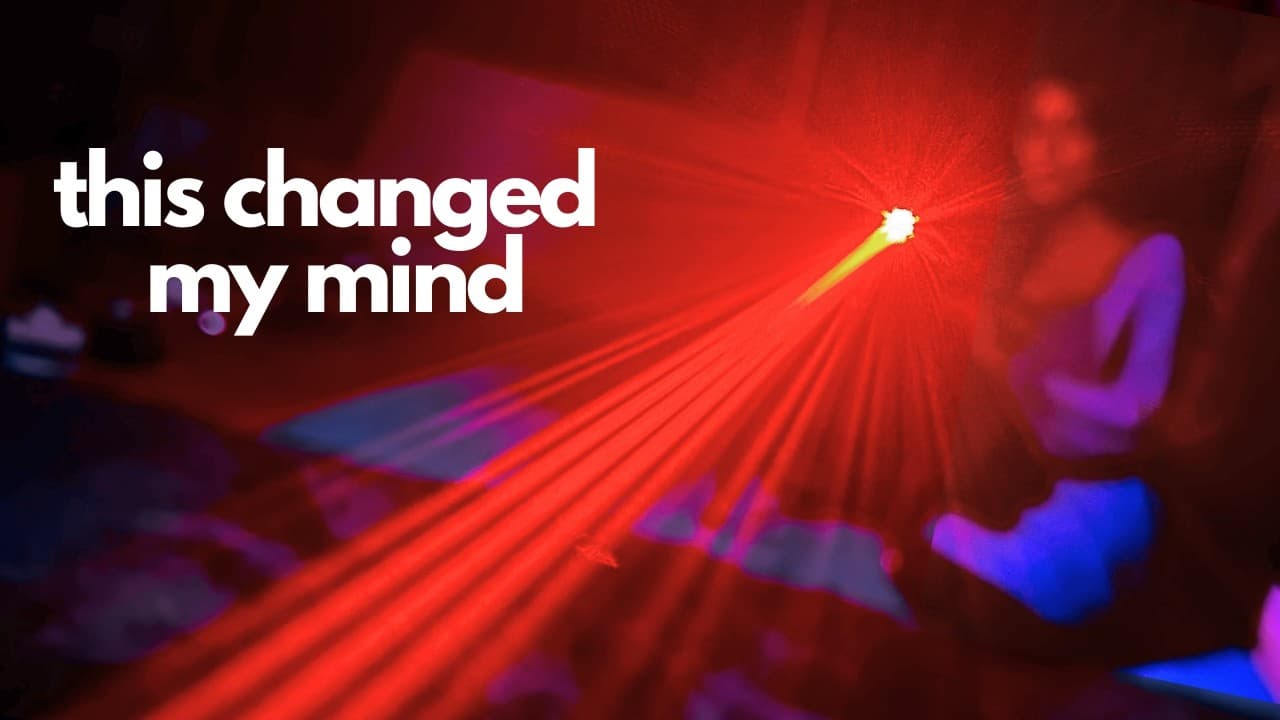
The double slit experiment reveals that light behaves like a wave, evidenced by patterns of light and dark created by interference. A variation using a hair instead of slits produces a similar pattern, demonstrating the wave-like properties of light, which cannot be adequately explained by traditional particle models.
Transcript
- How beautiful is this? This is an experiment in quantum mechanics called the double slit experiment but I really didn't expect to see this when I did it myself. And seeing this changed my mind on an important question in physics, what is light? But before all that, here's a simple experiment that you can do. All you'll need is a laser pointer and... Read More
Key Insights
- 🙂 The double slit experiment with a hair instead of slits demonstrates the wave properties of light.
- 🙂 Single slit interference plays a role in determining the pattern of light in the hair experiment.
- 🙂 The canceled out spots in the double slit experiment cannot be explained using a particle view of light.
Install to Summarize YouTube Videos and Get Transcripts
Explore YouTube Video Summarizer or Get YouTube Transcript Extractor
Questions & Answers
Q: How does the hair experiment differ from the double slit experiment?
In the hair experiment, the light passes through a single strand of hair, producing evenly spaced dashes of light. In the double slit experiment, the light passes through two narrow slits, creating a patchy pattern of dots. The difference is due to single slit interference in the hair experiment.
Q: What is single slit interference?
Single slit interference occurs when a wave, in this case, light, passes through a narrow opening. The wave spreads out and interferes with itself, creating a pattern of alternating light and dark regions. In the hair experiment, the interference causes the evenly spaced dashes of light.
Q: What is the significance of the canceled out spots in the double slit experiment?
The canceled out spots in the double slit experiment, where no light falls, cannot be explained using a particle view of light. Particles would be expected to reach those spots, but in the experiment, the interference of waves causes the particles to cancel each other out. This supports the wave view of light.
Q: How does the observed pattern in the double slit experiment demonstrate the wave-like behavior of light?
The pattern observed in the double slit experiment, with alternating spots of light and dark, corresponds to regions of wave interference. Waves, such as light waves, exhibit interference patterns, while particles do not. This suggests that light behaves more like a wave than a particle in the experiment.
Summary & Key Takeaways
-
The double slit experiment, a common quantum mechanics experiment, is usually conducted with light passing through two narrow slits. A variation of the experiment using a hair instead of slits produces similar patterns.
-
The pattern from the hair experiment shows evenly spaced dashes of light, while the pattern from the double slit experiment is more patchy due to a phenomenon called single slit interference.
-
The experiment demonstrates the wave-like behavior of light and raises questions about the traditional particle view of light.
Read in Other Languages (beta)
Share This Summary 📚
Summarize YouTube Videos and Get Video Transcripts with 1-Click
Try YouTube Summary with ChatGPT & Claude or YouTube Transcript Generator
Explore More Summaries from Looking Glass Universe 📚

Summarize YouTube Videos and Get Video Transcripts with 1-Click
Try YouTube Summary with ChatGPT & Claude or YouTube Transcript Generator