The most beautiful idea in physics - Noether's Theorem
TL;DR
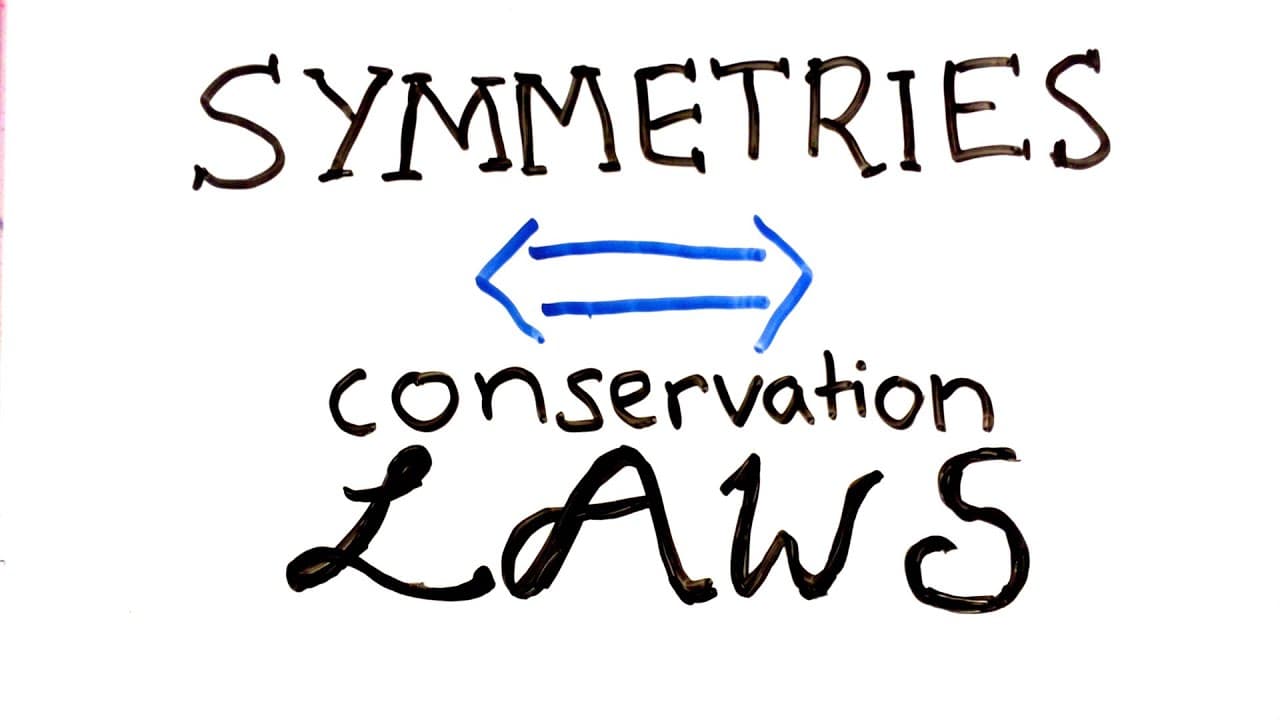
Emmy Noether's theorem shows that symmetries in the universe imply conservation laws, revealing the deep connection between the two.
Transcript
What if everything in the universe was actually a bit to the right of where it is now? Or if this orbiting planet was actually half a rotation ahead? What changes? More importantly what stays the same? These seem like fun but useless thought experiments until Emmy Noether discovered, what I think, is the most profound and far-reaching idea in physi... Read More
Key Insights
- 🪩 Symmetries in a system, including mirror, rotational, and translational symmetries, have profound implications for its behavior.
- 👮 Noether's theorem unveils the deep connection between symmetries and conservation laws, showing that symmetries imply the existence of conserved quantities.
- 🖐️ Conservation laws, such as the conservation of momentum and energy, play a crucial role in various branches of physics, including classical and quantum mechanics.
- ❓ Noether's theorem provides a mathematical framework to determine the conserved quantities associated with specific symmetries.
- 👻 The generality of Noether's theorem allows for the identification of conserved quantities in a wide range of physical systems, from individual particles to the entire universe.
- 👮 Noether's theorem not only explains the origin of conservation laws but also highlights their intrinsic nature and importance in understanding the natural world.
- 🦸 Noether's theorem has applications beyond classical physics and has contributed to the development of advanced concepts, such as super symmetry.
- 🥺 Exploring and understanding the symmetries and conserved quantities in different systems can lead to new insights in physics.
Install to Summarize YouTube Videos and Get Transcripts
Explore YouTube Video Summarizer or Get YouTube Transcript Extractor
Questions & Answers
Q: What is the significance of Emmy Noether's theorem in physics?
Emmy Noether's theorem demonstrates the profound connection between symmetries and conservation laws, providing a fundamental understanding of the behavior of physical systems.
Q: How does Noether's theorem define symmetry in a system?
According to Noether's theorem, symmetry in a system refers to the properties of the system that remain unchanged under specific transformations, such as rotation or translation.
Q: How does Noether's theorem relate to conservation laws?
Noether's theorem states that every symmetry in a system corresponds to a conservation law, meaning that certain quantities, such as momentum or energy, remain constant throughout the system's evolution.
Q: How can Noether's theorem be applied in classical physics?
In classical physics, Noether's theorem can be used to determine which quantities are conserved in a given system by identifying the symmetries present in the system and associating them with the corresponding conserved quantities.
Summary & Key Takeaways
-
Emmy Noether discovered a profound idea in physics that states symmetries in a system lead to conservation laws.
-
Symmetry can go beyond mirror symmetry and include rotational and translational symmetries.
-
Noether's theorem explains how symmetries in a system determine which quantities are conserved.
Read in Other Languages (beta)
Share This Summary 📚
Summarize YouTube Videos and Get Video Transcripts with 1-Click
Try YouTube Summary with ChatGPT & Claude or YouTube Transcript Generator
Explore More Summaries from Looking Glass Universe 📚






Summarize YouTube Videos and Get Video Transcripts with 1-Click
Try YouTube Summary with ChatGPT & Claude or YouTube Transcript Generator