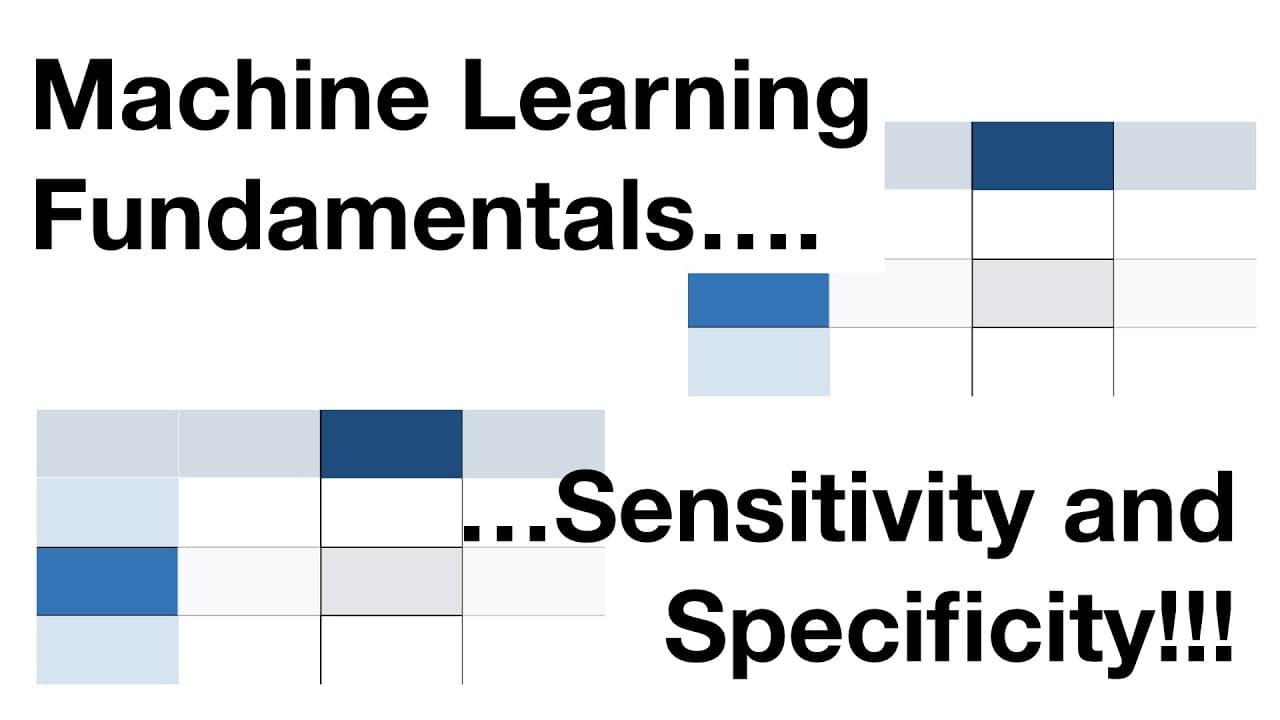
What Are Sensitivity and Specificity in Machine Learning?
TL;DR
Sensitivity is the percentage of true positive cases correctly identified by a model, while specificity measures the percentage of true negative cases correctly detected. Both metrics can be calculated using a confusion matrix, and the choice of modeling method should depend on whether correctly identifying positives or negatives is more crucial for the task.
Transcript
when the well runs dry you might be thirsty but this still StatQuest you can watch it StatQuest hello I'm Josh Starmar and welcome to StatQuest today we're gonna continue our series on machine learning fundamentals and we're going to talk about sensitivity and specificity they're gonna be clearly explained this StatQuest follows up on the one that ... Read More
Key Insights
- 🎰 Sensitivity and specificity are important metrics to evaluate the performance of machine learning models.
- 💼 Sensitivity measures the ability to correctly identify positive cases, while specificity measures the ability to correctly identify negative cases.
- ❓ Sensitivity and specificity can be calculated using formulas and values from the confusion matrix.
- ⚾ The choice of machine learning method should be based on the specific requirements of correctly identifying positives or negatives.
- 🏛️ Sensitivity and specificity calculations differ for confusion matrices with two-class and multi-class scenarios.
- 🎰 Sensitivity and specificity values can vary depending on the dataset and the machine learning algorithm used.
- 🎰 Sensitivity and specificity help in selecting the most suitable machine learning model for a given task.
Install to Summarize YouTube Videos and Get Transcripts
Explore YouTube Video Summarizer or Get YouTube Transcript Extractor
Questions & Answers
Q: What is the difference between sensitivity and specificity?
Sensitivity measures the percentage of true positives, while specificity measures the percentage of true negatives correctly identified by a model.
Q: How are sensitivity and specificity calculated for a confusion matrix with two rows and two columns?
Sensitivity is calculated by dividing the true positives by the sum of true positives and false negatives. Specificity is calculated by dividing the true negatives by the sum of true negatives and false positives.
Q: How do sensitivity and specificity change when using different machine learning methods?
Sensitivity and specificity values can vary depending on the machine learning method used. These metrics help determine which method is best suited for a specific dataset.
Q: When should we prioritize sensitivity over specificity, or vice versa?
If correctly identifying positives is crucial, such as detecting diseases, higher sensitivity is preferred. If correctly identifying negatives is more important, such as in spam email detection, more emphasis should be placed on specificity.
Summary & Key Takeaways
-
The video discusses sensitivity and specificity, key metrics in machine learning that measure the accuracy of a model in identifying positives and negatives.
-
Sensitivity is the percentage of true positives correctly identified, while specificity is the percentage of true negatives correctly identified.
-
The video demonstrates how to calculate sensitivity and specificity using examples with both two-class and multi-class confusion matrices.
Read in Other Languages (beta)
Share This Summary 📚
Summarize YouTube Videos and Get Video Transcripts with 1-Click
Try YouTube Summary with ChatGPT & Claude or YouTube Transcript Generator
Explore More Summaries from StatQuest with Josh Starmer 📚




Summarize YouTube Videos and Get Video Transcripts with 1-Click
Try YouTube Summary with ChatGPT & Claude or YouTube Transcript Generator