What Are Logistic Regression Coefficients and Their Meaning?
TL;DR
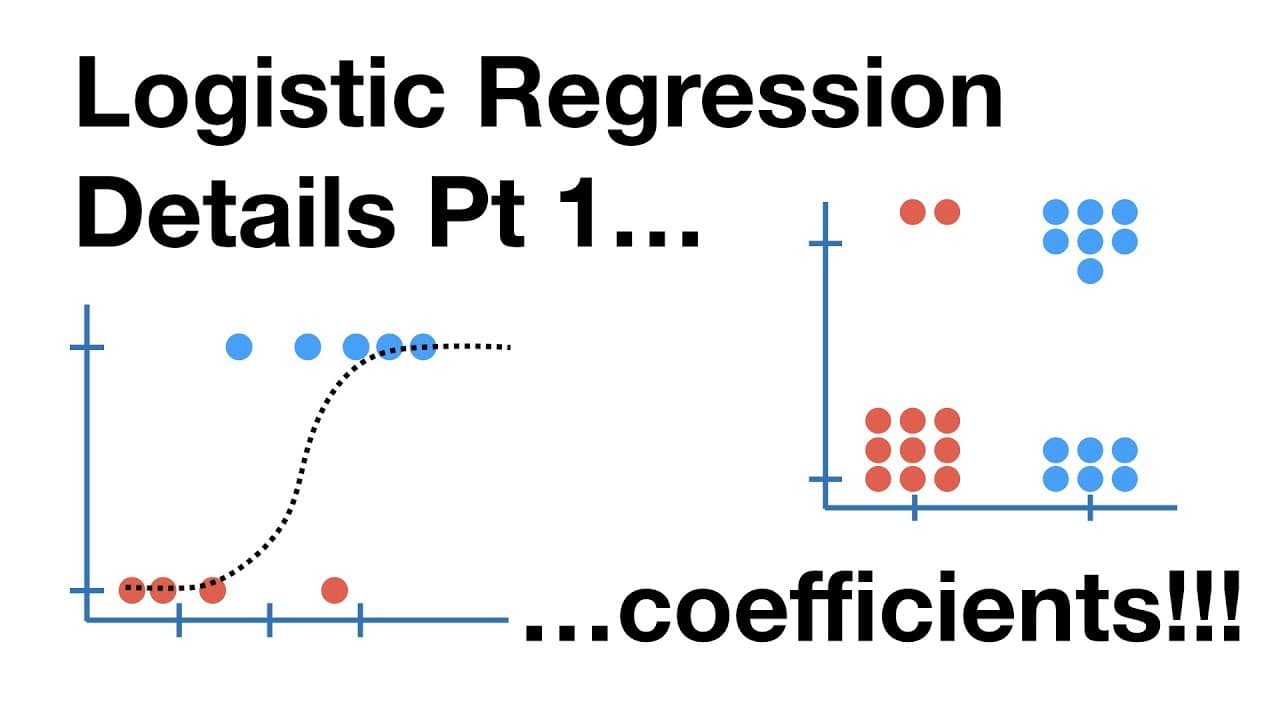
Logistic regression coefficients indicate the relationship between predictor variables and the log odds of a binary outcome. They can be used with continuous variables, like weight, to predict obesity or with discrete variables, such as a mutated gene, to evaluate its effect on obesity. Understanding these coefficients is crucial for interpreting the results of logistic regression analyses.
Transcript
If I were in Hawaii I'd be sitting on a beach In the shade of a tree Watching snack quest Hello, I'm Josh Starmer and welcome to StatQuest today We're gonna cover logistic regression and we're gonna dive deep into the details. This is part one of a series of videos I'm gonna do on logistic regression this time we're talking about coefficients This ... Read More
Key Insights
- 🅰️ Logistic regression is a type of generalized linear model that predicts probabilities or binary outcomes.
- 🧑💻 Logistic regression coefficients represent the relationship between predictors and the log odds of the outcome.
- 🍉 Coefficients can be interpreted in terms of the intercept, continuous predictors, and categorical predictors.
Install to Summarize YouTube Videos and Get Transcripts
Explore YouTube Video Summarizer or Get YouTube Transcript Extractor
Questions & Answers
Q: What is the difference between linear regression and logistic regression?
Linear regression predicts continuous outcomes, while logistic regression predicts probabilities or binary outcomes. Logistic regression uses the logit function to transform the outcome variable to log odds.
Q: How are coefficients determined in logistic regression?
Coefficients are determined through maximum likelihood estimation, which finds the values that maximize the likelihood of observing the data. The coefficients represent the relationship between predictors and the log odds of the outcome.
Q: How are coefficients interpreted in logistic regression?
The intercept coefficient represents the log odds when all predictors are zero. For continuous variables, the coefficient represents the change in log odds for a one-unit increase in the predictor. For categorical variables, the coefficient represents the difference in log odds compared to the reference category.
Q: How do you determine the significance of coefficients in logistic regression?
The significance of coefficients can be determined using Wald's test, which calculates the Z value by dividing the estimated coefficient by its standard error. If the Z value is greater than two, the coefficient is considered statistically significant.
Summary & Key Takeaways
-
Logistic regression is a specific type of generalized linear model used to predict probabilities.
-
Coefficients in logistic regression indicate the relationship between predictors and the outcome variable.
-
Logistic regression can be used with continuous variables, such as weight, to predict obesity, or with discrete variables, such as a mutated gene, to test its relation to obesity.
Read in Other Languages (beta)
Share This Summary 📚
Summarize YouTube Videos and Get Video Transcripts with 1-Click
Try YouTube Summary with ChatGPT & Claude or YouTube Transcript Generator
Explore More Summaries from StatQuest with Josh Starmer 📚






Summarize YouTube Videos and Get Video Transcripts with 1-Click
Try YouTube Summary with ChatGPT & Claude or YouTube Transcript Generator