How We Know The Earth Is Ancient
TL;DR
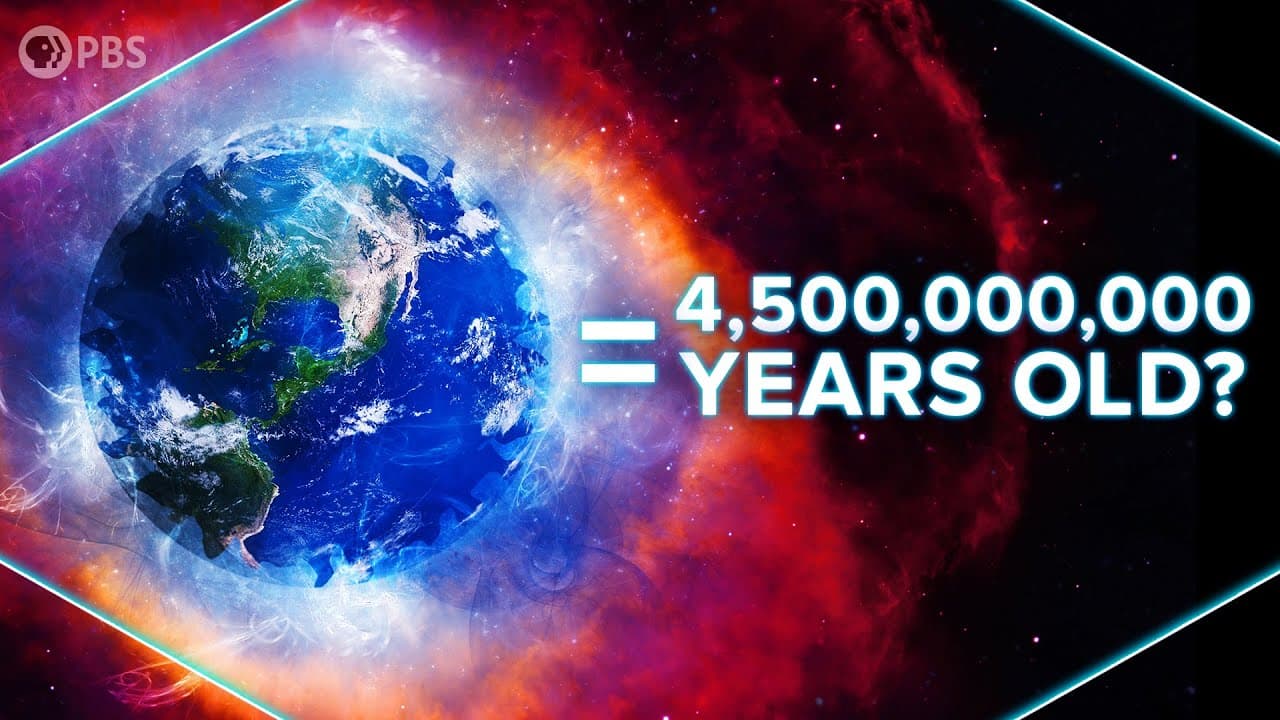
Exploring scientific methods that reveal Earth's age as 4.5 billion years.
Transcript
In astronomy we talk about billions of years like it’s no big deal. But how can we be sure about timescales so far beyond the capacity for human intuition? Our discovery of what we now call deep time is very recent - as recent as our discovery of the true spatial vastness of our universe. And it came as scientists tried to measure the age of the Ea... Read More
Key Insights
- The concept of deep time is recent, paralleling the discovery of the universe's vastness, fundamentally altering our perception of Earth's age.
- Ancient civilizations, such as the Sumerians and Babylonians, developed early cosmogonies, influencing later religious texts like Genesis, which attempted to date Earth's creation.
- Early scientific attempts to date Earth, such as by Buffon and Hutton, laid groundwork for modern geology, despite their initial inaccuracies.
- James Hutton's uniformitarianism introduced the idea that Earth's geological processes are slow and continuous, suggesting an ancient Earth.
- Radiometric dating, particularly uranium-lead dating, provides the most accurate measures of Earth's age, revealing it to be approximately 4.5 billion years old.
- Charles Lyell's geological work influenced Charles Darwin's evolutionary theory, providing the necessary timescale for natural selection.
- The discovery of radioactivity and its application in dating techniques revolutionized our understanding of geological and biological time.
- The age of the Earth is corroborated by lunar samples and meteorites, aligning with the estimated age of the solar system at 4.6 billion years.
Install to Summarize YouTube Videos and Get Transcripts
Explore YouTube Video Summarizer or Get YouTube Transcript Extractor
Questions & Answers
Q: What is the significance of deep time in understanding Earth's age?
Deep time is a concept that emerged alongside our understanding of the universe's vastness. It fundamentally altered our perception of Earth's age by introducing the idea that geological processes occur over millions or billions of years. This concept challenges traditional beliefs and allows for a scientific understanding of Earth's history and the timescales necessary for processes like evolution.
Q: How did early religious texts influence the dating of Earth's creation?
Early religious texts, such as the Genesis story, were influential in attempts to date Earth's creation. Figures like Bishop James Ussher used these texts, alongside other ancient sources, to calculate Earth's age, famously concluding it began in 4004 BC. These attempts, while inaccurate, highlight how religious narratives shaped early scientific inquiries into Earth's history.
Q: What role did James Hutton play in developing the concept of Earth's age?
James Hutton was instrumental in developing the concept of Earth's age through his theory of uniformitarianism. He proposed that geological processes observed today, such as erosion and sedimentation, operated in the past at similar rates. This suggested that Earth must be much older than previously thought, laying the foundation for modern geology and the acceptance of deep time.
Q: How does radiometric dating determine the age of Earth?
Radiometric dating determines Earth's age by measuring the decay of radioactive isotopes within rocks and minerals. Techniques like uranium-lead dating calculate the time elapsed since a rock formed by comparing the ratios of parent isotopes to their decay products. This method provides precise ages, revealing Earth to be approximately 4.5 billion years old, consistent with other solar system measurements.
Q: What impact did Charles Lyell's work have on Charles Darwin's theories?
Charles Lyell's work, particularly his 'Principles of Geology,' profoundly influenced Charles Darwin by providing the timescale necessary for natural selection to occur. Lyell's ideas about gradual geological change over millions of years supported Darwin's theory of evolution, which required vast periods for species to adapt and evolve, thus intertwining geology and evolutionary biology.
Q: How did the discovery of radioactivity revolutionize our understanding of geological time?
The discovery of radioactivity revolutionized our understanding of geological time by providing a mechanism to accurately date rocks and minerals. Radioactive decay, with its predictable half-lives, allowed scientists to measure the age of Earth and other celestial bodies precisely. This breakthrough confirmed the ancient age of Earth and aligned with evolutionary and geological theories, transforming our perception of Earth's history.
Q: What evidence supports the age of the solar system being around 4.6 billion years?
The age of the solar system, estimated at 4.6 billion years, is supported by radiometric dating of lunar samples and meteorites. These extraterrestrial materials, unaffected by Earth's geological processes, provide a consistent age when analyzed using techniques like uranium-lead dating. This evidence aligns with the estimated age of the Sun and supports a coherent narrative of solar system formation.
Q: Why is uranium-lead dating particularly useful for determining Earth's age?
Uranium-lead dating is particularly useful for determining Earth's age due to its ability to date ancient rocks over a wide range of timescales. Uranium isotopes decay into lead at known rates, and certain minerals, like zircon, incorporate uranium but exclude lead during formation. This allows for precise dating of rocks billions of years old, providing a reliable measure of Earth's age.
Summary & Key Takeaways
-
The concept of deep time emerged alongside our understanding of the universe's vastness, challenging traditional beliefs about Earth's age. Early attempts to date Earth, like those by Ussher and Buffon, were based on religious texts and flawed scientific methods, but they paved the way for modern geology.
-
James Hutton's uniformitarianism and Charles Lyell's geological work were pivotal in establishing Earth's ancient age. These ideas influenced Charles Darwin, who required vast timescales for his theory of evolution. Radiometric dating, particularly using uranium-lead techniques, later provided precise measurements of Earth's age.
-
The discovery of radioactivity and its application in radiometric dating transformed our understanding of geological time. The age of Earth, now estimated at 4.5 billion years, is supported by lunar samples and meteorites, which also date the solar system to around 4.6 billion years, providing a consistent scientific narrative.
Read in Other Languages (beta)
Share This Summary 📚
Summarize YouTube Videos and Get Video Transcripts with 1-Click
Try YouTube Summary with ChatGPT & Claude or YouTube Transcript Generator
Explore More Summaries from PBS Space Time 📚






Summarize YouTube Videos and Get Video Transcripts with 1-Click
Try YouTube Summary with ChatGPT & Claude or YouTube Transcript Generator