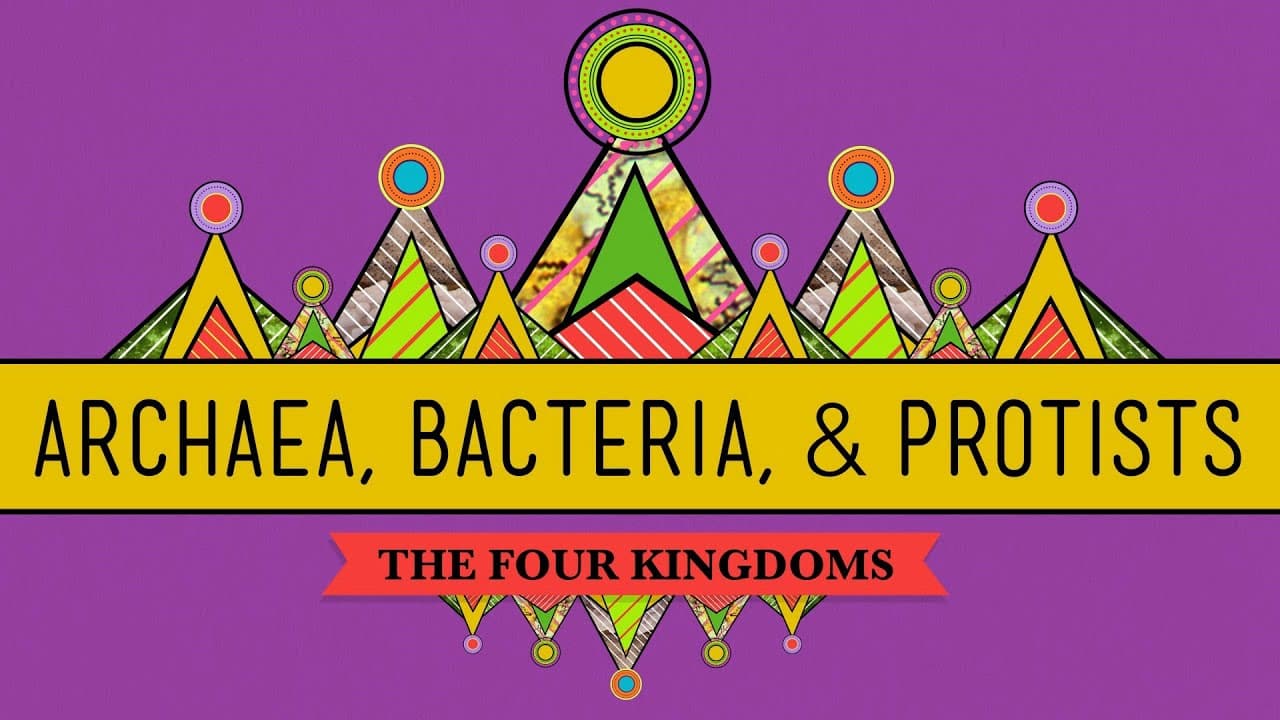
Old & Odd: Archaea, Bacteria & Protists - CrashCourse Biology #35
TL;DR
A deep dive into the oldest and diverse life forms on Earth.
Transcript
We've spent the past few months talking about animals here on Crash Course, specifically human animals, because... well, because humans... we love talking about ourselves, and also because animals are just really interesting. But it's high time that we talked about the rest of the living world. Because I hate to break it to ya, but most of the aliv... Read More
Key Insights
- Archaea, bacteria, and protists are the most abundant and diverse organisms on Earth, forming two of the three taxonomic domains and one of the four kingdoms of life.
- Archaea are ancient organisms that thrive in extreme environments, such as hydrothermal vents and acidic mines, and include groups like methanogens and extremophiles.
- Bacteria are prokaryotes that have been around for billions of years, showing incredible adaptability through mechanisms like horizontal gene transfer, contributing to antibiotic resistance.
- Protists are a diverse group of mostly single-celled eukaryotic organisms, including protozoa, algae, and slime molds, each with distinct characteristics and ecological roles.
- Protozoa are animal-like protists that are heterotrophic and exhibit diverse modes of movement, such as flagella and cilia, with some being parasitic.
- Algae are plant-like protists capable of photosynthesis, with varieties including unicellular diatoms and multicellular seaweeds, playing a crucial role in aquatic ecosystems.
- Slime molds, often resembling fungi, can move and ingest bacteria, displaying unique characteristics like bright colors and unusual names, such as Dog Vomit Slime Mold.
- Understanding these microorganisms provides insight into the origins of life on Earth and the evolutionary pathways that led to complex multicellular organisms, including humans.
Install to Summarize YouTube Videos and Get Transcripts
Explore YouTube Video Summarizer or Get YouTube Transcript Extractor
Questions & Answers
Q: What are the main differences between prokaryotes and eukaryotes?
Prokaryotes, such as bacteria and archaea, lack a nucleus and any organelles, with their DNA present in rings called plasmids. In contrast, eukaryotes, including protists, plants, fungi, and animals, have cells with a nucleus that houses their genetic material in the form of chromosomes, and they possess various organelles.
Q: How do archaea survive in extreme environments?
Archaea have evolved unique adaptations that allow them to thrive in extreme conditions, such as high temperatures, acidity, and salinity. Groups like thermophiles can survive temperatures above boiling point due to stable DNA and proteins, while halophiles thrive in high-salt environments using specialized pigments for energy production.
Q: What role do bacteria play in antibiotic resistance?
Bacteria contribute to antibiotic resistance through horizontal gene transfer, where they exchange genetic material, including drug-resistance genes, with other bacteria. This ability allows them to adapt quickly to antibiotics and evade immune responses, creating a continuous challenge for medical treatments.
Q: How do protists differ from archaea and bacteria?
Protists are primarily eukaryotic, meaning they have a nucleus and organelles, unlike prokaryotic archaea and bacteria. Protists exhibit greater complexity, with some being multicellular and capable of sexual reproduction. They are categorized based on similarities to plants, animals, or fungi, reflecting their diverse evolutionary paths.
Q: What are some examples of parasitic protozoa?
Parasitic protozoa include species like Plasmodium vivax, responsible for malaria, and Trypanosoma brucei, causing African Sleeping Sickness. These organisms often have complex life cycles and rely on hosts for survival, posing significant health challenges in affected regions.
Q: How do algae contribute to aquatic ecosystems?
Algae, as plant-like protists, perform photosynthesis, producing oxygen and serving as a primary food source in aquatic ecosystems. They form the base of food webs, supporting diverse aquatic life. Multicellular forms like seaweed provide habitat and nutrients, while unicellular algae contribute to nutrient cycling.
Q: What are slime molds, and how do they function?
Slime molds are fungus-like protists that absorb nutrients from their environment and can move like amoebas. They produce fruiting bodies for reproduction and feed on bacteria through phagocytosis. Their bright colors and unique movement patterns make them distinct from other protists and fungi.
Q: Why are archaea considered some of the oldest life forms?
Archaea are considered ancient due to fossil evidence dating back 3.5 billion years, shortly after Earth's formation. Their ability to survive in extreme environments likely allowed them to thrive in early Earth's harsh conditions, making them one of the earliest forms of life with a long evolutionary history.
Summary & Key Takeaways
-
In this episode of Crash Course Biology, the focus shifts from human anatomy to single-celled organisms that dominate Earth's biodiversity. Archaea, bacteria, and protists are introduced as key players in the history of life, showcasing their unique characteristics and ecological significance.
-
Archaea are highlighted for their ability to thrive in extreme environments, with groups like methanogens and extremophiles demonstrating remarkable adaptability. Bacteria's role in antibiotic resistance and their diverse forms are explored, emphasizing their evolutionary success.
-
Protists, the youngest of the three groups, are discussed in terms of their diversity and complexity. Protozoa, algae, and slime molds are examined for their ecological roles and unique traits, shedding light on the evolutionary bridge between simple and complex life forms.
Read in Other Languages (beta)
Share This Summary 📚
Summarize YouTube Videos and Get Video Transcripts with 1-Click
Try YouTube Summary with ChatGPT & Claude or YouTube Transcript Generator
Explore More Summaries from CrashCourse 📚




Summarize YouTube Videos and Get Video Transcripts with 1-Click
Try YouTube Summary with ChatGPT & Claude or YouTube Transcript Generator