Application experience tree,Huffman Encoding
TL;DR
Tree applications range from storing data to constructing expression trees and Huffman encoding for compression.
Transcript
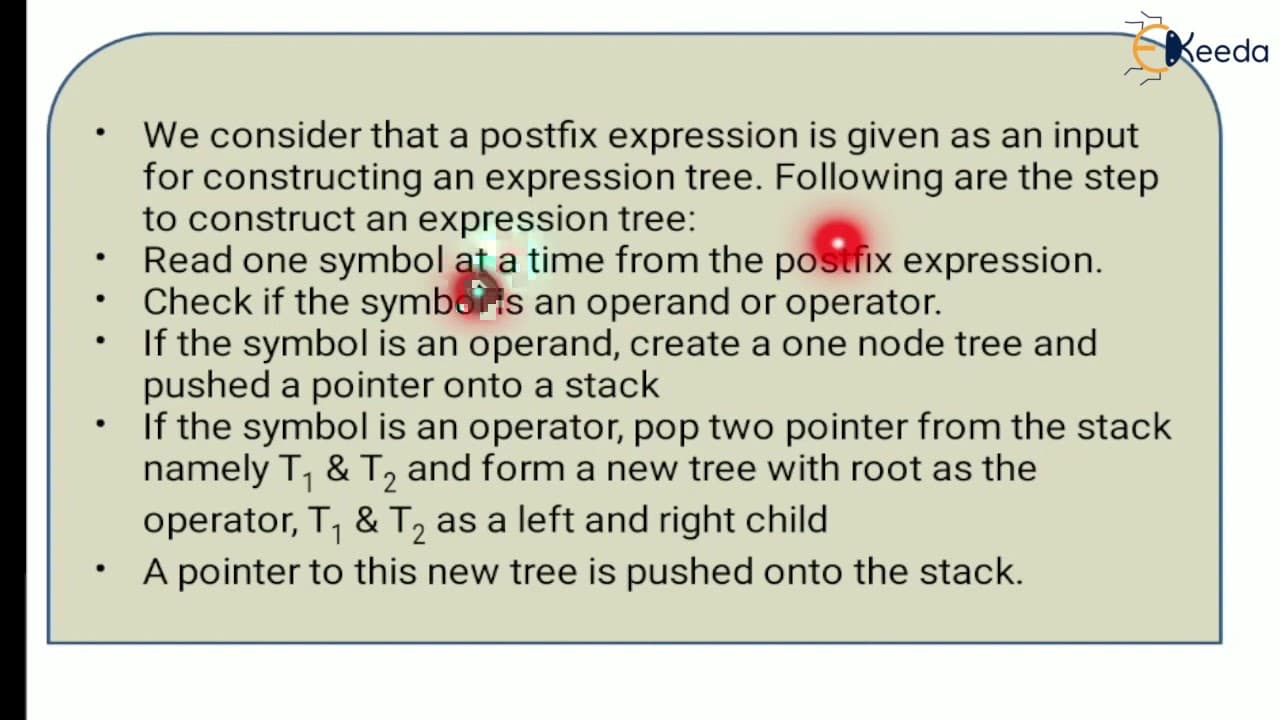
hello friends today we start with the new topic from the chapter tree is application of tree so in this application of trade topic first we discuss the general applications of tree and then we focus on two specific applications of tree that is expression tree and huffman encoding so let's start with the general applications of tree so the first app... Read More
Key Insights
- 🌲 Trees store various types of data, simple and complex, efficiently in a non-linear structure.
- 😑 Expression trees represent mathematical expressions as binary trees for structured analysis.
- 😒 Huffman encoding uses variable-length codes based on character frequency for lossless data compression.
- 🌲 Self-balancing trees like red-black trees play vital roles in operating system tasks.
- 🫰 B-minus trees are utilized to index and store large data structures on disk efficiently.
- 📁 Trees find applications in compiler constructions, database design, and file system directories.
- 🌲 Implementing hash tables and sets using trees showcase the versatility of tree data structures.
Install to Summarize YouTube Videos and Get Transcripts
Explore YouTube Video Summarizer or Get YouTube Transcript Extractor
Questions & Answers
Q: What are the general applications of trees?
Trees can store simple and complex data, implement data structures like hash tables, and are used in fields like compiler construction and file system directories.
Q: What is an expression tree?
An expression tree is a binary tree where internal nodes represent operators, and leaf nodes correspond to operands, used for representing expressions in a structured manner.
Q: How is a Huffman encoding tree constructed?
Huffman encoding involves creating leaf nodes for characters with their frequencies, arranging nodes by frequency, creating new nodes with the lowest frequency, and repeating these steps until a single tree is formed.
Q: What is the purpose of Huffman encoding?
Huffman encoding is a compression technique assigning variable-length codes to characters based on their frequency in the data, allowing efficient data storage and transmission.
Summary & Key Takeaways
-
Trees are used to store simple and complex data in a graphical manner, applicable in various fields like database design and operating systems.
-
Other data structures like hash tables and sets can be implemented using trees.
-
Expression trees and Huffman encoding are specific applications of trees for constructing binary trees and data compression, respectively.
Read in Other Languages (beta)
Share This Summary 📚
Summarize YouTube Videos and Get Video Transcripts with 1-Click
Try YouTube Summary with ChatGPT & Claude or YouTube Transcript Generator
Explore More Summaries from Ekeeda 📚



Summarize YouTube Videos and Get Video Transcripts with 1-Click
Try YouTube Summary with ChatGPT & Claude or YouTube Transcript Generator