What If Physics IS NOT Describing Reality?
TL;DR
Physics models our knowledge, not reality itself.
Transcript
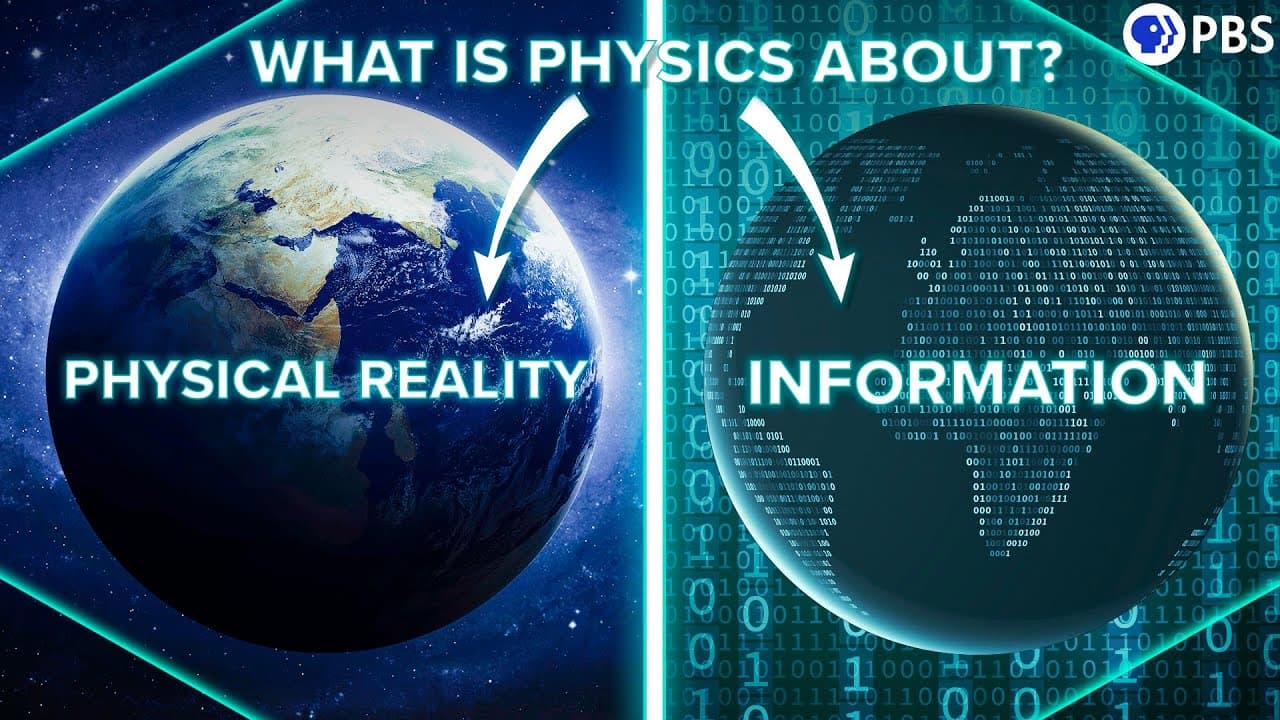
Neils Bohr said, “It is wrong to think that the task of physics is to find out how Nature is. Physics concerns what we can say about Nature.” Well it turns out that if we pay attention to this subtle difference, some of the most mysterious aspects of nature make a lot more sense. What is physics really trying to do? Is it to find the mathematic... Read More
Key Insights
- Neils Bohr emphasized that physics is about what we can say about nature, not how nature truly is, suggesting a focus on our observations rather than an objective reality.
- Quantum mechanics, according to some interpretations, models our information about particles rather than the particles themselves, indicating a shift from physical to informational perspectives.
- John Archibald Wheeler's 'it from bit' concept proposes that information is fundamental, with reality emerging from the interaction between observer and observed.
- Quantum systems can be understood as collections of informational propositions, where questions posed to the system define the available information, reflecting on quantum indeterminacy and entanglement.
- Anton Zeilinger's informational approach suggests that quantum systems are defined by binary questions, explaining phenomena like superposition and entanglement through informational limits.
- The entropic uncertainty principle refines the traditional uncertainty principle, using information theory to explain quantum phenomena like wave-particle duality.
- The wavefunction in quantum mechanics may not represent physical reality but rather our knowledge about potential measurement outcomes, challenging traditional views of physical existence.
- The debate on observer-centric interpretations raises questions about the existence of an observer-independent reality, with implications for how we understand the universe.
Install to Summarize YouTube Videos and Get Transcripts
Explore YouTube Video Summarizer or Get YouTube Transcript Extractor
Questions & Answers
Q: What did Neils Bohr mean by saying physics is about what we can say about nature?
Neils Bohr suggested that physics is not about uncovering the true nature of reality but rather about describing what we can observe and measure. This implies that the role of physics is to model our experiences and observations, rather than to provide a direct depiction of an objective reality. This perspective shifts the focus from seeking absolute truths to understanding the limits and scope of our knowledge.
Q: How does the 'it from bit' concept relate to quantum mechanics?
The 'it from bit' concept, proposed by John Archibald Wheeler, suggests that information is the fundamental building block of reality. In the context of quantum mechanics, this idea implies that the physical universe arises from informational interactions between the observer and the observed. It challenges traditional notions of physical reality by proposing that reality is fundamentally about information and the questions posed to it, rather than the existence of concrete particles or fields.
Q: What is the significance of Anton Zeilinger's informational approach to quantum mechanics?
Anton Zeilinger's informational approach to quantum mechanics proposes that quantum systems are defined by informational propositions rather than physical components. This perspective suggests that the behavior of quantum systems can be understood through binary questions, where each system contains only a limited amount of information. This approach helps explain quantum phenomena like superposition and entanglement by emphasizing the role of information and the questions we ask of quantum systems.
Q: How does the entropic uncertainty principle refine our understanding of quantum mechanics?
The entropic uncertainty principle refines the traditional uncertainty principle by applying information theory to quantum mechanics. It uses the concept of Shannon entropy to measure the information content of a quantum system, providing a tighter bound on the uncertainty in measurements. This approach explains phenomena like wave-particle duality by highlighting the limited information available in a quantum system, thus offering a deeper understanding of the inherent uncertainties in quantum mechanics.
Q: What role does the wavefunction play in the informational interpretation of quantum mechanics?
In the informational interpretation of quantum mechanics, the wavefunction represents our knowledge about the probabilities of different measurement outcomes, rather than a physical entity. It describes the distribution of potential results rather than the state of a physical system. This view challenges the traditional understanding of the wavefunction as a fundamental physical reality, suggesting instead that it is a tool for modeling our informational limitations and the questions we pose to quantum systems.
Q: Why is the concept of observer-centric interpretations significant in quantum mechanics?
Observer-centric interpretations in quantum mechanics emphasize the role of the observer in defining reality. These interpretations suggest that the properties of quantum systems are not inherent but are determined by the act of observation. This raises fundamental questions about the existence of an observer-independent reality and challenges traditional views of objective reality. It suggests that our understanding of the universe is inherently linked to our interactions with it, making the observer a crucial part of the quantum framework.
Q: How does the informational perspective explain quantum entanglement?
The informational perspective explains quantum entanglement by viewing it as a distribution of information across multiple particles. When particles are entangled, their informational content is not isolated but shared between them. This means that measuring the state of one particle instantaneously affects the state of the other, as the information is non-locally distributed. This view aligns with the idea that quantum systems are defined by informational propositions, where entanglement represents the interconnectedness of information between particles.
Q: What implications does the informational approach have for our understanding of reality?
The informational approach to quantum mechanics implies that reality is fundamentally about information and the questions we ask, rather than the existence of concrete physical entities. This perspective challenges traditional notions of an objective reality, suggesting that our understanding of the universe is shaped by our observations and interactions. It raises questions about the nature of reality and the role of the observer, potentially leading to new insights into the fundamental nature of the universe and the limits of human knowledge.
Summary & Key Takeaways
-
The video explores the idea that physics models our experience and information about reality, rather than reality itself. Neils Bohr and others argue that quantum mechanics deals with our knowledge of particles, not the particles themselves, emphasizing an informational perspective.
-
John Archibald Wheeler's 'it from bit' concept suggests that information is fundamental, with reality emerging from the interaction between observer and observed. This view is supported by interpretations that see quantum systems as informational propositions.
-
The informational approach to quantum mechanics explains phenomena like entanglement and uncertainty through limits on information. The wavefunction may represent knowledge about potential outcomes, challenging traditional views of physical existence and the observer's role in defining reality.
Read in Other Languages (beta)
Share This Summary 📚
Summarize YouTube Videos and Get Video Transcripts with 1-Click
Try YouTube Summary with ChatGPT & Claude or YouTube Transcript Generator
Explore More Summaries from PBS Space Time 📚




Summarize YouTube Videos and Get Video Transcripts with 1-Click
Try YouTube Summary with ChatGPT & Claude or YouTube Transcript Generator