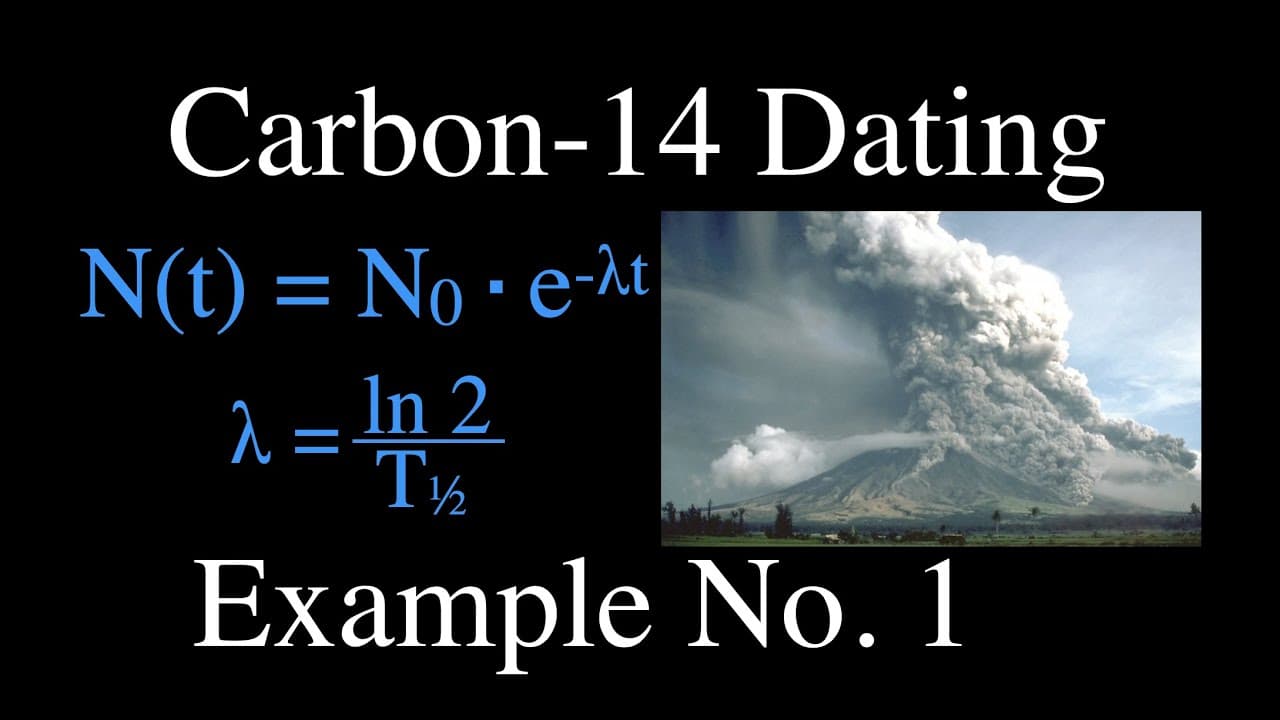
Radioactivity (15 of 16) Carbon-14 Dating, When did the Volcano Erupt?
TL;DR
Solving a radiocarbon dating problem using decay law reveals the age of an olive tree branch.
Transcript
okay that's right as you can see in this video we are going to be going over an example for carbon-14 dating carbon-14 dating or radiocarbon dating now before we do that please don't forget in the bottom right hand corner there is that little red icon down there click on that subscribe to my channel get all my excellent physics chemistry and math v... Read More
Key Insights
- 🤕 Radiocarbon dating utilizes decay law to determine the age of samples.
- 🧑🤝🧑 The decay constant, derived from the half-life, is crucial for accurate dating calculations.
- 🤩 Initial and remaining carbon-14 isotopes in a sample provide key data for time estimation.
- 🧑🤝🧑 Natural logarithms help simplify exponential terms in radiocarbon dating equations.
- 👮 Precise calculations using decay law can reveal the time elapsed since a significant event like a volcanic eruption.
- 🧑🤝🧑 Understanding the relationship between carbon-14 decay and time is essential for accurate radiocarbon dating.
- 🧑🤝🧑 Radiocarbon dating examples, like the olive tree branch on Santorini, demonstrate the application of physics principles in archaeological investigations.
Install to Summarize YouTube Videos and Get Transcripts
Explore YouTube Video Summarizer or Get YouTube Transcript Extractor
Questions & Answers
Q: How did the discovery of an olive tree branch on Santorini spark a radiocarbon dating inquiry?
The branch, found after a volcanic eruption, led to a radiocarbon dating problem to determine the eruption's age based on carbon-14 decay.
Q: What is the significance of the decay constant in radiocarbon dating calculations?
The decay constant, derived from the half-life, is crucial in determining the time elapsed since an event through the decay of carbon-14 isotopes.
Q: How does the natural logarithm aid in solving radiocarbon dating equations?
The natural log function helps isolate the unknown time variable in decay law equations by simplifying exponential terms to solve for the age of a sample.
Q: Why is it essential to consider the original and remaining carbon-14 atoms in radiocarbon dating?
Comparing the initial and final amounts of carbon-14 allows for precise calculations of time since an event, such as a volcanic eruption, based on radioactive decay.
Summary & Key Takeaways
-
Explanation of a radiocarbon dating problem involving an olive tree branch found after a volcanic eruption on Santorini.
-
Description of the decay of carbon-14 in the branch and its relationship to the time since the eruption.
-
Application of the decay law and half-life concept to calculate the age of the branch and the volcanic eruption.
Read in Other Languages (beta)
Share This Summary 📚
Summarize YouTube Videos and Get Video Transcripts with 1-Click
Try YouTube Summary with ChatGPT & Claude or YouTube Transcript Generator
Explore More Summaries from Step by Step Science 📚

Summarize YouTube Videos and Get Video Transcripts with 1-Click
Try YouTube Summary with ChatGPT & Claude or YouTube Transcript Generator