Products
Features
YouTube Video Summarizer
Summarize YouTube videos
Web & PDF Highlighter
Highlight web pages & PDFs
Chat with PDF
Ask any PDF questions with AI
Ask AI Clone
Chat with your highlights & memories
Audio Transcriber
Transcribe audio files to text
Glasp Reader
Read and highlight articles
Kindle Highlight Export
Export your Kindle highlights
Idea Hatch
Hatch ideas from your highlights
Integrations
Obsidian Plugin
Notion Integration
Pocket Integration
Instapaper Integration
Medium Integration
Readwise Integration
Snipd Integration
Hypothesis Integration
Apps & Extensions
Chrome Extension
Safari Extension
Edge Add-ons
Firefox Add-ons
iOS App
Android App
Discover
Discover
Ideas
Discover new ideas and insights
Articles
Curated articles and insights
Books
Book recommendations by great minds
Posts
Essays and notes from readers
Quotes
Inspiring quotes collection
Videos
Curated videos and summaries
Explore Glasp
Glasp Newsletter
Weekly insights and updates
Glasp Talk
Interview series with great minds
Glasp Blog
Latest news and articles
Glasp Use Cases
Learn how others use Glasp
Build & Support
Glasp API
Access Glasp's API for developers
MCP Connector
Connect Glasp to Claude & ChatGPT
Community
Glasp Reddit Community
Students
Student discount and benefits
FAQs
Frequently Asked Questions
AboutPricing
DashboardLog inSign up

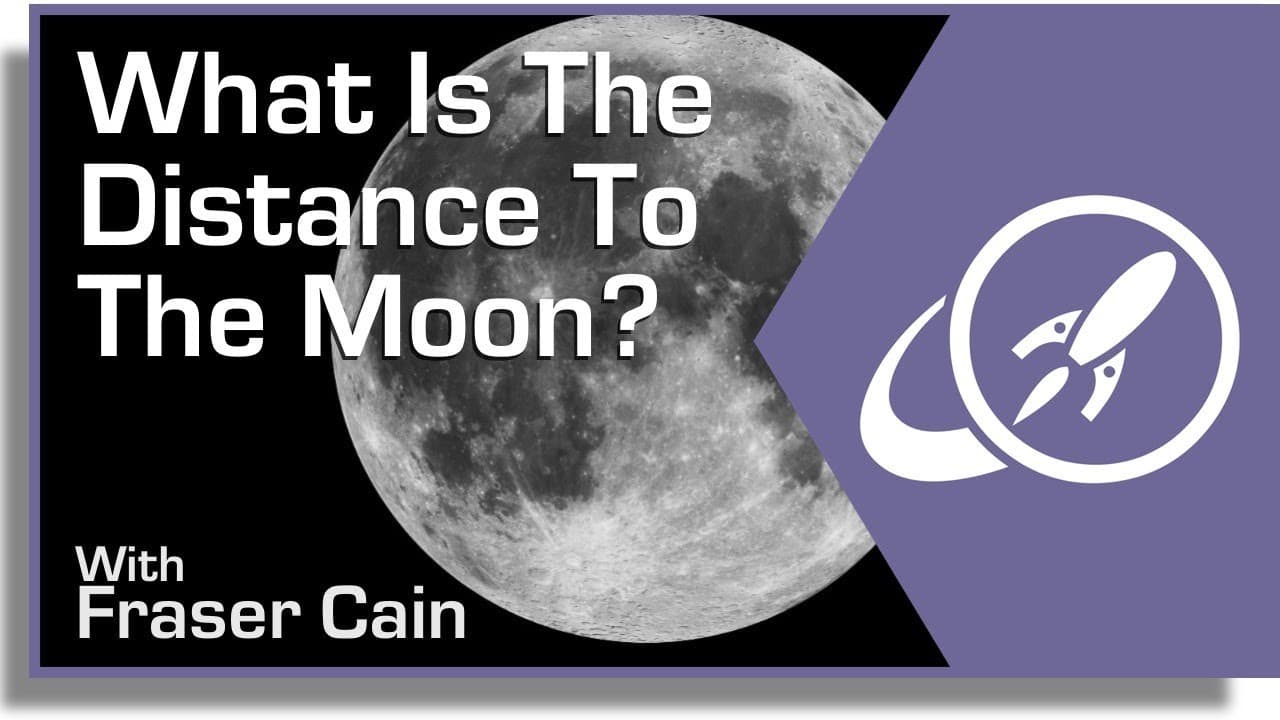
What is the Distance to the Moon?
99.4K views
•
June 29, 2013
by
Fraser Cain
YouTube video player
What is the Distance to the Moon?

TL;DR

The Moon is 384,000 km from Earth, varying about 44,000 km due to its elliptical orbit and can appear different sizes.

Transcript

I'm Fraser Cain, the publisher of Universe Today. The Moon is such a familiar object in the sky, but did you ever wonder how far away it is? The answer is, on average, 384,000 kilometers from Earth. It's hard to put that into context, so let's do a demonstration. Here's the Earth... and here's the Moon to scale. Now how far away would I have to sta... Read More

Key Insights

  • ⏰ The Moon is 384,000 km on average from Earth, varying up to 44,000 km due to its elliptical orbit.
  • 📑 Perigee (363,000 km) and apogee (406,000 km) mark the Moon's closest and farthest points from Earth.
  • 🧡 Laser ranging experiments help astronomers measure the Moon's distance with precision.
  • 😚 Supermoons occur when the Moon is closer to Earth, appearing larger in the sky.
  • 🕧 The Moon's distance affects its illumination, varying by more than thirty percent from Full Moon to Full Moon.
  • 🥺 The Moon orbits Earth on an elliptical path, leading to distance fluctuations.
  • ☠️ The Moon is slowly moving away from Earth at a rate of 3.8 cm/year.

Install to Summarize YouTube Videos and Get Transcripts

Explore YouTube Video Summarizer or Get YouTube Transcript Extractor

Questions & Answers

Q: How do the Moon's distance variations affect its appearance?

The Moon appears larger during perigee (Supermoon) at 363,000 km and smaller during apogee at 406,000 km due to its elliptical orbit.

Q: How do astronomers measure the Moon's distance accurately?

Astronomers use the Lunar Laser Ranging experiment with retroreflecting mirrors on the Moon's surface to calculate precise distances with millimeter accuracy.

Q: How does the Moon's distance change over time?

The Moon is drifting away from Earth at 3.8 cm/year, resulting in a gradual decrease in apparent size over billions of years.

Q: What is the significance of the Moon's distance variations?

Understanding the Moon's distance variations helps astronomers study its orbit dynamics, lunar phases, and Earth-Moon interactions.

Summary & Key Takeaways

  • The Moon is an average of 384,000 km from Earth, with its closest point (perigee) at 363,000 km and furthest point (apogee) at 406,000 km.

  • The Moon's distance affects its size, with a Full Moon appearing larger during perigee (Supermoon) due to closer proximity.

  • Astronomers use laser ranging to measure the Moon's distance, which is slowly drifting away from Earth at 3.8 cm/year.


Read in Other Languages (beta)

English

Share This Summary 📚

Summarize YouTube Videos and Get Video Transcripts with 1-Click

Download browser extensions on:

Try YouTube Summary with ChatGPT & Claude or YouTube Transcript Generator

Explore More Summaries from Fraser Cain 📚
Why Isn't the Asteroid Belt a Planet? thumbnail
Why Isn't the Asteroid Belt a Planet?
Fraser Cain
Are We Living in a Simulation? Understanding the Simulation Hypothesis thumbnail
Are We Living in a Simulation? Understanding the Simulation Hypothesis
Fraser Cain
Why Did Mars Lose Its Atmosphere? And How Can We Get It Back? thumbnail
Why Did Mars Lose Its Atmosphere? And How Can We Get It Back?
Fraser Cain
Exploring Space Lava Tubes: How To Prepare For It thumbnail
Exploring Space Lava Tubes: How To Prepare For It
Fraser Cain / Universe Today Podcast
What's On The Far Side Of The Moon? thumbnail
What's On The Far Side Of The Moon?
Fraser Cain

Summarize YouTube Videos and Get Video Transcripts with 1-Click

Download browser extensions on:

Try YouTube Summary with ChatGPT & Claude or YouTube Transcript Generator

Apps & Extensions

  • Chrome Extension
  • Safari Extension
  • Edge Add-ons
  • Firefox Add-ons
  • iOS App
  • Android App

Key Features

  • YouTube Video Summarizer
  • Web & PDF Summarizer
  • Web & PDF Highlighter
  • Chat with PDF
  • Ask AI Clone
  • Audio Transcriber
  • Glasp Reader
  • Kindle Highlight Export
  • Idea Hatch

Integrations

  • Obsidian Plugin
  • Notion Integration
  • Pocket Integration
  • Instapaper Integration
  • Medium Integration
  • Readwise Integration
  • Snipd Integration
  • Hypothesis Integration

More Features

  • APIs
  • MCP Connector
  • Blog & Post
  • Embed Links
  • Image Highlight
  • Personality Test
  • Quote Shots

Company

  • About us
  • Blog
  • Community
  • FAQs
  • Job Board
  • Newsletter
  • Pricing
Terms

•

Privacy

•

Guidelines

© 2026 Glasp Inc. All rights reserved.