What Is the Surface Area to Volume Ratio of Cells?
TL;DR
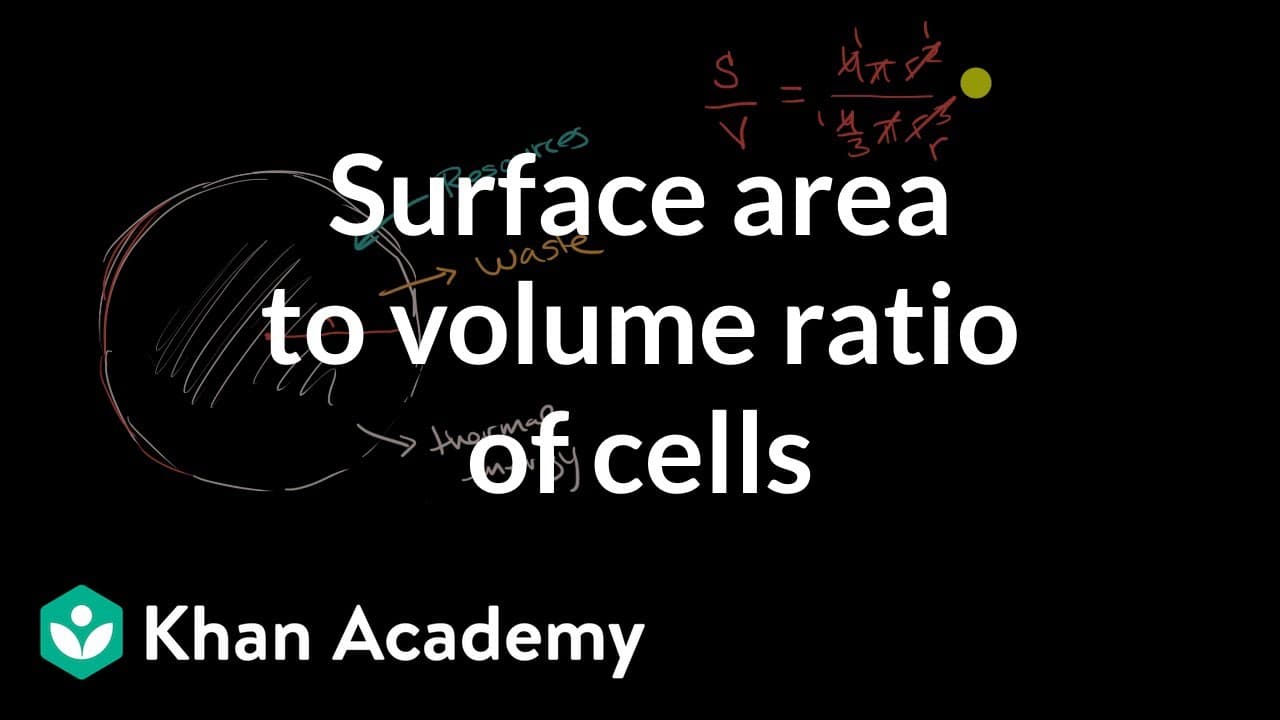
The surface area to volume ratio of cells decreases as cell size increases, making it more difficult for larger cells to effectively exchange resources, waste, and energy. This limitation can be mitigated by adaptations such as having folded membranes, which increase surface area without significantly increasing volume.
Transcript
- [Instructor] So let's say that this is a cell. So we know that all sorts of activity is going on inside of this cell here, and we will study that in a lot more depth as we go further in our study of biology. But it's important to realize that this cell and the activity in that cell is not operating in isolation. That in order to live, that cell n... Read More
Key Insights
- 🗑️ Cells require resources from the external environment and release waste products and energy across their outer membrane.
- 🥳 The surface area to volume ratio of cells decreases as the cell size increases, making it challenging for larger cells to effectively exchange materials and energy.
- 🔈 Cells can compensate for a low surface area to volume ratio by having folded membranes or specialized structures that increase surface area.
- 🗑️ The exchange of resources, waste, and energy in cells relies on the diffusion process across the cell membrane.
- 🥳 Understanding the surface area to volume ratio is crucial for comprehending the limitations and adaptations of cellular functionality.
- 🥳 The mathematically derived formula allows for predicting the changes in the surface area to volume ratio based on the size of the cell.
- 😀 Cells with larger volumes relative to their surface area face limitations in obtaining necessary resources and disposing of waste efficiently.
Install to Summarize YouTube Videos and Get Transcripts
Explore YouTube Video Summarizer or Get YouTube Transcript Extractor
Questions & Answers
Q: Why is it important for cells to have resources from the outside world?
Cells require external resources such as nutrients, oxygen, and other molecules to perform essential functions and sustain life. Without these resources, the cell cannot survive or carry out its activities.
Q: How does the cell release waste products across its membrane?
Waste products generated by cellular activities are released across the cell membrane through various mechanisms such as diffusion, active transport, or exocytosis. These processes allow the cell to get rid of waste and maintain homeostasis.
Q: How does the surface area to volume ratio change as the cell size increases?
As the size of a cell increases, the volume increases at a faster rate than the surface area. This results in a decrease in the surface area to volume ratio, making it harder for the cell to efficiently exchange resources, waste, and energy with its surroundings.
Q: How do cells overcome the limitation of a low surface area to volume ratio?
Cells can increase their surface area by having folded membranes or structures like villi in the small intestine or cristae in mitochondria. These folded structures provide a larger surface area for enhanced exchange processes and help overcome the limitations caused by a low surface area to volume ratio.
Summary & Key Takeaways
-
Cells are not isolated entities but require resources from the outside and release waste products and energy across their outer membrane.
-
The ratio of surface area to volume decreases as the size of the cell increases, hindering efficient exchange of resources, waste, and energy.
-
Cells can increase their surface area by having folded membranes, allowing for more efficient exchange processes.
Read in Other Languages (beta)
Share This Summary 📚
Summarize YouTube Videos and Get Video Transcripts with 1-Click
Try YouTube Summary with ChatGPT & Claude or YouTube Transcript Generator
Explore More Summaries from Khan Academy 📚





Summarize YouTube Videos and Get Video Transcripts with 1-Click
Try YouTube Summary with ChatGPT & Claude or YouTube Transcript Generator