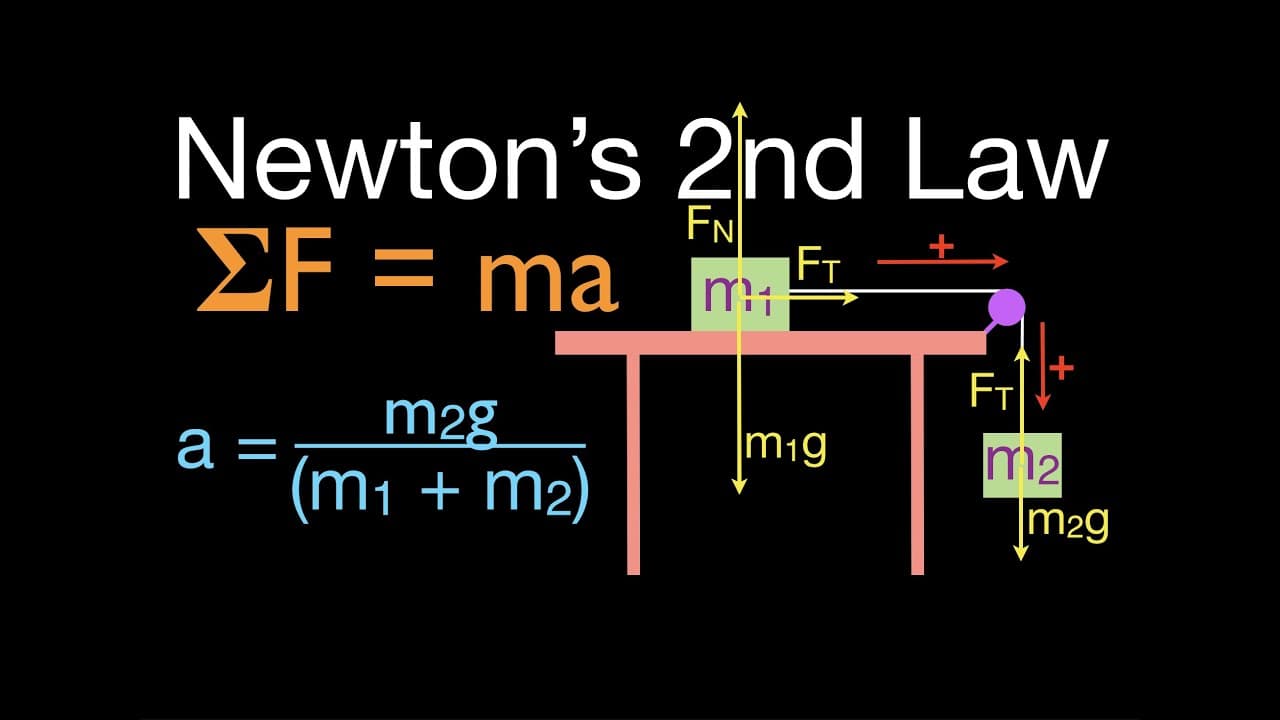
Newton's 2nd Law (10 of 21) Calculate Acceleration w/o Friction; Table, Pulley, Two Masses
TL;DR
Solving for acceleration and tension in a frictionless scenario using Newton's second law.
Transcript
okay in today's video we're going to go over another problem involving acceleration without friction and this is the situation we have we have mass m1 which is sitting on the table mass m1 has a mass of seven kilo gram the coefficient of friction between m1 and the table is zero there is no friction between these two objects this is the magic frict... Read More
Key Insights
- ❓ Frictionless scenarios simplify force analysis.
- ☠️ Masses connected by an inelastic string accelerate at the same rate.
- 👮 Newton's second law helps determine acceleration and tension in a system.
- ❓ Tension in the string is crucial for maintaining equilibrium.
- 🧑🏭 Forces acting on each object must be considered independently.
- ⚖️ Equilibrium is achieved when forces are balanced in the system.
- ❓ Understanding the properties of the string and pulley aids in calculations.
Install to Summarize YouTube Videos and Get Transcripts
Explore YouTube Video Summarizer or Get YouTube Transcript Extractor
Questions & Answers
Q: How does the assumption of a frictionless scenario simplify the analysis?
Assuming no friction allows us to ignore energy loss and focus solely on the forces affecting acceleration, making calculations clearer.
Q: Why do both masses experience the same acceleration in this scenario?
The masses are connected by a massless, inelastic string, implying they will have the same acceleration due to the string's properties.
Q: How is Newton's second law applied to determine the acceleration of the two masses?
By summing the forces acting in the direction of motion for each object, we can calculate the acceleration using mass and force components.
Q: Why is the tension in the string critical to understanding the system's equilibrium?
Tension balances the forces acting on the two masses, ensuring they move together harmoniously, making it crucial to solve for system stability.
Summary & Key Takeaways
-
Two masses connected by a frictionless string accelerate with the same rate due to Newton's second law.
-
Applying forces on each object individually reveals the acceleration of 3.56 m/s^2.
-
Tension in the string, found to be 24.9 N, confirms equilibrium in the system.
Read in Other Languages (beta)
Share This Summary 📚
Summarize YouTube Videos and Get Video Transcripts with 1-Click
Try YouTube Summary with ChatGPT & Claude or YouTube Transcript Generator
Explore More Summaries from Step by Step Science 📚

Summarize YouTube Videos and Get Video Transcripts with 1-Click
Try YouTube Summary with ChatGPT & Claude or YouTube Transcript Generator