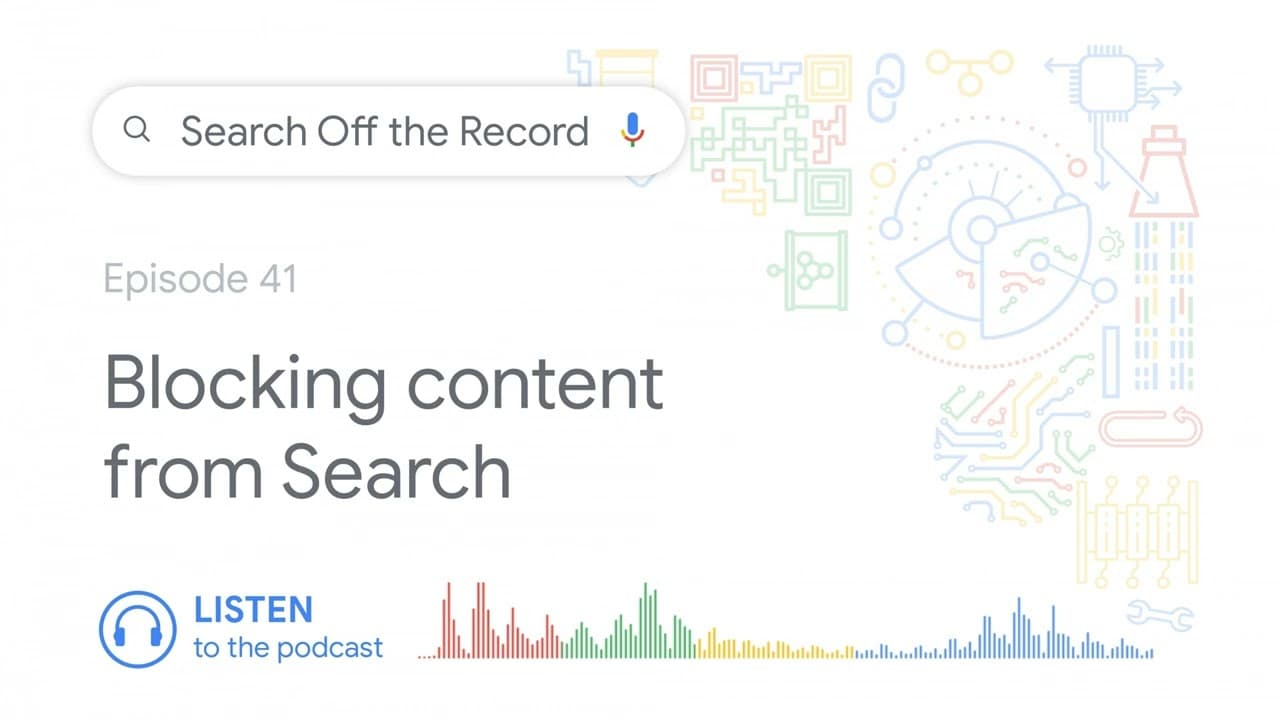
How to Block Content from Appearing in Google Search?
TL;DR
To block content from appearing in Google Search, use a robots.txt file to prevent crawling or apply 'noindex' meta tags to stop indexing. While robots.txt doesn't guarantee content won't be indexed, combining 'noindex' with other tags like 'nofollow' and 'nosnippet' provides more control over how your content is treated in search results.
Transcript
[MUSIC PLAYING] LIZZI SASSMAN: Hello, hello, and welcome to another episode of "Search Off the Record," a podcast coming to you from the Google Search team, discussing all things search and maybe having some fun along the way. My name is Lizzi, and I'm joined today by some other folks on the Google Search team, Gary and John. Hi, Gary. GARY ILLYES:... Read More
Key Insights
- Robots.txt files can instruct search engines not to crawl specific URLs, but they don't prevent indexing if the page is linked elsewhere.
- Using robots meta tags like 'noindex' can ensure content is not indexed, providing a stronger method than robots.txt.
- Combining 'noindex' with 'nofollow' and other meta tags can fine-tune control over how content is handled by search engines.
- Password protection is a viable method to restrict access to content, but it doesn't prevent indexing if the login page is indexed.
- Meta tags like 'noarchive' and 'nosnippet' offer control over how content is displayed in search results without blocking it entirely.
- It's important to consider the long-term implications of using meta tags, as they can affect visibility and user access.
- For specific file types like PDFs, using the robots HTTP header can prevent indexing if server access is available.
- The discussion highlights the importance of understanding different methods to control content visibility in search engines.
Install to Summarize YouTube Videos and Get Transcripts
Explore YouTube Video Summarizer or Get YouTube Transcript Extractor
Questions & Answers
Q: What is the role of robots.txt in blocking content?
Robots.txt files are used to instruct search engines not to crawl specific URLs on a website. However, they do not prevent the content from being indexed if it is linked from other pages. This means that while the content may not be crawled, it could still appear in search results if it gains popularity or is linked to extensively.
Q: How can robots meta tags be used to block content?
Robots meta tags, such as 'noindex', can be placed in the HTML of a webpage to instruct search engines not to index the page. This is a more reliable method than robots.txt for preventing content from appearing in search results, as it directly tells the search engine to exclude the page from its index.
Q: What are the limitations of using robots.txt?
The primary limitation of robots.txt is that it only prevents search engines from crawling a page, not from indexing it. If a page is linked to from other sources, it can still be indexed and appear in search results, albeit without the content being crawled. This makes robots.txt less effective for completely blocking content.
Q: Why might someone use the 'noarchive' meta tag?
The 'noarchive' meta tag is used to prevent search engines from displaying a cached version of a webpage in search results. This can be useful for content that changes frequently or for sites that want to ensure users see the most current version of a page by visiting the site directly, rather than viewing an outdated cached version.
Q: How does password protection affect content indexing?
Password protection can restrict access to content but does not necessarily prevent it from being indexed. If the login page itself is indexed, users may still find the page in search results. It's important to ensure that login pages are not indexed if the content behind them should remain private.
Q: What is the 'nosnippet' meta tag used for?
The 'nosnippet' meta tag prevents search engines from displaying a snippet of the page's content in search results. This can be useful for pages where the content should not be previewed in search results, such as when there are proprietary or sensitive details that should only be visible on the actual site.
Q: Can robots.txt be used for non-HTML content?
Robots.txt can be used to prevent crawling of non-HTML content like images and videos, which are indexed differently from HTML content. However, for files like PDFs, which are converted to HTML for indexing, robots.txt is less effective. In such cases, using the robots HTTP header to prevent indexing is recommended if server access is available.
Q: What challenges exist with creating new meta tags?
Creating new meta tags involves significant overhead, including ensuring long-term support, documentation, and implementation. It's important that new tags provide long-term value and are not tied to short-lived features. This complexity often leads to a reluctance to introduce new meta tags unless they address a significant and persistent need.
Summary & Key Takeaways
-
In this episode, the Google Search team discusses various methods to block content from appearing in Google Search results. They explore the use of robots.txt files, robots meta tags, and other techniques to control crawling and indexing.
-
The team highlights the limitations of robots.txt, which only prevents crawling, and the effectiveness of using 'noindex' meta tags to prevent indexing. They also discuss the potential issues with password protection and login pages.
-
The conversation covers advanced topics like combining multiple meta tags for fine-tuned control, the use of 'noarchive' and 'nosnippet' tags, and strategies for handling non-HTML content like PDFs using HTTP headers.
Read in Other Languages (beta)
Share This Summary 📚
Summarize YouTube Videos and Get Video Transcripts with 1-Click
Try YouTube Summary with ChatGPT & Claude or YouTube Transcript Generator
Explore More Summaries from Google Search Central 📚

Summarize YouTube Videos and Get Video Transcripts with 1-Click
Try YouTube Summary with ChatGPT & Claude or YouTube Transcript Generator