How to Graph Quadratic Functions Using Intercepts
TL;DR
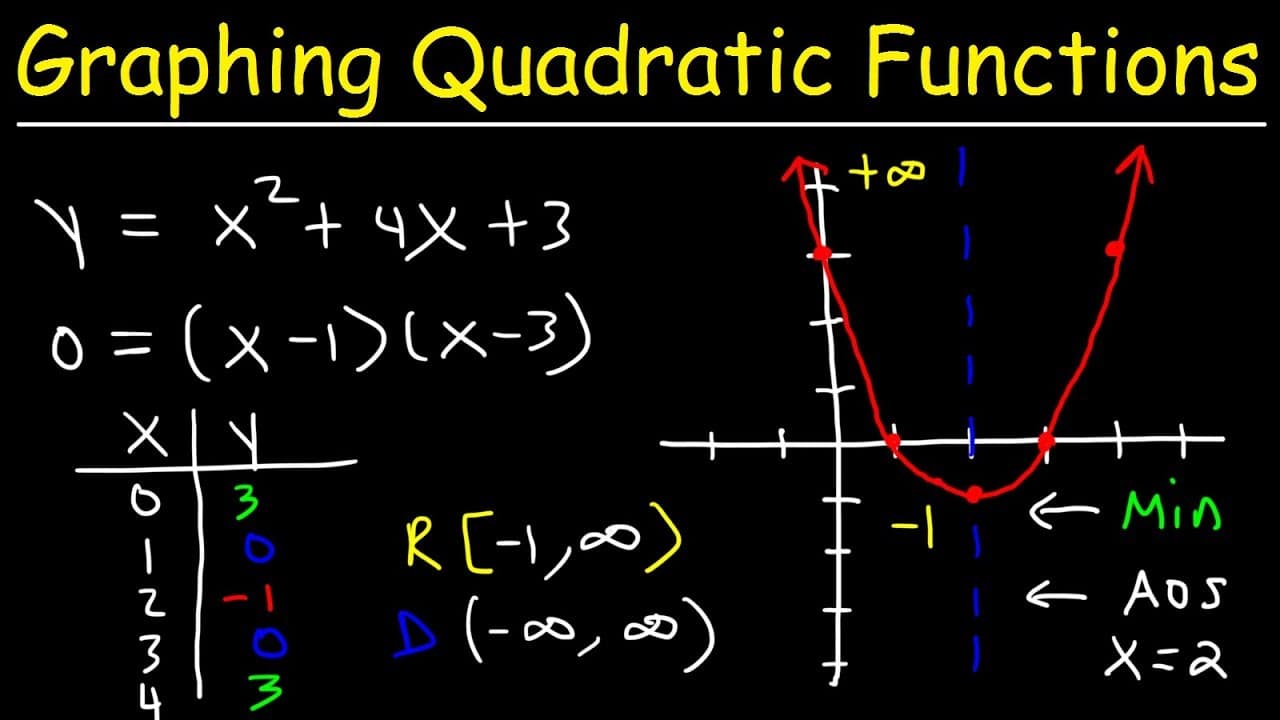
To graph a quadratic function in standard form, first find the vertex using the formula -b/2a. Then locate the x-intercepts by setting y to zero and factoring, and find the y-intercept by replacing x with zero in the equation. Plot these points to create the graph, noting that the domain is all real numbers and the range depends on the vertex's y-coordinate.
Transcript
now let's work on some more examples graphing quadratic functions in standard form now we did one example using the data table and there are some other things that you may need to find such as the x-intercept and the y-intercept but i think it's still good to like put that information in the form of a data table it's simply helpful the first thing ... Read More
Key Insights
- ❓ The vertex of a quadratic function can be found using the formula -b/2a.
- ❣️ The y-intercept of a quadratic function is found by replacing x with zero.
- ❣️ The x-intercepts of a quadratic function are found by setting y equal to zero and factoring the equation.
- 📈 The vertex is critical in determining the maximum or minimum value and the axis of symmetry of the graph.
- 💁 The domain of a quadratic function in standard form is all real numbers.
- 💁♂️ The range of a quadratic function in standard form varies depending on the vertex's y-coordinate.
- ❣️ Graphing a quadratic function involves plotting the vertex, x-intercepts, and y-intercept.
Install to Summarize YouTube Videos and Get Transcripts
Explore YouTube Video Summarizer or Get YouTube Transcript Extractor
Questions & Answers
Q: How do you find the vertex of a quadratic function in standard form?
The vertex can be found using the formula -b/2a, where a is the coefficient of x^2 and b is the coefficient of x. For example, if the equation is y = x^2 - 4x + 3, the vertex would be (2, -1).
Q: How do you find the x-intercepts of a quadratic function?
To find the x-intercepts, set y equal to zero and factor the equation. For example, in the equation y = x^2 - 4x + 3, factoring it gives (x - 1)(x - 3). Therefore, the x-intercepts are 1 and 3.
Q: How do you find the y-intercept of a quadratic function?
To find the y-intercept, replace x with zero in the equation. In the equation y = x^2 - 4x + 3, substituting x = 0 gives y = 3. Hence, the y-intercept is (0, 3).
Q: What is the significance of the vertex in graphing a quadratic function?
The vertex represents the maximum or minimum point on the graph of a quadratic function. It is the point where the function is at its highest or lowest value depending on the direction of the parabola.
Summary & Key Takeaways
-
The first step is to find the vertex of the quadratic function using the formula -b/2a.
-
To find the y-coordinate of the vertex, substitute the x-coordinate into the quadratic equation.
-
To find the x-intercepts, set y equal to zero and factor the equation.
-
The y-intercept can be found by replacing x with zero in the equation.
Read in Other Languages (beta)
Share This Summary 📚
Summarize YouTube Videos and Get Video Transcripts with 1-Click
Try YouTube Summary with ChatGPT & Claude or YouTube Transcript Generator
Explore More Summaries from The Organic Chemistry Tutor 📚

Summarize YouTube Videos and Get Video Transcripts with 1-Click
Try YouTube Summary with ChatGPT & Claude or YouTube Transcript Generator