Probability of Complementary Events & Sample Space
TL;DR
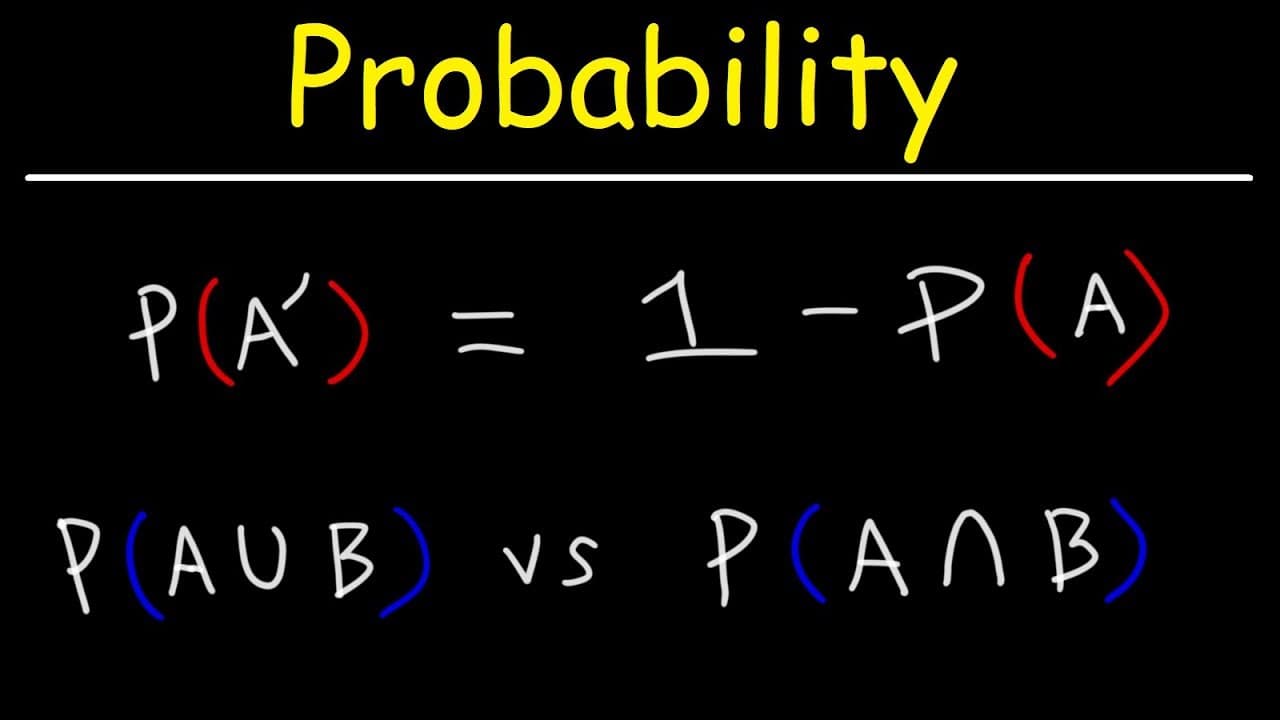
The probability of a complementary event is 1 minus the probability of the original event. For a 6-sided die, event A has probability 2/3 and its complement, outcomes 5 and 6, has probability 1/3, so they sum to 1. The same rule turns a 35% red-marble probability into a 65% not-red probability, and the worked examples show why.
Transcript
let's say we want to roll a 6-sided die and so let's write the sample space for that so we have six possible outcomes we can get any number between one and six now let's say that event a includes the outcomes all natural numbers so less than or equal to four an event B has the outcomes three four and five given us information what is the probabilit... Read More
Key Insights
- 👾 The probability of two events occurring together is calculated by finding the intersection of their sample spaces.
- 🇪🇺 The probability of the union of two events occurring is calculated by considering all favorable outcomes.
- 👾 The complement of an event includes all outcomes not included in the event's sample space.
- 👻 The probability of an event and its complement sum up to 1, allowing the calculation of one based on the other.
- ➖ The formula for calculating the probability of a complement is 1 minus the probability of the event.
Install to Summarize YouTube Videos and Get Transcripts
Explore YouTube Video Summarizer or Get YouTube Transcript Extractor
Questions & Answers
Q: What is the sample space for rolling a 6-sided die?
The sample space contains six possible outcomes: 1, 2, 3, 4, 5, and 6. Each roll produces one number from this set.
Q: How do you calculate the probability of events A and B occurring together?
Find the intersection, meaning the outcomes shared by both events. Events A and B share 3 and 4, so there are two favorable outcomes out of six, giving 2/6 or 1/3, approximately 33%.
Q: What is the probability of event A or event B occurring?
Combine the outcomes in the union of A and B without counting duplicates. This includes every die outcome except 6, so the probability is 5/6, approximately 0.83 or 83.3%.
Q: What is the complement of event A?
The complement contains every outcome in the sample space that is not in event A. Since event A contains 1, 2, 3, and 4, its complement contains 5 and 6.
Q: What is the probability of the complement of event A?
The complement of event A has two favorable outcomes, 5 and 6, among six possible outcomes. Its probability is therefore 2/6, which reduces to 1/3.
Q: What is the probability of event A?
Event A contains four favorable outcomes: 1, 2, 3, and 4. Out of six possible outcomes, its probability is 4/6, which reduces to 2/3.
Q: How are the probabilities of an event and its complement related?
Their probabilities add up to 1. In the die example, P(A) is 2/3 and the probability of A's complement is 1/3, giving 3/3 or 1.
Q: If the probability of selecting a red marble is 35%, what is the probability of selecting a marble that is not red?
Subtract the red-marble probability from 1. Since 35% is 0.35, the calculation is 1 minus 0.35, which gives 0.65 or a 65% chance of selecting a marble that is not red.
Summary & Key Takeaways
-
Definition: A sample space contains every possible outcome of an experiment.
-
Number: A 6-sided die has six possible outcomes, the numbers 1 through 6.
-
Definition: Event A contains outcomes 1, 2, 3, and 4, while event B contains 3, 4, and 5.
-
Definition: The intersection of A and B contains their shared outcomes, 3 and 4.
-
Number: The probability of A and B is 2/6, or 1/3, approximately 33%.
-
Definition: The union of A and B contains every listed outcome except 6.
-
Number: The probability of A or B is 5/6, approximately 0.83 or 83.3%.
-
Definition: The complement of A contains outcomes 5 and 6, everything in the sample space that is not in A.
-
Number: Event A has probability 4/6 or 2/3, while its complement has probability 2/6 or 1/3.
-
Step 1: Calculate a complement by subtracting the event's probability from 1.
-
Number: A 35% red-marble probability equals 0.35, so the not-red probability is 0.65 or 65%.
Read in Other Languages (beta)
Share This Summary 📚
Summarize YouTube Videos and Get Video Transcripts with 1-Click
Try YouTube Summary with ChatGPT & Claude or YouTube Transcript Generator
Explore More Summaries from The Organic Chemistry Tutor 📚


Summarize YouTube Videos and Get Video Transcripts with 1-Click
Try YouTube Summary with ChatGPT & Claude or YouTube Transcript Generator