What Are Marginal Cost and Average Total Cost?
TL;DR
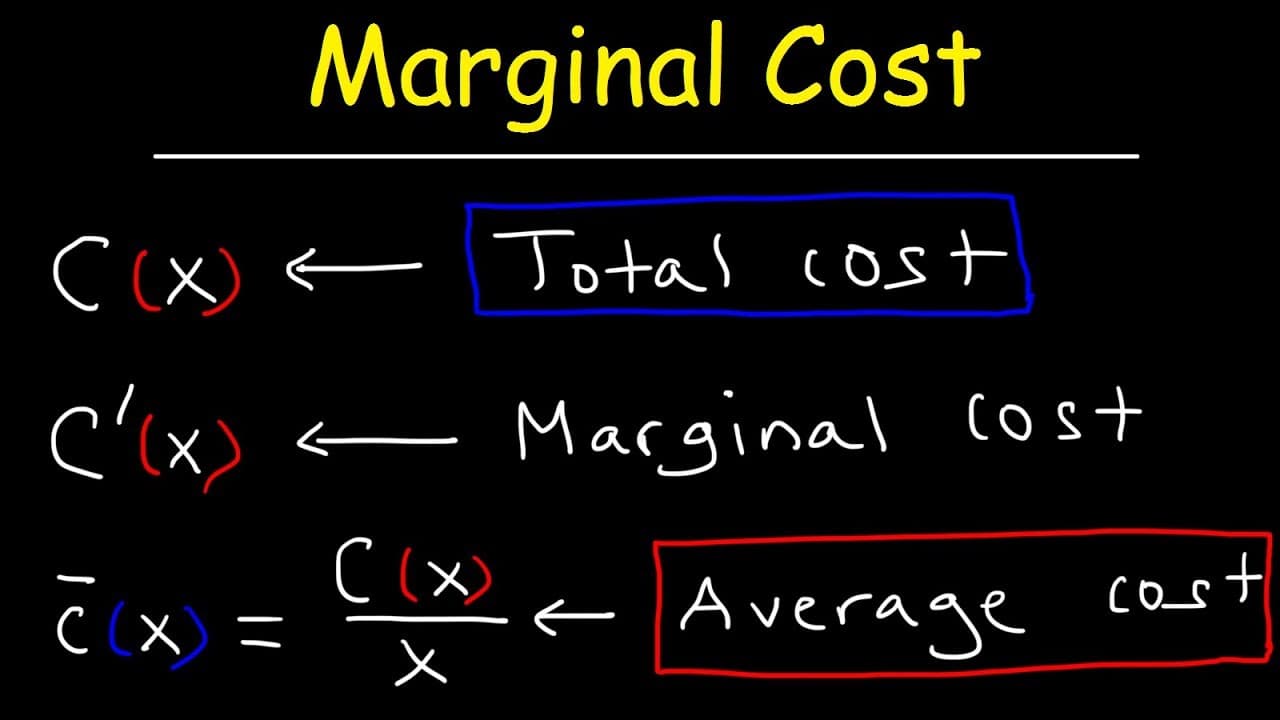
Marginal cost refers to the additional cost of producing one extra unit, calculated by taking the derivative of the cost function. The average total cost is the total cost divided by the number of units produced. The production level that minimizes average total cost occurs when marginal cost equals average total cost.
Transcript
in this video we're going to go over basically this problem on marginal cost and average costs so let's say if we have the cost function c of x and let's say it's equal to 1500 plus five x plus point zero one x square so find the cost average cost and marginal cost to produce two hundred units so let's find the cost at a production level of two hun... Read More
Key Insights
- 🍉 The cost function consists of a constant term, a linear term, and a quadratic term.
- 🇨🇷 The average cost is calculated by dividing the total cost by the production level.
- 🇨🇷 The marginal cost is determined by finding the derivative of the cost function.
- 🇨🇷 The marginal cost represents the additional cost required to produce one extra unit.
- 🇨🇷 The marginal cost and average cost are used to find the production level that minimizes the average cost.
- 🇨🇷 The minimum average cost occurs when the marginal cost equals the average cost.
- 🇨🇷 The total cost to make one additional unit is obtained by plugging in x+1 in the cost function.
Install to Summarize YouTube Videos and Get Transcripts
Explore YouTube Video Summarizer or Get YouTube Transcript Extractor
Questions & Answers
Q: What is the difference between the total cost and the marginal cost?
The total cost refers to the cost of producing a specific quantity of units, while the marginal cost represents the cost of producing an additional unit.
Q: How is the average cost calculated?
The average cost is obtained by dividing the total cost by the production level. It provides the average cost per unit.
Q: How can the marginal cost be determined mathematically?
The marginal cost is found by taking the derivative of the cost function. In this case, it is derived from the given cost function using calculus.
Q: Why is the average cost minimized when the marginal cost equals the average cost?
When the marginal cost equals the average cost, it indicates that producing an additional unit won't increase the average cost significantly, leading to the minimum average cost.
Summary & Key Takeaways
-
The video demonstrates how to find the cost, average cost, and marginal cost for a given production level of 200 units using a cost function.
-
The average cost is determined by dividing the total cost by the production level.
-
The video also explains that the marginal cost is the additional cost required to produce one extra unit and how to calculate it.
Read in Other Languages (beta)
Share This Summary 📚
Summarize YouTube Videos and Get Video Transcripts with 1-Click
Try YouTube Summary with ChatGPT & Claude or YouTube Transcript Generator
Explore More Summaries from The Organic Chemistry Tutor 📚



Summarize YouTube Videos and Get Video Transcripts with 1-Click
Try YouTube Summary with ChatGPT & Claude or YouTube Transcript Generator