【ゆっくり解説】スモールライトを浴びると体はどうなるのか?
TL;DR
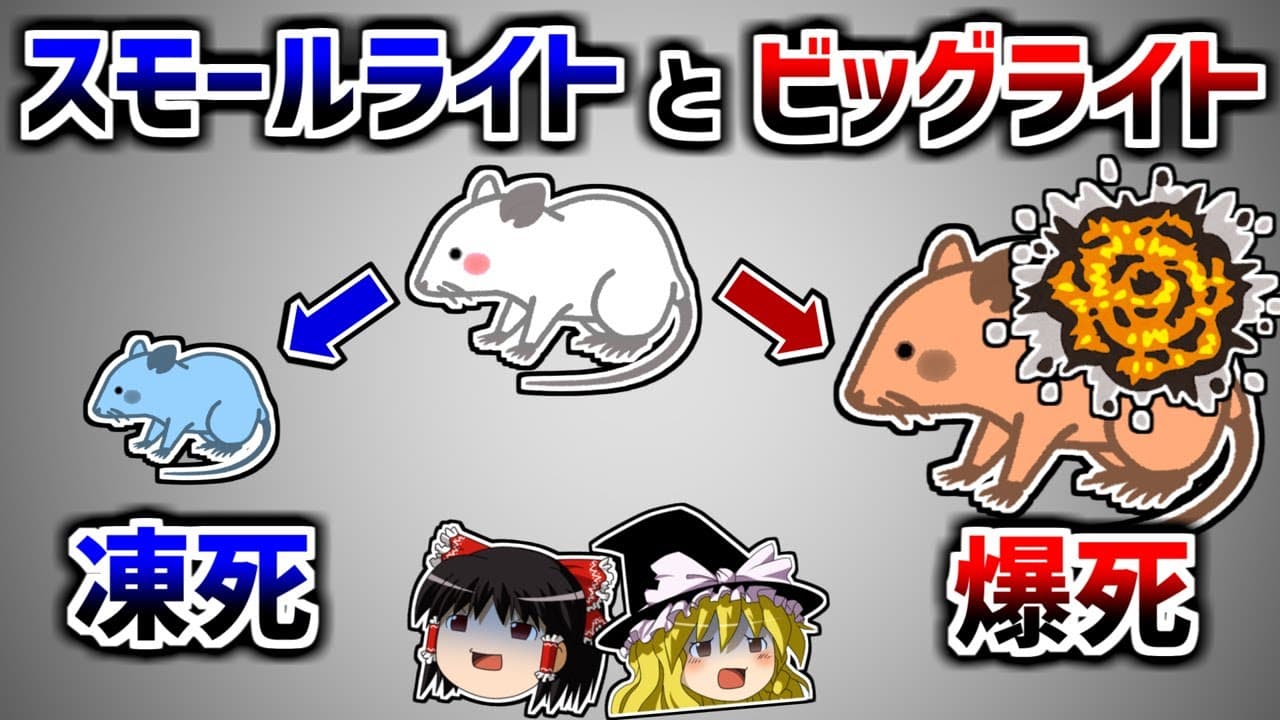
Size-altering lights pose significant biological risks.
Transcript
Hey, Marisa. What's the matter, Reimu? I'm watching a Doraemon cartoon right now. I was wondering if I could have a word with you. What's bothering you? Yeah, it's like Doraemon. You know how they say Small Light and Big Light? You know, the one that makes objects get bigger or smaller when illuminated? You're right, it comes up a lot. What about i... Read More
Key Insights
- The concept of size-altering lights, like those in Doraemon, raises questions about their feasibility and biological implications.
- Changing an animal's size with lights could cause severe thermal regulation issues, leading to death by freezing or overheating.
- Organisms have evolved specific sizes to maintain thermal balance; altering size disrupts this equilibrium, affecting survival.
- The surface area-to-volume ratio is crucial in understanding why size changes lead to thermal imbalance in organisms.
- Larger animals have slower metabolisms, generating less heat per cell, allowing them to maintain stable body temperatures.
- Smaller animals require more food relative to their size to sustain high metabolic rates and maintain body heat.
- Scaling up or down affects structural integrity; larger versions of small animals or vice versa may struggle with weight support.
- The physical abilities of insects, like jumping, are remarkable due to their small size; scaling them up would hinder movement.
Install to Summarize YouTube Videos and Get Transcripts
Explore YouTube Video Summarizer or Get YouTube Transcript Extractor
Questions & Answers
Q: Why can't we use size-altering lights on animals?
Using size-altering lights on animals poses significant biological risks. Changing an animal's size disrupts its thermal regulation, leading to overheating or freezing. The surface area-to-volume ratio becomes imbalanced, affecting the animal's ability to maintain a stable body temperature, ultimately threatening its survival.
Q: How does changing an animal's size affect its metabolism?
Altering an animal's size impacts its metabolism due to changes in the surface area-to-volume ratio. Larger animals have slower metabolisms, generating less heat per cell, while smaller animals require more food relative to their size to sustain higher metabolic rates and maintain body heat. Size changes disrupt this balance.
Q: What are the structural implications of scaling an animal's size?
Scaling an animal's size affects its structural integrity. Larger versions of small animals may struggle to support their weight, as muscle strength increases proportionally to cross-sectional area, not volume. This imbalance can lead to issues with weight support and movement, hindering the animal's ability to function.
Q: Why do smaller animals consume more food relative to their size?
Smaller animals consume more food relative to their size to sustain high metabolic rates necessary for maintaining body temperature. Their cells must remain active to generate sufficient heat, requiring a greater energy intake. This contrasts with larger animals, which have slower metabolisms and lower relative food consumption.
Q: How does the surface area-to-volume ratio affect thermal regulation?
The surface area-to-volume ratio is crucial for thermal regulation. A larger surface area relative to volume allows for more efficient heat dissipation. When this ratio is disrupted by size changes, an organism struggles to maintain a stable body temperature, leading to overheating or freezing, depending on the size alteration.
Q: What makes the physical abilities of insects remarkable?
Insects' physical abilities are remarkable due to their small size, which allows them to perform feats like jumping great distances relative to their body length. This is possible because of their lightweight and efficient structural design. Scaling them up would hinder movement, as their physical capabilities are size-specific.
Q: Why is it dangerous to use size-altering lights on humans?
Using size-altering lights on humans is dangerous as it would cause severe structural and thermal regulation issues. A human scaled up in size would struggle to support increased weight and maintain body temperature, leading to potential collapse or overheating. The body's adaptation to its original size is crucial for survival.
Q: How do larger animals maintain stable body temperatures?
Larger animals maintain stable body temperatures through slower metabolisms, generating less heat per cell. Their larger volume and surface area balance heat production and dissipation, allowing them to maintain a consistent body temperature. This adaptation is crucial for their survival at larger sizes, preventing overheating.
Summary & Key Takeaways
-
The video explores the hypothetical effects of using size-altering lights on animals, drawing parallels with Doraemon's gadgets. It discusses the biological challenges and dangers posed by changing an organism's size, such as thermal regulation issues leading to overheating or freezing.
-
The concept of size change is explained through the surface area-to-volume ratio, highlighting why organisms are adapted to specific sizes. Larger animals have slower metabolisms, generating less heat, while smaller animals consume more food relative to their size to maintain body temperature.
-
The discussion extends to structural implications, noting that scaling up small animals would lead to support and movement issues. The unique abilities of insects are attributed to their small size, and altering this would disrupt their physical capabilities, emphasizing the importance of size-specific adaptations.
Read in Other Languages (beta)
Share This Summary 📚
Summarize YouTube Videos and Get Video Transcripts with 1-Click
Try YouTube Summary with ChatGPT & Claude or YouTube Transcript Generator
Explore More Summaries from るーいのゆっくり科学 📚




Summarize YouTube Videos and Get Video Transcripts with 1-Click
Try YouTube Summary with ChatGPT & Claude or YouTube Transcript Generator