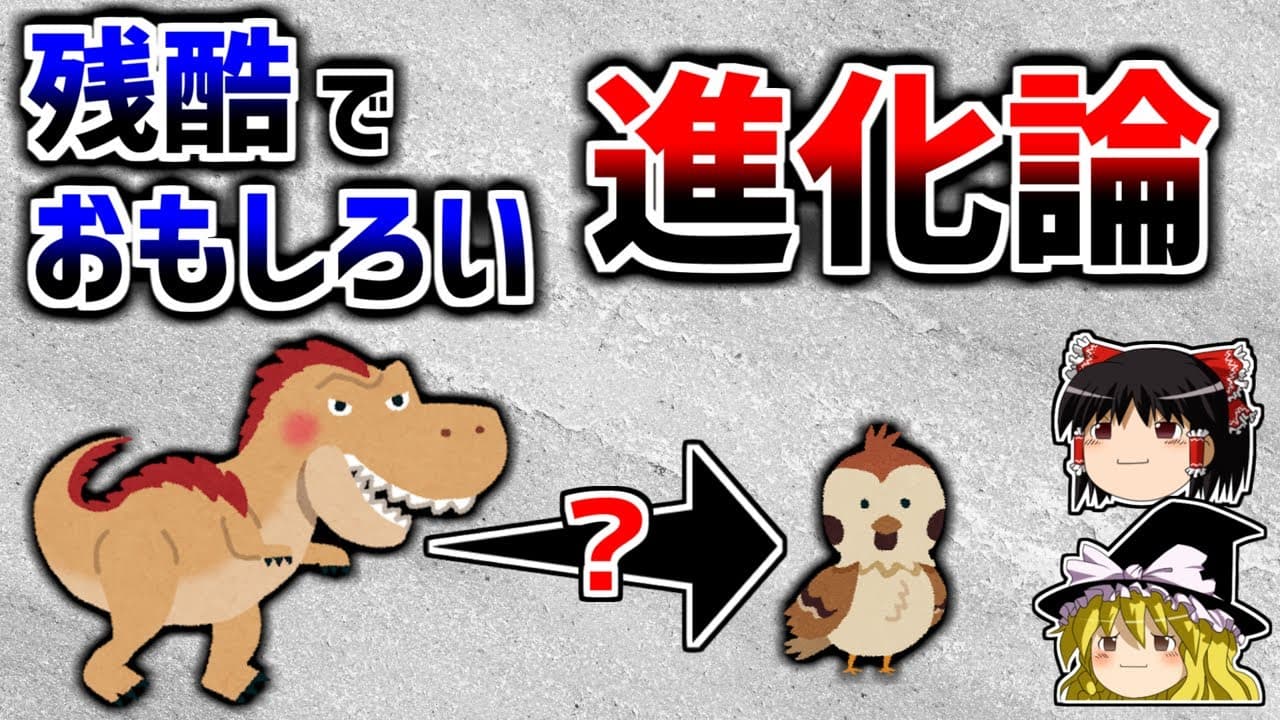
【ゆっくり解説】残酷でおもしろい「進化論」-鳥になった恐竜-
TL;DR
Evolution is driven by natural selection, not purposeful change.
Transcript
Oh, just once I'd like to fly through the sky like a bird. What are you talking about, Reimu? No, I was bored today, so I just kept looking out. I saw all kinds of birds flying around, and I thought it looked like fun. I see. So you envy birds that can fly. Something like that. You know, I'm pretty sure that living things are... I thought we were s... Read More
Key Insights
- Evolution is not a purposeful process; it is driven by natural selection where advantageous mutations are preserved over time.
- The development of traits, such as a giraffe's long neck, is due to random mutations that prove beneficial for survival and reproduction.
- Natural selection can be directional, favoring certain traits, or stabilizing, maintaining existing traits if they are optimal for survival.
- Evolution is not synonymous with progress; it involves adaptations to environmental conditions, which may include loss or gain of traits.
- The evolution of wings in birds from dinosaurs was gradual, with early wings serving purposes other than flight, such as temperature regulation or courtship.
- Human evolution involved changes in traits like color vision, which fluctuated over time, reflecting adaptation rather than linear improvement.
- Death is an integral part of evolution, allowing for natural selection to maintain species' adaptability to changing environments.
- Evolutionary theory, as proposed by Darwin, emphasizes the importance of reproductive success over individual longevity in driving evolutionary changes.
Install to Summarize YouTube Videos and Get Transcripts
Explore YouTube Video Summarizer or Get YouTube Transcript Extractor
Questions & Answers
Q: How does natural selection drive evolution?
Natural selection drives evolution by favoring individuals with advantageous traits that increase their chances of survival and reproduction. These traits arise from random mutations. Over time, individuals with beneficial traits are more likely to reproduce and pass these traits to their offspring, leading to evolutionary changes in the population.
Q: Why can't humans evolve to fly by training their arms?
Humans cannot evolve to fly by training their arms because evolution does not occur through acquired characteristics or intentional effort. Evolution is driven by genetic mutations that offer a reproductive advantage. For humans to evolve wings, a beneficial mutation would need to occur and be passed down over many generations, which is highly improbable.
Q: What is the difference between directional and stabilizing selection?
Directional selection occurs when natural selection favors a specific trait, leading to a shift in the population's characteristics in one direction. Stabilizing selection, on the other hand, favors the average trait in a population, maintaining the status quo by selecting against extreme variations. Both types of selection play roles in shaping evolutionary outcomes.
Q: How did bird wings evolve from dinosaurs?
Bird wings evolved from dinosaurs through a gradual process where early wing-like structures served functions other than flight, such as regulating body temperature or aiding in courtship displays. Over time, these structures were refined by natural selection, eventually leading to wings capable of flight. This demonstrates how evolution repurposes existing traits for new functions.
Q: Why is evolution not considered progress?
Evolution is not considered progress because it does not aim for improvement or perfection. Instead, it involves adaptations to changing environments, which can include both the gain and loss of traits. Evolution is about survival and reproductive success, not achieving a higher state of being. Different organisms evolve different traits based on their ecological niches.
Q: What role does death play in evolution?
Death plays a crucial role in evolution by allowing natural selection to operate. As individuals with less advantageous traits die, those with beneficial traits are more likely to survive and reproduce. This process ensures that traits conducive to survival and reproduction become more common in the population, driving evolutionary change and maintaining species' adaptability.
Q: How does the evolution of color vision illustrate evolutionary adaptation?
The evolution of color vision illustrates evolutionary adaptation by showing how traits can change in response to environmental needs. Human ancestors had dichromatic vision, but as they evolved, trichromatic vision developed, enhancing color discrimination. This adaptation improved survival and reproductive success, demonstrating evolution's role in optimizing organisms for their environments.
Q: What misconceptions about evolution are addressed in the video?
The video addresses misconceptions such as the belief that evolution is a purposeful process or that humans can evolve wings through effort. It clarifies that evolution is driven by random mutations and natural selection, not intentional change. The video also explains that evolution is not linear progress but adaptation to environmental conditions, with traits being gained or lost over time.
Summary & Key Takeaways
-
The video explains that evolution is a process driven by natural selection, where advantageous traits are preserved and passed down through generations. Misconceptions about evolution, such as the belief that it is a purposeful process, are clarified through examples like the giraffe's neck.
-
Evolution involves both the gain and loss of traits, as seen in the development of color vision in humans. The process is not linear progress but adaptation to environmental conditions, with traits being favored or discarded based on reproductive success.
-
The origins of bird wings are discussed, highlighting that early wings served functions other than flight. The video also touches on the philosophical aspect of evolution, noting that death is necessary for natural selection to maintain a species' adaptability.
Read in Other Languages (beta)
Share This Summary 📚
Summarize YouTube Videos and Get Video Transcripts with 1-Click
Try YouTube Summary with ChatGPT & Claude or YouTube Transcript Generator
Explore More Summaries from るーいのゆっくり科学 📚
Summarize YouTube Videos and Get Video Transcripts with 1-Click
Try YouTube Summary with ChatGPT & Claude or YouTube Transcript Generator