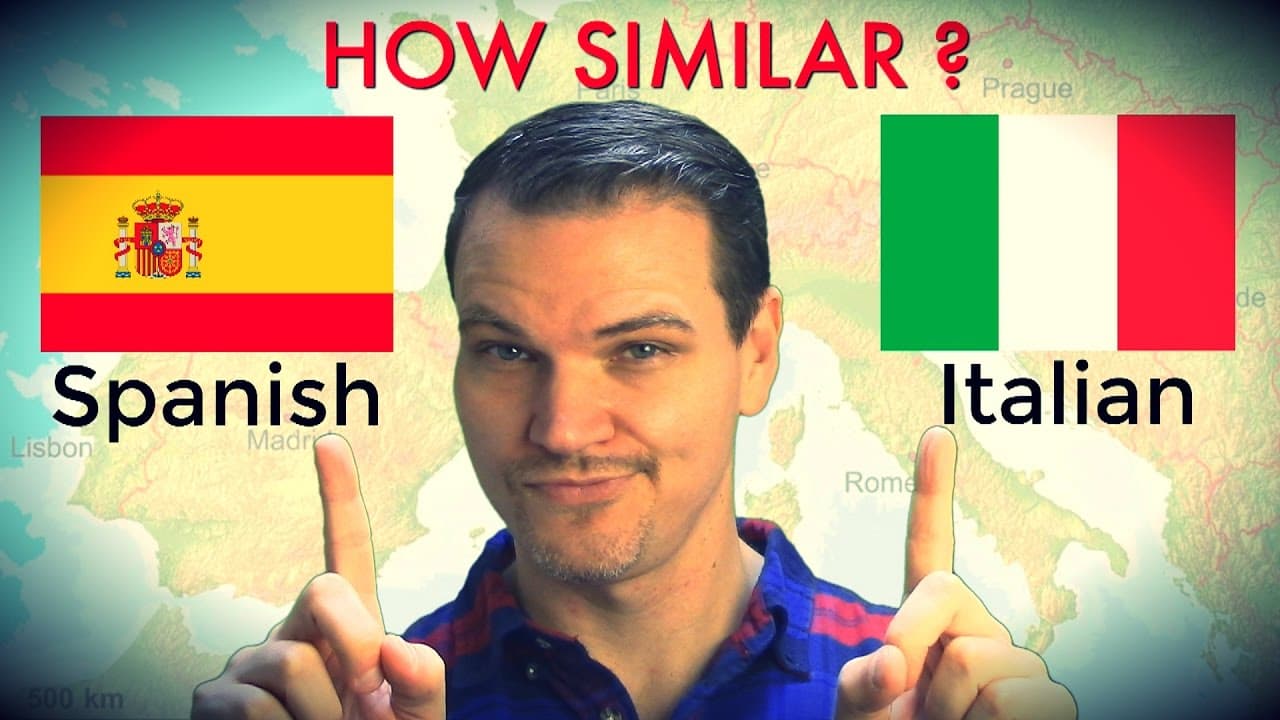
How Similar Are Spanish and Italian?
TL;DR
Spanish and Italian share similarities but have notable differences.
Transcript
Follow LangFocus on Facebook, Twitter and Instagram. Hello, everyone. Welcome to the LangFocus channel and my name is Paul. Today, we'll be answering the question... How similar are Spanish and Italian? Spanish and Italian are both members of the Romance Language Family, which developed from dialects of Vulgar Latin which were spoken throughout ... Read More
Key Insights
- Spanish and Italian are both Romance languages with 82% lexical similarity, allowing for some mutual intelligibility, especially in written form.
- Spanish and Italian share many cognates, but there are also false friends that can cause confusion due to different meanings.
- Spanish has more in common lexically with Portuguese, while Italian shares more vocabulary with French, yet Spanish and Italian are closer in pronunciation.
- Both languages have five common vowel sounds, but Italian includes two additional vowel sounds, impacting pronunciation differences.
- The pronunciation of 'c' and 'g' before 'i' or 'e' differs between Spanish and Italian, leading to different soft sounds.
- Italian words often end in vowels, whereas Spanish words frequently end in consonants, showcasing a key pronunciation difference.
- Italian grammar is slightly more complex, with more variations in articles and possessive pronouns compared to Spanish.
- Despite similarities in word order and verb conjugations, Spanish and Italian have distinct vocabulary, pronunciation, and orthography.
Install to Summarize YouTube Videos and Get Transcripts
Explore YouTube Video Summarizer or Get YouTube Transcript Extractor
Questions & Answers
Q: How similar are Spanish and Italian in terms of vocabulary?
Spanish and Italian have about 82% lexical similarity, meaning that 82% of the words in either language have cognate vocabulary in the other language. This high percentage allows for some mutual intelligibility, particularly in written form, although there are also false friends that learners must be cautious of.
Q: What are some pronunciation differences between Spanish and Italian?
Italian includes two additional vowel sounds beyond the five common ones shared with Spanish. Moreover, Italian words typically end in vowels, while Spanish words often end in consonants. The pronunciation of 'c' and 'g' before 'i' or 'e' also differs, with Italian having distinct soft sounds compared to Spanish.
Q: How do Spanish and Italian handle soft 'c' and 'g' sounds?
In Spanish, the soft 'c' sounds like 'th' or 's', while in Italian, it sounds like 'tch'. For the soft 'g', Spanish uses a sound similar to 'h', whereas Italian uses a 'j' sound. These differences affect how similar words are pronounced in each language.
Q: What are some grammatical differences between Spanish and Italian?
Italian grammar is more complex, with more variations in articles and possessive pronouns. For instance, Italian indefinite articles change before certain consonants, and possessive pronouns are often used with definite articles. Spanish has a simpler system with fewer variations in these areas.
Q: How does word order compare between Spanish and Italian?
The general word order of Spanish and Italian is very similar, allowing sentences to often be translated word for word. Both languages typically omit the subject pronoun as the verb is conjugated for person and number, maintaining a similar structure in sentence construction.
Q: Are there differences in verb conjugation between Spanish and Italian?
While the verb tenses and conjugation systems in Spanish and Italian are quite similar, the exact conjugations are not identical. Italian verbs often end in a double consonant and a vowel, whereas Spanish verbs do not. Additionally, Italian uses two auxiliary verbs for the present perfect tense, while Spanish uses only one.
Q: What are some challenges learners face with false friends in Spanish and Italian?
False friends are words that appear similar in Spanish and Italian but have different meanings. For example, 'pronto' means 'soon' in Spanish but 'ready' in Italian. Such false friends can cause confusion for learners, emphasizing the need for careful study of vocabulary beyond surface similarities.
Q: How does knowledge of one language help in learning the other?
Knowledge of either Spanish or Italian can aid in learning the other due to their shared Romance language roots. Familiarity with similar vocabulary, grammar structures, and pronunciation aids comprehension. However, attention to distinct differences, such as false friends and pronunciation nuances, is necessary for accurate language production.
Summary & Key Takeaways
-
Spanish and Italian are both Romance languages with significant similarities, including lexical overlap and mutual intelligibility, especially in written form. However, they also have distinct differences in vocabulary, pronunciation, and grammar, making them unique languages.
-
Cognates are common between Spanish and Italian, but learners must be wary of false friends, words that look similar but have different meanings. Pronunciation differences arise from additional vowel sounds in Italian and variations in soft 'c' and 'g' sounds.
-
Grammar in Italian is more complex than in Spanish, with additional rules for articles and possessive pronouns. Despite these differences, both languages share a similar word order and verb conjugation system, aiding mutual understanding.
Read in Other Languages (beta)
Share This Summary 📚
Summarize YouTube Videos and Get Video Transcripts with 1-Click
Try YouTube Summary with ChatGPT & Claude or YouTube Transcript Generator
Explore More Summaries from Langfocus 📚


Summarize YouTube Videos and Get Video Transcripts with 1-Click
Try YouTube Summary with ChatGPT & Claude or YouTube Transcript Generator