Basic Operation on Discrete Time Signals (Problem 3) | Representation of Signals | Signals & Systems
TL;DR
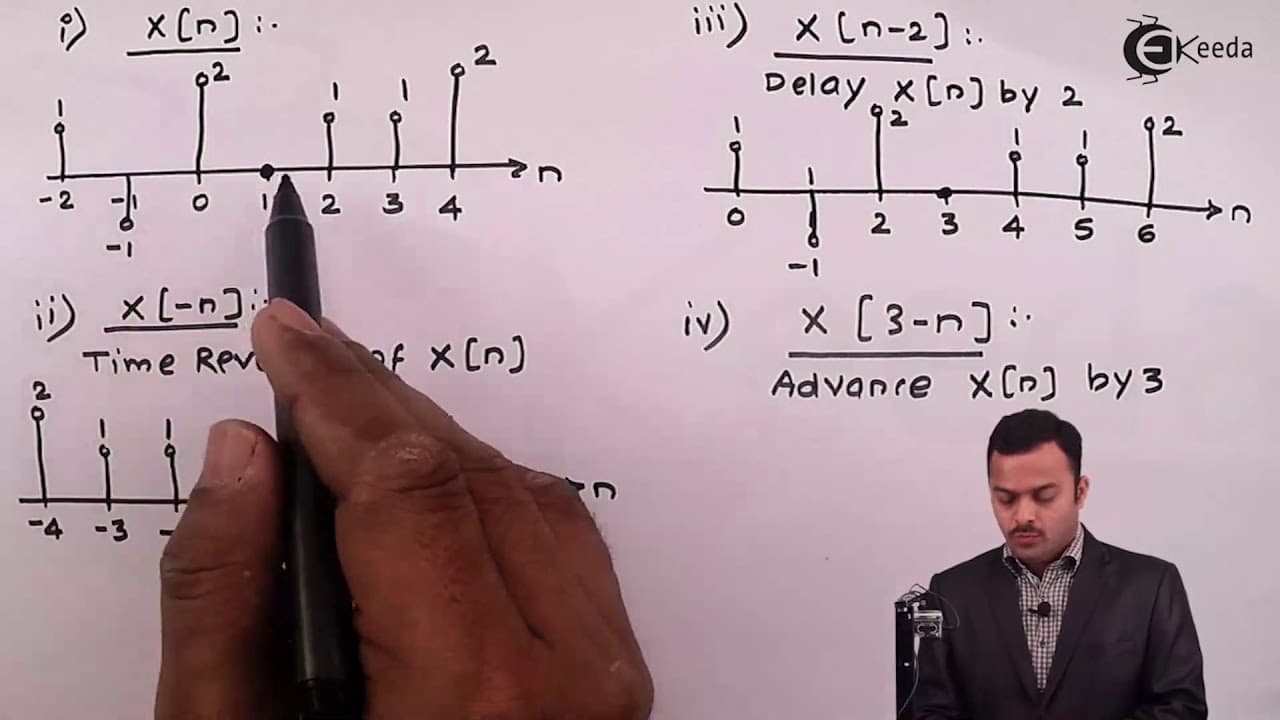
Analyzing basic signal operations like time reversal, time shifting, and time scaling for a discrete time signal.
Transcript
hi friends in this video we are going to see basic signal operations like time reversal time shifting time scaling for a discrete time signal so x often is a discrete time signal given as and origin is this so this is a indication of origin means what this is n equal to zero point and for this signal we have to obtain obtain means we have to plot a... Read More
Key Insights
- ⌛ Signal operations like time reversal, time shifting, and time scaling impact the representation of a discrete time signal.
- 📡 Multiplying signals involves instant-by-instant computations to derive the resulting signal.
- 🥺 Compression in time scaling of discrete signals can lead to loss of data points that are not multiples of the scaling factor.
- ⌛ The combination of operations like time reversal, time shifting, and time scaling allows for a comprehensive analysis of signal behavior.
Install to Summarize YouTube Videos and Get Transcripts
Explore YouTube Video Summarizer or Get YouTube Transcript Extractor
Questions & Answers
Q: What are the basic signal operations covered in the video?
The video covers basic signal operations like time reversal, time shifting, and time scaling for a discrete time signal to analyze their effects on the signal.
Q: How do you obtain a signal x(2n+1)?
To get x(2n+1), the signal is first shifted by one unit towards the y-axis and then compressed by a factor of 2, leading to potential loss of data due to non-integer multiples.
Q: What happens when multiplying x(n) and u(n-1)?
Multiplying x(n) and u(n-1) results in a signal where the value is calculated by instant-by-instant multiplication, yielding a signal with specific values based on the multiplication result.
Q: Explain the signal x(n-1) delta(n-2).
The signal x(n-1) delta(n-2) is obtained by delaying x(n-1) by one unit and then multiplying it with the impulse function delta(n-2), resulting in a signal where every point yields 0 when multiplied.
Summary & Key Takeaways
-
Explained basic signal operations like time reversal, time shifting, and time scaling for a discrete time signal.
-
Demonstrated plotting of signals x(n), x(-n), x(n-2), x(3-n), x(2n+1), x(4-2n), x(n)u(n-1), and x(n-1) delta(n-2).
-
Showed how to obtain each signal through a combination of time reversal, time shifting, and time scaling.
Read in Other Languages (beta)
Share This Summary 📚
Summarize YouTube Videos and Get Video Transcripts with 1-Click
Try YouTube Summary with ChatGPT & Claude or YouTube Transcript Generator
Explore More Summaries from Ekeeda 📚



Summarize YouTube Videos and Get Video Transcripts with 1-Click
Try YouTube Summary with ChatGPT & Claude or YouTube Transcript Generator