Detecting Faces (Viola Jones Algorithm) - Computerphile
TL;DR
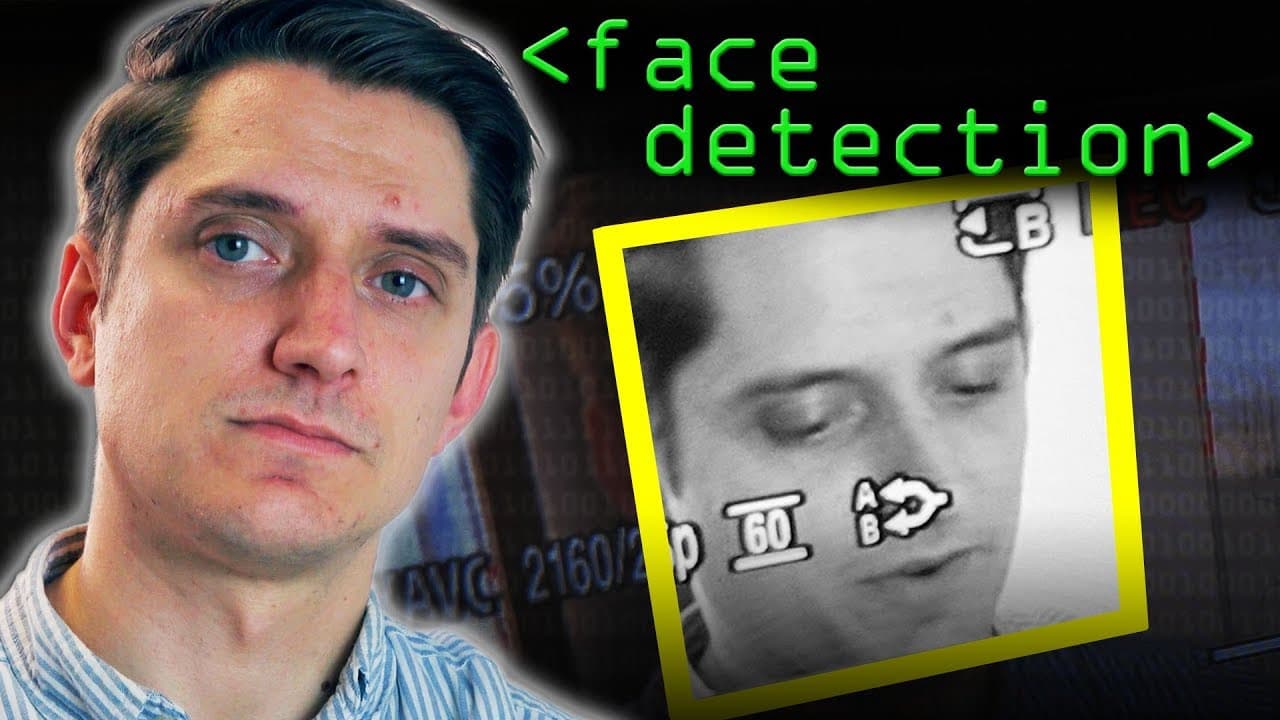
Face detection can be accomplished using a non-deep learning approach developed in the early 2000s, using simple features and a boosted cascade classifier.
Transcript
I'd like to talk about face detection All right. So this is the idea or if you've got a picture with one face in it or many faces in it how do we find those faces and The standard approaches is "Ah, we'll just use deep learning" Now you can use deep learning to find faces But actually the approach that everyone uses isn't deep learning and it was d... Read More
Key Insights
- 😀 Face detection can be achieved without deep learning using the Viola-Jones algorithm.
- ❓ The algorithm relies on simple features and a boosted cascade classifier.
- ❓ The integral image technique improves the efficiency of calculating rectangular regions.
Install to Summarize YouTube Videos and Get Transcripts
Explore YouTube Video Summarizer or Get YouTube Transcript Extractor
Questions & Answers
Q: How does face detection using simple features differ from deep learning-based approaches?
Deep learning-based approaches analyze complex hierarchies of features to identify faces, while the Viola-Jones algorithm focuses on quick decisions using simple features. It looks for differences in brightness or darkness between facial regions, rather than specific facial features like eyes or nose.
Q: How does the Viola-Jones algorithm handle different facial variations?
The algorithm evaluates thousands of combinations of 2, 3, and 4 rectangular features for a given dataset of faces and non-faces. It learns which features best separate positives from negatives, allowing it to adapt to different facial variations.
Q: How does the integral image technique improve the efficiency of face detection?
The integral image precomputes sums of pixel values, enabling quick addition and subtraction of rectangular regions. This technique significantly reduces the computational load, making face detection faster.
Q: Why is the Viola-Jones algorithm still used today despite the popularity of deep learning?
The algorithm remains effective and efficient for face detection tasks. Many cameras and devices utilize this technique for real-time face detection because it achieves the desired trade-off between accuracy, speed, and false positives/negatives.
Summary & Key Takeaways
-
Face detection is a challenging problem due to variations in face size, resolution, and presence of different facial features.
-
In the early 2000s, Paul Viola and Michael Jones introduced a paper on rapid object detection, which presented a non-deep learning approach using handcrafted features and a boosted cascade classifier.
-
The algorithm uses simple rectangular features and an integral image technique to quickly identify possible face regions and make a decision on whether it is a face or not.
Read in Other Languages (beta)
Share This Summary 📚
Summarize YouTube Videos and Get Video Transcripts with 1-Click
Try YouTube Summary with ChatGPT & Claude or YouTube Transcript Generator
Explore More Summaries from Computerphile 📚






Summarize YouTube Videos and Get Video Transcripts with 1-Click
Try YouTube Summary with ChatGPT & Claude or YouTube Transcript Generator