What Is the Nature of Space and Time?
TL;DR
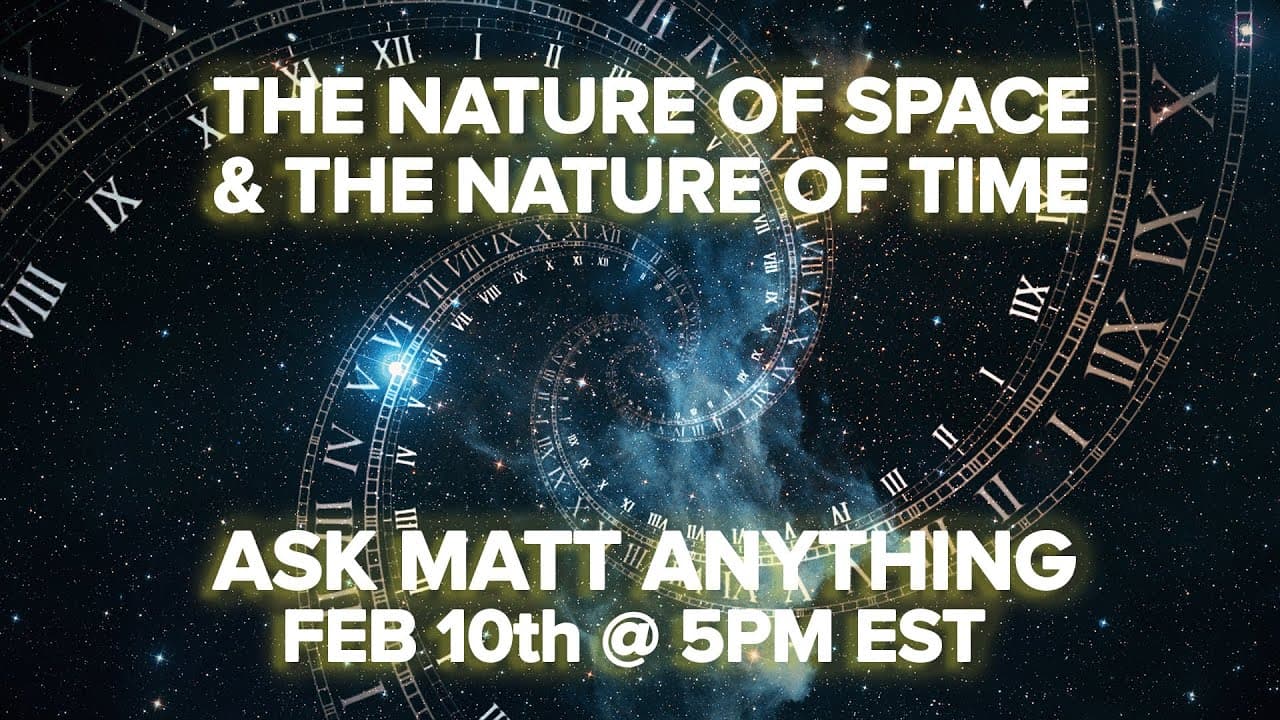
The nature of space and time is still largely unknown, but theories like Einstein's space-time framework and the block universe suggest they are intertwined and evolve based on observer perspective. Space expands through a scale factor rather than objects moving apart, and the flow of time is linked to increasing entropy, defining an arrow of time in our universe.
Transcript
welcome dennis of space time i hope you could hear me okay this is the second or third in our now erratically but semi-regular amas in this case however it's i guess an a-m-a-a ask me almost everything we polled you to ask if you would prefer that we do a topic focused ama or a true ama ask me anything the poll lasted for a few days and i think the... Read More
Key Insights
- The nature of space and time remains largely unknown, with ongoing debates about their true essence and properties.
- Space and time were unified into space-time by Einstein, creating a dynamic framework dependent on the observer's reference frame.
- The block universe theory suggests that all points in time exist simultaneously, challenging the traditional perception of time's flow.
- Quantum mechanics and general relativity clash at Planck scales, indicating the need for a new theory of quantum gravity.
- String theory and loop quantum gravity are among the theories attempting to explain the fundamental structure of space and time.
- The concept of space expanding is often misunderstood; it involves the increase of the scale factor, stretching the spatial grid.
- Gravity's effect on space-time is often visualized with analogies like a rubber sheet, though these are imperfect representations.
- The arrow of time is primarily defined by entropy, with time appearing to flow in the direction of increasing disorder.
Install to Summarize YouTube Videos and Get Transcripts
Explore YouTube Video Summarizer or Get YouTube Transcript Extractor
Questions & Answers
Q: What is the nature of space and time?
The nature of space and time is still a subject of debate and exploration. While we have mathematical descriptions and theories, such as Einstein's space-time concept, the true essence and properties of space and time remain largely unknown. Various theories, including string theory and loop quantum gravity, attempt to explain their fundamental structure, but no definitive answers have been found.
Q: How does Einstein's theory change our understanding of space and time?
Einstein's theory unified space and time into a single entity called space-time, fundamentally changing our understanding of these dimensions. According to his theory, space and time are not separate entities but are interconnected and dependent on the observer's reference frame. This means that the perception of time and space can vary based on the observer's motion and position, leading to phenomena such as time dilation and the relativity of simultaneity.
Q: What is the block universe theory?
The block universe theory posits that all points in time—past, present, and future—exist simultaneously in a 'block' of space-time. This challenges the traditional view of time as a flowing entity and suggests a more static perspective where time is another dimension like space. In this view, events are fixed and unchanging, and the flow of time is an illusion created by our perception.
Q: How does the expansion of space work?
The expansion of space is described by the increase of the scale factor, which stretches the spatial grid over time. This expansion is not about objects moving through space but rather the space itself expanding, causing distances between objects to increase. This concept is central to understanding the expanding universe and is mathematically described by the Friedmann equations.
Q: What role does gravity play in shaping space-time?
Gravity shapes space-time by curving it, which can be visualized with analogies like a rubber sheet being deformed by a heavy object. This curvature affects the paths of objects, causing them to follow curved trajectories. Gravity's influence on space-time is a key concept in general relativity, where massive objects like stars and planets warp the space-time around them.
Q: What defines the arrow of time?
The arrow of time is primarily defined by entropy, the measure of disorder in a system. In our universe, entropy tends to increase over time, leading to the perception of time flowing in one direction—from a state of lower entropy to higher entropy. This increase in disorder is a fundamental aspect of thermodynamics and provides a directionality to time.
Q: Can the speed of light change over time?
The speed of light is defined as a constant in relativity, but some theories propose that it might have varied over time. Changes in the speed of light could mimic the effects of an expanding universe, but such changes would require adjustments in other fundamental constants. Currently, there is no observational evidence for variations in the speed of light, and it remains a cornerstone of modern physics.
Q: How do quantum mechanics and general relativity conflict at small scales?
Quantum mechanics and general relativity conflict at Planck scales, where the concepts of smooth, continuous space-time break down. At these scales, the predictions of general relativity and quantum mechanics become incompatible, leading to the need for a new theory of quantum gravity. This conflict highlights the limitations of our current understanding and the need for a unified theory that can reconcile these two foundational pillars of physics.
Summary & Key Takeaways
-
The discussion delves into the complex and largely unknown nature of space and time, highlighting the challenges in defining their properties and essence. The conversation covers various theories and concepts, including Einstein's unification of space-time, the block universe theory, and the conflicts between quantum mechanics and general relativity.
-
The expansion of space is explained through the concept of the scale factor, which stretches the spatial grid over time. This expansion is often misunderstood, and the discussion clarifies that it doesn't imply objects moving through space but rather the space itself expanding.
-
Gravity's influence on space-time is visualized using analogies like a rubber sheet, though these are imperfect. The arrow of time is linked to entropy, suggesting that time flows in the direction of increasing disorder. The discussion also touches on the potential variability of the speed of light over time.
Read in Other Languages (beta)
Share This Summary 📚
Summarize YouTube Videos and Get Video Transcripts with 1-Click
Try YouTube Summary with ChatGPT & Claude or YouTube Transcript Generator
Explore More Summaries from PBS Space Time 📚

Summarize YouTube Videos and Get Video Transcripts with 1-Click
Try YouTube Summary with ChatGPT & Claude or YouTube Transcript Generator