What Is Personal Identity and Why Is It Important?
TL;DR
Personal identity refers to what makes you the same person over time, typically considered through the Body Theory and Memory Theory. While Body Theory ties identity to a physical body, Memory Theory connects it to the continuity of memories. Understanding personal identity is crucial as it affects our social obligations, responsibilities, and how we navigate relationships throughout our lives.
Transcript
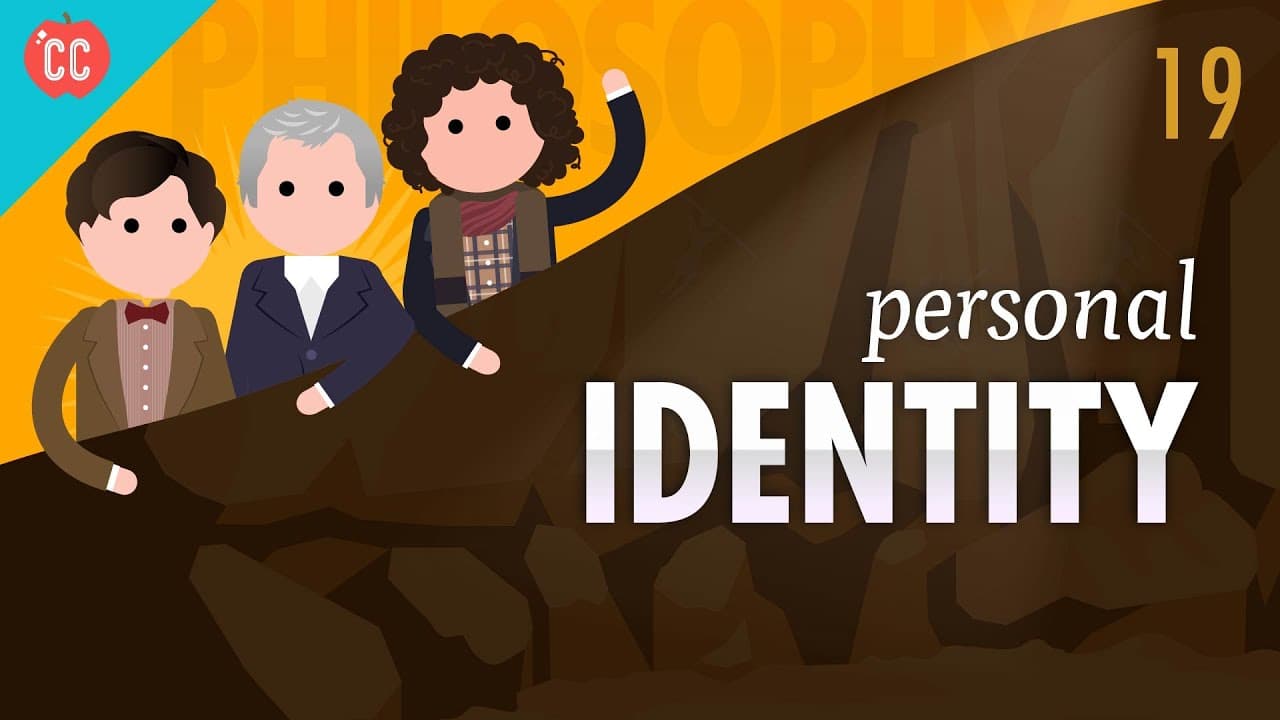
Crash Course Philosophy is brought to you by Squarespace. Squarespace: share your passion with the world. Who is The Doctor? Is it this guy? Or this one? How about him? As any good Whovian knows, the answer is yes, all of them. But, also, wait: No. In the show Doctor Who, each incarnation of The Doctor has a completely different body, different man... Read More
Key Insights
- The concept of personal identity questions what makes a person the same over time, despite physical and mental changes.
- The Body Theory posits that personal identity is tied to having the same physical body from birth to death, though bodies change over time.
- The Memory Theory suggests personal identity is maintained through connected memories, but raises issues with memory loss and false memories.
- Philosopher Bernard Williams' thought experiment challenges where we believe our identity lies, questioning the link between body and mind.
- John Locke's Memory Theory argues that identity persists through a chain of memories, but it struggles with gaps and inaccuracies in memory.
- The persistence of identity is crucial for social and ethical obligations, affecting promises, responsibilities, and personal relationships.
- The episode questions the necessity of a continuous personal identity, linking it to practical life aspects like work and social contracts.
- The discussion highlights the philosophical struggle with defining identity, impacting how we perceive ourselves and others.
Install to Summarize YouTube Videos and Get Transcripts
Explore YouTube Video Summarizer or Get YouTube Transcript Extractor
Questions & Answers
Q: What is the Body Theory of personal identity?
The Body Theory suggests that personal identity is maintained by having the same physical body throughout one's life. However, it faces challenges as the body undergoes constant changes, such as skin shedding and cell renewal, raising questions about how much physical change alters identity.
Q: How does the Memory Theory define personal identity?
The Memory Theory, proposed by John Locke, defines personal identity through a chain of connected memories. It argues that identity persists as long as a person can remember past experiences, but it struggles with issues like memory loss and the reliability of memories.
Q: What is Bernard Williams' thought experiment about identity?
Bernard Williams' thought experiment involves a mad scientist transferring mental content between two people, challenging the notion of identity. It questions whether identity lies in the physical body or the mental content, as one must decide which body receives a reward or punishment post-transfer.
Q: Why is the persistence of personal identity important?
The persistence of personal identity is crucial for maintaining social and ethical obligations. It affects how promises and responsibilities are upheld, as identity continuity ensures that individuals remain accountable for their actions and relationships over time.
Q: What are the challenges of the Memory Theory?
The Memory Theory faces challenges with memory gaps and inaccuracies. It struggles to account for identity during periods of memory loss, such as infancy or dementia, and questions the impact of false memories on one's sense of self and continuity.
Q: How does the episode relate personal identity to everyday life?
The episode links personal identity to practical aspects like work and social contracts. It emphasizes that identity persistence is foundational for societal functions, affecting how people fulfill obligations, maintain relationships, and perceive their own roles and responsibilities.
Q: What are the limitations of the Body Theory?
The Body Theory's limitation lies in its inability to account for the constant physical changes a body undergoes. It raises questions about how much physical alteration can occur before a person is considered a different individual, challenging the notion of identity being solely body-based.
Q: How does the episode challenge the necessity of a continuous identity?
The episode questions the necessity of a continuous identity by exploring philosophical theories that challenge the idea of a consistent self. It suggests that identity might not be as fixed as commonly believed, impacting how individuals perceive themselves and navigate social expectations.
Summary & Key Takeaways
-
The episode delves into personal identity, examining whether it resides in the physical body or the continuity of memories. It challenges the notion of a consistent self through philosophical theories and thought experiments.
-
Through the Body Theory and Memory Theory, the episode explores the complexities of identity, questioning how changes in body and memory affect a person's continuity over time.
-
The importance of personal identity is emphasized in relation to social contracts and ethical obligations, questioning the implications of identity persistence on everyday life and relationships.
Read in Other Languages (beta)
Share This Summary 📚
Summarize YouTube Videos and Get Video Transcripts with 1-Click
Try YouTube Summary with ChatGPT & Claude or YouTube Transcript Generator
Explore More Summaries from CrashCourse 📚




Summarize YouTube Videos and Get Video Transcripts with 1-Click
Try YouTube Summary with ChatGPT & Claude or YouTube Transcript Generator