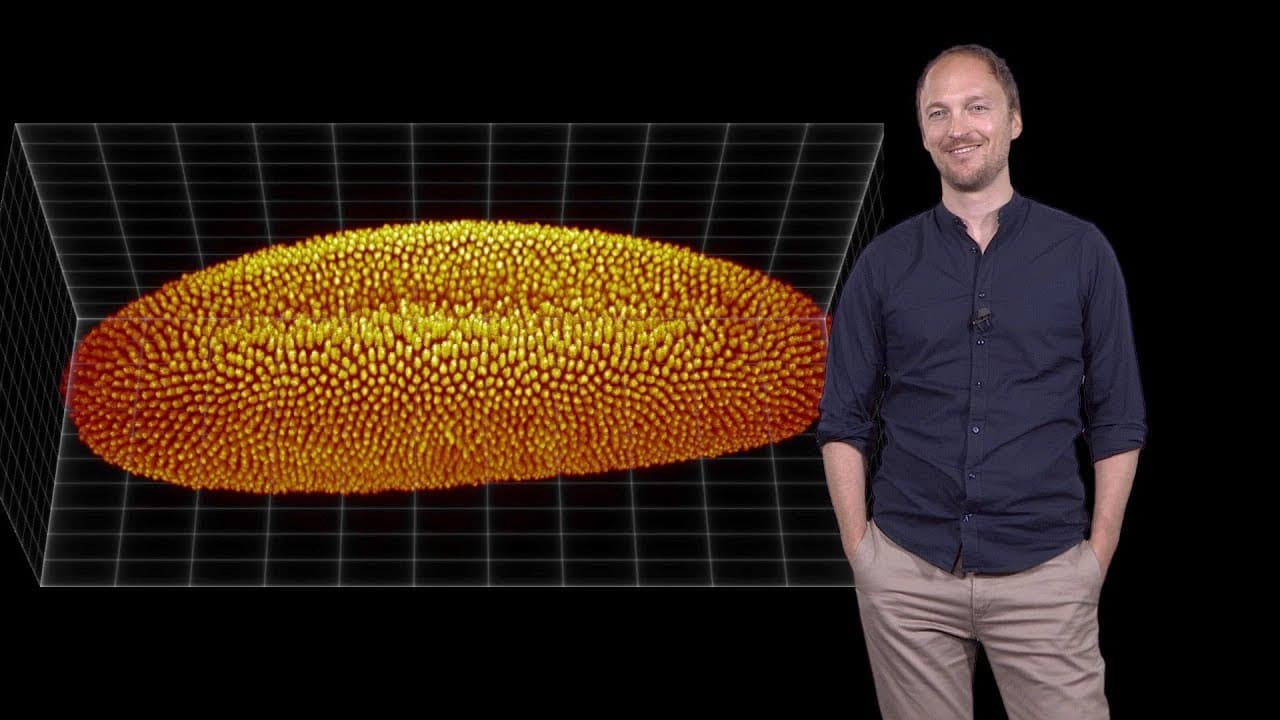
Multi-Dimensional Microscopy Datasets - Loic Royer (CZ Biohub)
TL;DR
Modern microscopy challenges data storage, processing, and visualization.
Transcript
Hi, my name is Loic Royer. I am a group leader at The Chan Zuckerberg Biohub. Today, I will lay out the basics on how to store, process, and visualize N-dimensional microscopy datasets. This presentation is part of the image analysis course. So, microscopy starts at the microscope, by acquiring the image data on a camera or detector. This data is t... Read More
Key Insights
- Modern microscopy has evolved to produce multi-dimensional datasets, creating challenges in data storage, processing, and visualization that require innovative solutions.
- The acquisition of 3D microscopy data results in 'stacks,' with each voxel representing a data point, much like pixels in 2D images.
- Efficient data storage involves chunking datasets to allow localized access and using image pyramids for rapid access to lower-resolution data.
- Data compression, both lossless and lossy, is crucial in managing the large datasets produced by modern microscopes, balancing between compression ratio and speed.
- Processing multi-dimensional datasets involves denoising, background correction, and deconvolution, often requiring consideration of the data's multi-dimensional nature.
- Deep learning is increasingly used in processing these datasets due to its efficiency and impressive results, leveraging specialized computing hardware.
- Visualization techniques include rendering 3D data into 2D screens using volume rendering, ray casting, and innovative methods like Fibonacci rendering for efficiency.
- Volume rendering needs to be fast and fluid for interactive visualization, with techniques like multipass and Fibonacci rendering improving speed and quality.
Install to Summarize YouTube Videos and Get Transcripts
Explore YouTube Video Summarizer or Get YouTube Transcript Extractor
Questions & Answers
Q: What are the main challenges of modern microscopy datasets?
Modern microscopy datasets are multi-dimensional and large, posing challenges in data storage, processing, and visualization. These challenges include managing vast amounts of data, efficiently storing and accessing it, processing it accurately, and visualizing it in a way that maintains its multi-dimensional nature.
Q: How is data stored efficiently in multi-dimensional microscopy?
Efficient data storage involves chunking datasets, allowing localized access without loading entire data stacks. Image pyramids are used for rapid access to lower-resolution data, and data compression techniques, both lossless and lossy, help manage the large datasets by reducing their size while balancing compression speed and data integrity.
Q: What role does deep learning play in processing microscopy data?
Deep learning is increasingly used to process multi-dimensional microscopy datasets due to its efficiency and impressive results. It leverages specialized computing hardware to handle complex data processing tasks like denoising, background correction, and deconvolution, which often require consideration of the data's multi-dimensional nature.
Q: What are some visualization techniques for 3D microscopy data?
Visualization techniques for 3D microscopy data include rendering 3D data into 2D screens using volume rendering and ray casting. Methods like multipass and Fibonacci rendering improve speed and quality, allowing for efficient and interactive visualization that maintains the data's multi-dimensional nature.
Q: How does chunking improve data storage and access?
Chunking improves data storage and access by dividing datasets into smaller, manageable units. This allows localized access to specific data points without needing to load entire data stacks, thereby increasing efficiency and reducing the time and resources needed to access and process the data.
Q: What is the significance of image pyramids in microscopy data?
Image pyramids are significant in microscopy data as they provide rapid access to lower-resolution versions of the data. This is particularly useful for quick visualization and processing, allowing users to access and analyze data at varying levels of detail without loading the entire high-resolution dataset.
Q: Why is volume rendering important for visualizing microscopy data?
Volume rendering is important for visualizing microscopy data as it allows for the representation of 3D datasets on 2D screens. Techniques like ray casting and attenuation modeling provide detailed and informative visualizations, maintaining the integrity and depth of the original data, which is crucial for accurate analysis and interpretation.
Q: What are the advantages of using Fibonacci rendering?
Fibonacci rendering offers advantages in speed and quality for visualizing microscopy data. By optimally shifting sampling patterns using mathematical properties of the Fibonacci sequence, it reduces the perception of blinking or flashing, providing a smoother and more interactive visualization experience, especially in large datasets.
Summary & Key Takeaways
-
Modern microscopy produces large multi-dimensional datasets, posing challenges in data management. Techniques such as chunking, image pyramids, and data compression help in efficient storage and processing. Visualization methods like volume rendering and innovative approaches enhance data representation.
-
Deep learning offers efficient processing of multi-dimensional datasets, leveraging specialized hardware for improved results. Techniques like denoising, background correction, and deconvolution are essential in handling the complex nature of these datasets.
-
Visualization of 3D microscopy data involves rendering techniques such as volume rendering and ray casting. Innovative methods like Fibonacci rendering improve speed and quality, making interactive visualization more effective and informative.
Read in Other Languages (beta)
Share This Summary 📚
Summarize YouTube Videos and Get Video Transcripts with 1-Click
Try YouTube Summary with ChatGPT & Claude or YouTube Transcript Generator
Explore More Summaries from iBiology Techniques 📚
Summarize YouTube Videos and Get Video Transcripts with 1-Click
Try YouTube Summary with ChatGPT & Claude or YouTube Transcript Generator