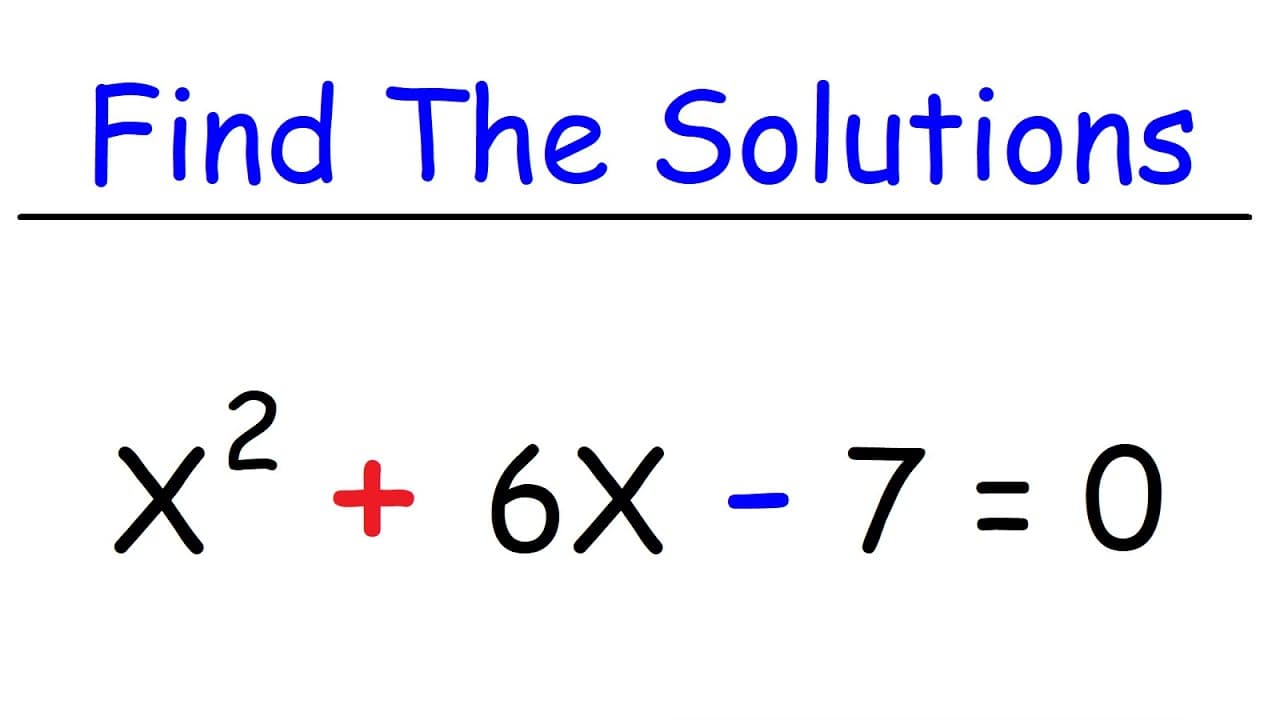
How To Find The Real & Imaginary Solutions of Polynomial Equations
TL;DR
Learn how to find real and imaginary solutions to polynomial equations by factoring and using synthetic division.
Transcript
in this video we're going to talk about how to find all of the solutions the real and the imaginary solutions of a polynomial function so let's start with this example we have x to the fourth minus 16 is equal to zero what are the solutions to this function or to this equation well we could use this formula we have a difference of perfect squares a... Read More
Key Insights
- 💯 The difference of perfect squares method can be used to factor polynomial equations and find their solutions.
- 🧑🏭 Factoring by grouping is an effective strategy for polynomial equations with quadratics as factors.
- 💼 Synthetic division is a useful tool for finding solutions to polynomial equations, especially for cases where factoring is challenging.
- #️⃣ The number of solutions to a polynomial equation is determined by the degree of the polynomial.
Install to Summarize YouTube Videos and Get Transcripts
Explore YouTube Video Summarizer or Get YouTube Transcript Extractor
Questions & Answers
Q: How can the difference of perfect squares method be used to find the solutions to a polynomial equation?
The difference of perfect squares method involves factoring the expression as (a - b)(a + b), where a and b are the square roots of the terms being squared. By setting each factor equal to zero, the solutions can be determined.
Q: What is the process of factoring by grouping?
Factoring by grouping requires identifying common factors in pairs of terms. By factoring out these common factors from each pair, a polynomial can be rewritten with common factors in separate sets, allowing for further factoring.
Q: How does synthetic division help find solutions to polynomial equations?
Synthetic division is a method used to divide a polynomial by a binomial of the form (x - a), where 'a' is a potential solution. By performing the division, the remainder can be checked, and if it is zero, 'a' is a solution to the polynomial equation.
Q: What is the relationship between the degree of a polynomial and the number of solutions it can have?
The degree of a polynomial is determined by the highest power of the variable. The number of solutions a polynomial can have is at most equal to its degree. For example, a degree 3 polynomial can have up to three solutions.
Summary & Key Takeaways
-
In the first example, the polynomial function x^4 - 16 = 0 is factored using the difference of perfect squares method, resulting in two real solutions (x = 2 and x = -2) and two imaginary solutions (x = 2i and x = -2i).
-
The second example explores the polynomial function x^3 - 3x^2 + 9x - 27 = 0, which is factored by grouping, giving one real solution (x = 3) and two imaginary solutions (x = 3i and x = -3i).
-
The third example deals with the polynomial function x^3 + 8 = 0, which is factored as a sum of perfect cubes, yielding one real solution (x = -2) and two imaginary solutions (x = 1 + √3i and x = 1 - √3i).
-
The fourth and final example demonstrates the use of synthetic division to find the solutions to the polynomial function x^3 + 6x - 7 = 0. One real solution is found (x = 1), while the remaining quadratic factor has two imaginary solutions (x = -1 + 3√3i/2 and x = -1 - 3√3i/2).
Read in Other Languages (beta)
Share This Summary 📚
Summarize YouTube Videos and Get Video Transcripts with 1-Click
Try YouTube Summary with ChatGPT & Claude or YouTube Transcript Generator
Explore More Summaries from The Organic Chemistry Tutor 📚


Summarize YouTube Videos and Get Video Transcripts with 1-Click
Try YouTube Summary with ChatGPT & Claude or YouTube Transcript Generator