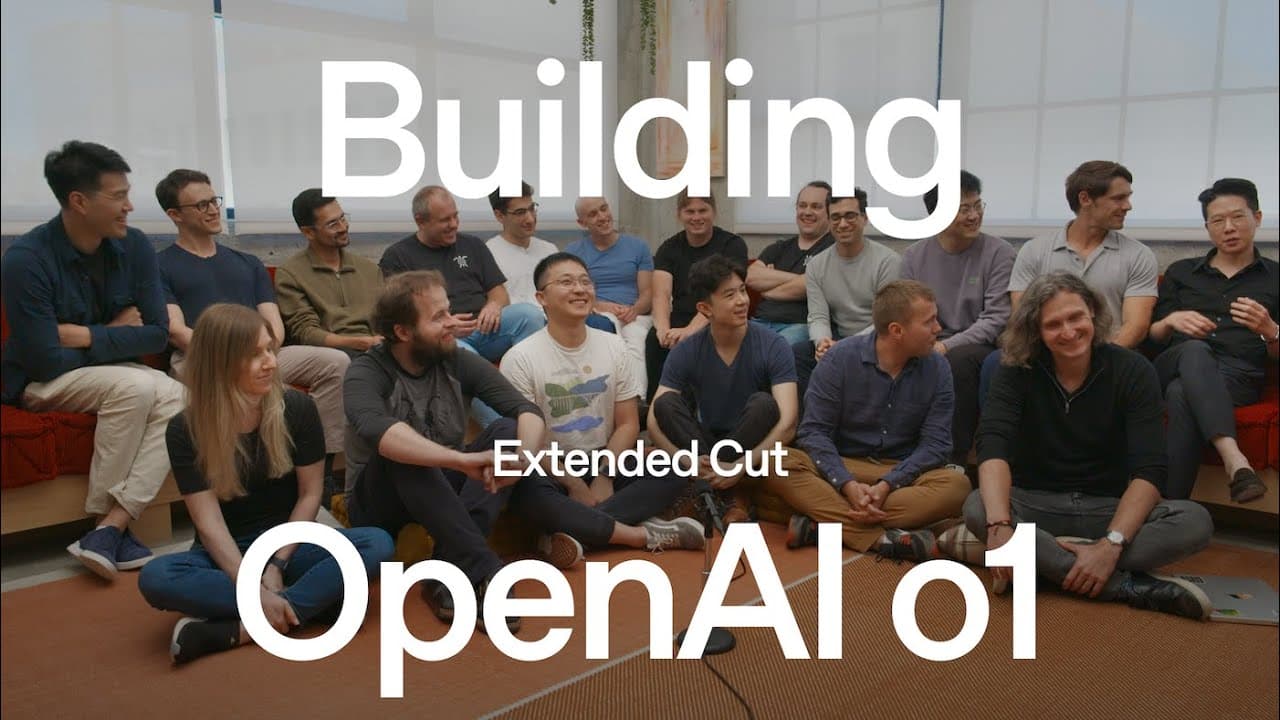
Building OpenAI o1 (Extended Cut)
TL;DR
OpenAI introduces O1 and O1 Mini, enhancing reasoning capabilities for better problem-solving.
Transcript
all right I'm Bob McGrew I lead the research team here at open aai we've just released a preview of our new series of models 01 and 01 mini which we are very excited about and we've got the whole team here to tell you about them what exactly is 01 so we're starting a series of new models uh with the new name oan this is to highlight the fact that y... Read More
Key Insights
- 👶 O1 and O1 Mini represent a new phase in AI development, emphasizing enhanced reasoning capabilities to generate superior answers.
- 💭 The reasoning model philosophy underpins O1's design, encouraging deeper thought processes for complex problem-solving tasks.
- ⏮️ Insights drawn from previous models like GPT-2 and GPT-3 were instrumental in shaping O1's unique features and capabilities.
- 👍 The combination of reinforcement learning with self-generated reasoning chains proved pivotal for improving model performance.
- 🚂 Training large-scale AI models poses significant technical challenges, necessitating collaborative problem-solving among the research team.
- 👤 O1 Mini aims to provide cost-effective access to advanced reasoning capabilities for wider user adoption and practical applications.
- 😤 Team members leverage the O1 model as a valuable tool for both technical tasks and creative brainstorming, enhancing their overall productivity.
Install to Summarize YouTube Videos and Get Transcripts
Explore YouTube Video Summarizer or Get YouTube Transcript Extractor
Questions & Answers
Q: What distinguishes the O1 model from previous models like GPT-4?
O1 is specifically designed as a reasoning model, emphasizing the importance of thoughtful consideration before delivering answers. This results in improved outcomes, especially for complex queries, differentiating it from earlier models that often provided immediate responses without deeper reasoning.
Q: How did earlier models like GPT-2 and GPT-3 influence the development of O1?
The development of O1 built on past experiences with earlier models, where the team recognized the need for improved reasoning abilities. Results from training these earlier models informed the iterative process, leading to enhancements in the O1 model's capacity to generate coherent chains of thought during complex problem-solving tasks.
Q: Can you explain how the O1 Mini complements the O1 model?
O1 Mini serves as a lighter, faster version of the O1 model, designed for broader accessibility and affordability. While it retains core reasoning capabilities, it focuses on efficiency, making it ideal for users needing rapid insights without compromising the depth of reasoning inherent in the larger O1 model.
Q: What "aha" moments did the team experience during the development of O1?
The team experienced several "aha" moments, particularly during training when they realized that using reinforcement learning to let the model generate its own reasoning processes yielded better results than relying solely on human-written thought processes. Discovering this capability marked a significant point in O1's development.
Q: What challenges did the team face while training large models like O1?
Training large models presents numerous challenges, including technical failures, infrastructure issues, and the complexity of ensuring consistent learning and performance improvements. Each training run can encounter countless obstacles, requiring extensive collaboration and problem-solving among team members to navigate these challenges effectively.
Q: How do team members utilize the O1 model in their work?
Team members use the O1 model for various tasks, such as coding, debugging, and brainstorming. It helps define problem specifications, generates unit tests, and provides insights into complex topics, allowing team members to focus on higher-level problem-solving rather than getting lost in the technical details.
Q: How does OpenAI prioritize both algorithmic advancements and reliable infrastructure?
OpenAI values the seamless integration of algorithmic developments with robust infrastructure, recognizing that both are crucial for the success of projects. The team's commitment to building reliable systems means each new model benefits from lessons learned in previous projects, fostering continuous improvement and innovation.
Q: What are the long-term aspirations for models like O1 and O1 Mini?
The long-term goal is to develop models capable of reasoning and planning over extended periods, potentially for days or months. The current advances mark the beginning of a journey towards models that not only improve human productivity but also contribute meaningfully to scientific discovery and knowledge creation.
Summary & Key Takeaways
-
OpenAI has unveiled two new models, O1 and O1 Mini, designed to improve reasoning and problem-solving capabilities, distinguishing them from previous iterations like GPT-4.
-
The team emphasizes the importance of reasoning, where more thoughtful consideration leads to superior outcomes, particularly for complex tasks like writing and problem-solving.
-
The development process combined insights from deep reinforcement learning and supervised learning, yielding significant advancements in model capabilities and user interactions.
Read in Other Languages (beta)
Share This Summary 📚
Summarize YouTube Videos and Get Video Transcripts with 1-Click
Try YouTube Summary with ChatGPT & Claude or YouTube Transcript Generator
Explore More Summaries from OpenAI 📚




Summarize YouTube Videos and Get Video Transcripts with 1-Click
Try YouTube Summary with ChatGPT & Claude or YouTube Transcript Generator